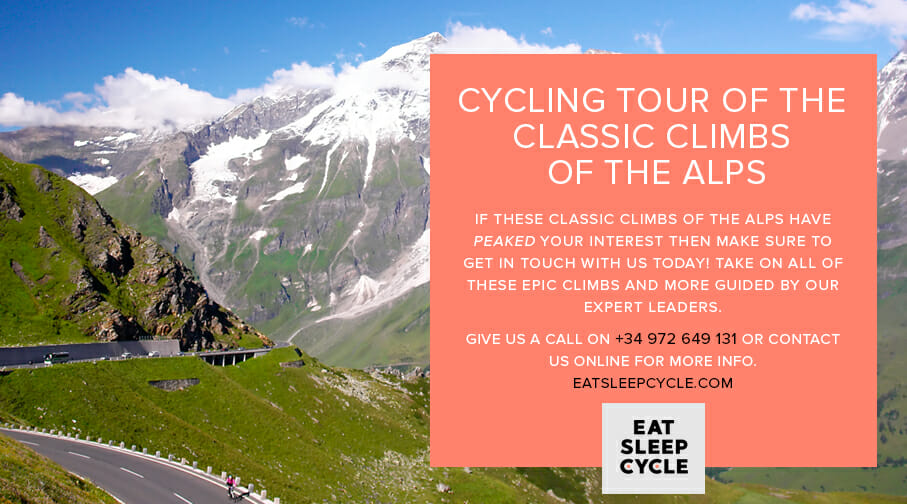
Category: France

  • Which European country is best for cycling?

    The big players on the European cycling scene always top the list for the best European country for cycling: France, Italy, Spain. There’s no doubt these nations offer an incredible array of terrains, stunning landscapes and a deep-rooted cycling culture. But they’re not the only destinations to be considered when planning a European cycling holiday. How about Denmark, Slovenia, Portugal, the UK and Ireland or even Iceland? The bike-friendly nations offer some spectacular opportunities for riding, epic climbs, picturesque scenery and great cycling infrastructure. Pick your season well and it could be the cycling holiday of a lifetime. 

    Join us as we explore these on- and off-the-beaten-track destinations to help you decide which European country is best for cycling

    Cycling in Iceland, the land of fire and ice

    Iceland is a country known for its outstanding natural beauty, with dramatic landscapes featuring towering glaciers, black sand beaches and vast lava fields. Cycling in Iceland is unlike anywhere else in Europe. It is even possible to cycle around the entire island (over several days) covering around 1,300 km of stunning wilderness, or head up into the Highlands on gravel tracks that wind through lunar-esqe volcanic terrain. As well as cycling, it is common to see locals hiking, trail running, skiing, snowboarding, horseriding and even ice climbing… any chance to soak in the local natural wonders. 

    Our Iceland Fire & Ice Gravel Adventure offers a packed eight days of riding around the southwest of Iceland, visiting natural must-see spots such as the Svínaskard pass, the Hvalfjörður inlet, the mighty Langjökull (the Long Glacier) and the Þingvellir National Park. In total, the cycling holiday covers 520 km through these majestic landscapes. Along the way, we’ll visit hot springs, experience the strange sensation of 24-hour sunlight, and sample delicious local dishes on this full-board tour. 

    Cycling in Slovenia, vast forests and stunning lakes

    Slovenia is another European cycling destination rapidly becoming one of the best choices for cycling among road and gravel riders. These rich landscapes span coastline, mountains and valleys, from the warm Adriatic to the peaks of the Julian Alps across the country’s well-maintained network of bike paths and trails. Slovenia also has a strong cycling culture, exemplified by Ljubljana’s 300 km of cycle lanes, and the government’s promotion of rural cycling routes around the capital (surrounded by lush forests that cover more than 60% of the country’s landscapes) and beyond. 

    Our Tour of Slovenia and Slovenia Gravel cycling tours aim to showcase the best this country has to offer in seven jam-packed days of riding (both available in guided and self-guided formats). These tours explore the picturesque Logar Valley, with the chance to sample local homemade cheeses, and the iconic Lake Bled, boasting fairytale views of its island church and surrounding mountains. Highlights on the road tour include tackling mountain passes, such as the Vršič Pass or Mangart Saddle, the former featuring 50 hairpin bends and breathtaking views, and the Triglav National Park, featuring well-marked routes winding through beech, fir, and spruce forests. The routes on our gravel tour mainly stick to wide, compact gravel roads ideal for most experience levels. 

    Cycling in France, into the belly of the beast

    France might just be the first country you think of when comparing European countries best for cycling. From the Tour de France and its historic mountain passes over the Alps and Pyrenees, to the country’s popularity among bikepackers exploring the sweeping landscapes of Provence, France is a veritable playground for all disciplines and levels of experience with an unrivalled cycling heritage. Just the mention of the Alpe d’Huez, Lacets du Montvernier and the Col du Télégraphe bring shivers to those who have witnessed the gruelling climbs of the Tour. 

    Part of our Tour of Provence, the mighty Mont Ventoux is another favourite among road riders, another of the Tour’s climbs, which has ascended the mountain eighteen times since 1951. The French Pyrenees offer more epic climbs, thrilling descents and exquisite, ever-changing scenery, featuring the Tourmalet, the Peyresourde, the Aspin, the Hautacam, Luz Ardiden and more, interspersed with pretty villages such as Luchon, Saint Lary and Saint Savin nestled into the green valleys. Add in France’s exceptional cuisine and world-class cycling infrastructure, and it’s no surprise this country continues to top the list of the best European countries for cycling

    Spain, much more than sun, sea and sand

    Spain is a tapestry of cultures, of landscapes and of people. Lying just a few kilometres from North Africa, Spain’s landscapes span deserts, snow-capped mountains, lush vineyards, and extensive national parks. Spain caters to every type of rider, and every type of traveller, with the option to explore mainland Spain on the Iberian Peninsula, or its numerous islands that make up the Balearic and Canary archipelagos

    Starting in the north, Girona, the city Eat Sleep Cycle calls home, has earned its reputation as a cyclist’s paradise, attracting professional teams and cycling enthusiasts of all disciplines to explore the vast network of roads and trails that criss-cross northern Catalonia. Iconic climbs like Rocacorba or Els Àngels are easily accessible for riders staying in the city centre, the perfect base for pre- and post-ride food, drink and activities (feel free to stop by the ESC Girona Hub for tips!). 

    Moving towards the south, we find Andalusia, home to Malaga, our second ESC Hub, and Almeria’s Badlands, miles and miles of rugged, wild, arid expanses, ideal for gravel and mountain biking. The Badlands stretch from the Gorafe and Tabernas Deserts to the coast of the Cabo de Gata Nature Reserve. This dramatic landscape presents challenging terrain (which has in the past been used as a filming location for spaghetti Westerns), but a unique adventure that leaves a mark on any rider who conquers it. 

    Heading on to Malaga on Spain’s southern coast, the unique blend of coastal and mountainous terrain, year-round sunshine and warm winter climate offer the perfect combination of conditions for off-season riding. Ride the seaside routes along the Costa del Sol, or explore the Montes de Málaga through fields of almond and avocado trees. For us, Spain always ranks highly for best European country for cycling; it just ticks all the boxes. Take a look at our full range of Spanish cycling holidays including tours in Mallorca, the Spanish Pyrenees, Gran Canaria, Tenerife, Girona and Málaga, among others. 

    UK and Ireland, the wild isles

    While they are often dismissed for their notorious climate, the UK and Ireland have a huge array of riding opportunities to be sought out and discovered. These isles’ rolling green hills, dramatic coastlines and quiet back roads stretch as far as the eye can see, offering some stunning backdrops for road, gravel and mountain biking. Both islands are steeped in history following numerous invasions over the centuries, which has created a rich patchwork of unmissable architecture, historic ruins and a network of quiet, winding roads carved out by Vikings, Celts and Romans. The magic of an early misty morning, or a crimson sunset filling the open sky, will forge unforgettable memories that call you back to these special islands time and time again.

    Our Tour of Yorkshire captures some of this magic, as we aim to showcase the beautiful English countryside in its best light. Starting on the east coast of England in the picturesque village of Robin Hood’s Bay, the Tour begins with a gentle spin to the fishing town of Whitby, before heading west across the famous Yorkshire Moors and into the stunning Yorkshire Dales. Riders will experience the majesty of the Lake District, sampling local treats such as Kendal Mint Cake, and visiting traditional English pubs for craft beer. There’ll be ample opportunities to try afternoon tea, (nowhere in the UK does tearooms quite like Yorkshire), fish & chips, hearty roast dinners and Yorkshire puddings. Riding highlights include Buttertubs Pass and Fleet Moss, Wrynose and Hardnott Pass (two of the toughest climbs in the UK), and riding the banks of Lake Windermere. 

    Want to discover the most bike-friendly country in Europe for yourself?

    As soon as you’re ready to travel we would love to show you around! Check out our selection of European Tours or give us a call now on +34 972 754 301 or contact us online for more info!

    P.S. Enjoyed this blog? Why not sign up to receive notifications every time we post and get regular updates on our latest tours!

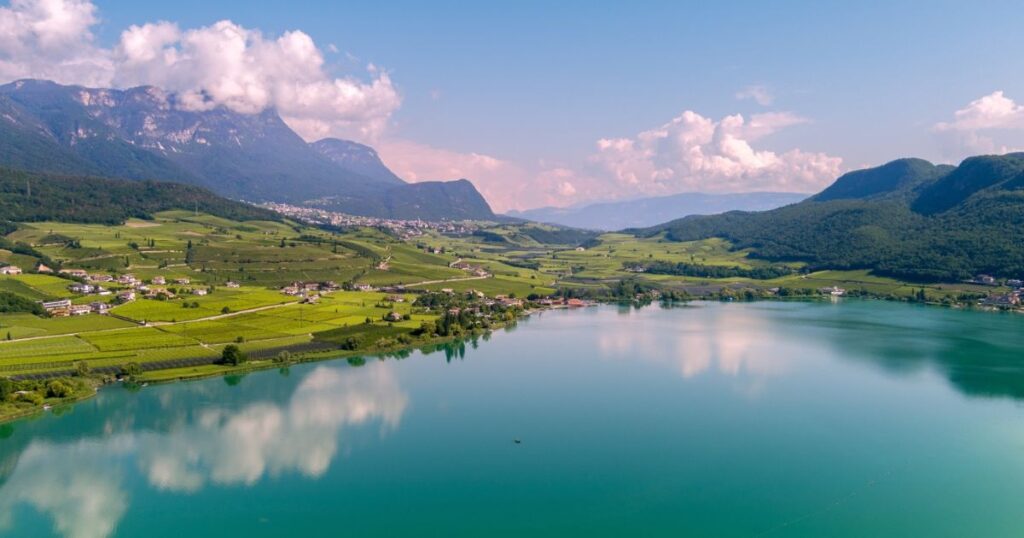
  • The best self-guided bike tours in Europe

    For many of us, the beauty of exploring new destinations by bike lies in the opportunity cycling gives us to move at our own pace, pause when we need or want to, and uncover hidden gems that might otherwise be left unturned. Our selection of self-guided bike tours in Europe has been carefully hand-picked and curated to offer riders just that: freedom and autonomy to explore some of the most beautiful locations on the continent. We do the legwork before launching any self-guided bike tour, plotting routes and scouting points of interest to make sure each trip showcases the best of each region in terms of riding, cuisine, culture, and hospitality. 

    When you book a self-guided bike tour with Eat Sleep Cycle, you get a detailed itinerary with route information and our recommendations for places to see en route and stop for coffee, lunch, afternoon snacks and the best spots to enjoy your evening meals. Your accommodation and luggage will be waiting for you each evening after each leg of the journey (daily luggage transfers are included) and we’re a phone call away should you need any support. 

    Self-guided cycling tours in Spain

    Our self-guided bike tours in Spain offer riders a chance to get to know some of the lesser known roads, routes and regions of this fantastic country. Spain is a haven for cyclists of all disciplines. Home to the Vuelta a España, one of road cycling’s most prestigious grand tours, one of Europe’s most amicable climates, and a wealth of routes on both the mainland and surrounding islands, Spain is an ideal destination for cyclists looking to take their time, and combine great hospitality with fabulous local food and a rich culture. 

    Mallorca 

    Just off the mainland in the Balearic archipelago, we find Mallorca. Sun, sea and sand aside, Mallorca provides incredible cycling opportunities that attract cyclists from all over the world, even pro teams train here. The island boasts a network of well-maintained roads that wind through quaint villages, alongside cliffs, coastline and vineyards, and take on some of the most challenging climbs in Spain. Our Self-Guided Tour of Mallorca takes riders up into the Tramuntana Mountains, a UNESCO World Heritage Site, Mallorca’s wild and rugged mountain range running along the island’s southwest to northeast coast. 

    One of our favourite routes is a Tramuntana special. The route starts from the island’s capital, Pollença, and heads west into a steady 10 km ascent to reach 600 m in the heart of the Tramuntana Mountains. From there, the route descends to the Port of Sa Calobra on the coast,  from where the only way out is by boat, or by retracing your steps back up the 10 km climb. It’s a magical and hugely rewarding experience, with a picnic lunch at midday to refuel. As all routes are autonomous, you set the dates. Spring and autumn are the best seasons for riding in Mallorca, avoiding the sizzling heat of the summer, and the fierce winds and rain in winter. 

    Girona

    Girona is another hugely popular destination for self-guided bike tours (and home to the first Eat Sleep Cycle hub!). Girona is located in Spain’s northern region of Catalonia, just over one hour’s drive from Barcelona, and about one and a half hours’ drive from the French border. This unique destination is alive with cycling culture, fantastic infrastructure, a rich medieval heritage and plenty of opportunities to soak up the region’s beauty and charm on two wheels. For road riders, the region is known for iconic climbs like Els Àngels and Rocacorba, which are easily accessible for guests using Girona as a base, while numerous gravel tracks criss-cross the hills and mountains, out to the stunning Girona coast, giving riders a chance to discover adventure off the beaten track.

    We have curated various self-guided bike tours in and around Girona for both road and gravel riders. Given our proximity to France, several of our routes head up into the Pyrenees mountains and across the border, offering riders the chance to experience the changing landscapes, cultures, people and languages that have shaped each region and town’s identity. For example, our five-day Catalunya North Gravel Self-Guided Tour introduces riders to epic climbs such as Col du Fortou and Col d’Ares, as well as ancient towns like Castellar de la Muntanya. Our five-day Mountains of Catalunya road bike tour takes riders from the Pyrenees, through the Serra del Catllaràs and the Guilleries-Savassona national park, with plenty of  numerous colls, sweeping descents, scenic mountain tops to sink your tyres into. 

    Andalucia 

    Andalucia is the Spanish mainland’s largest and southernmost region, spanning 87,597 square kilometres from the Mediterranean coast in the east to the Atlantic Ocean in the west, and bordering Portugal. Andalucia’s vast terrains encompass desert, forestland, snow-capped mountains, valleys and rolling hills, mostly used for olive, almond, mango, avocado and orange cultivation. This rich variety has created a stunning tapestry of landscapes, and a haven for all road, gravel and MTB riders to explore. 

    Starting in the east of Andalucia, we find the city of Almeria lying between the Cabo de Gata-Níjar Natural Park and the Sierra de Los Filabres. Beyond the Sierra lies Granada, home to the tradition of tapas, the historic Albaycín, and the Alhambra, one of the best-preserved palaces of the historic Islamic world. Between these two worlds, lies the Badlands. Our Badlands Epic: Granada to Cabo de Gata Self-Guided Tour Gravel Tour starts in the historic city of Granada, before winding through the dramatic desert scenery of the Gorafe and Tabernas Badlands, with other-worldly rock formations and arid plains create a unique backdrop. The tour spans seven days of truly epic riding, culminating in the gorgeous Cabo de Gata-Níjar Natural Park. It’s a grizzly but incredibly rewarding experience, and one we highly recommend to anyone seeking true adventure. 

    If you’re looking to explore a wider range of Andalucian landscapes, the Classic Andalucia Self-Guided Road Tour heads from west to east across the region, offering an intimate introduction to this stunning part of the country. Highlights include the cities of Antequera, Ronda and Granada, the Alhambra, the Sierra Grazalema Natural Park, the Sierra Nevada, and much more in between. This is a seven-day bike tour that spans almost 400 km, giving self-guided riders the opportunity to get a real taste of the region, its terrain and landscapes, its food and culture. Andalucia is principally agricultural, an identity not only reflected in the scenery, but also in the region’s ventas, traditional roadside restaurants where riders can refuel with hearty, home-cooked meals, such as migas (fried breadcrumbs, often served with chorizo), callos (a tripe and chickpea dish), chorizo al vino, and plato alpujarreño.

    Self-guided cycling tours in Slovenia

    Slovenia is swiftly becoming one of the most sought-after destinations for bike tours in Europe, given the country’s extensive, well-maintained cycling infrastructure, stunning landscapes, and warm, welcoming hospitality. With plenty of routes for both road and gravel riders, and for all levels of experience, Slovenia always tops our list of recommended destinations for self-guided bike tours. At Eat Sleep Cycle, we offer two self-guided tours in Slovenia, as well as the chance to design your own itinerary, to check off any hotspots or hot routes we might have missed. First of all, our Tour of Slovenia Self-Guided Road Tour is a six-night journey that showcases some of the country’s most scenic and diverse regions. 

    Starting in the capital of Ljubljana, the route heads north into the peaceful Logar Valley, a glacial alpine landscape surrounded by the peaks of the Kamnik-Savinja Alps. Riders then pass into Austria before looping back into Slovenia, continuing through the serene Jezersko region and eventually reaching the iconic Lake Bled. One of the many highlights of this tour is the stunning  Vršič Pass, a 11.7 km climb with an average gradient of 7%. This epic, winding ascent features 50 hairpin bends, offering spectacular views of the Julian Alps before a sweeping descent towards the Soča Valley. Along the way, riders can look forward to refuelling on dishes such as štruklji (rolled dumplings), traditional stews, local cheese and regional wines. 

    For riders looking to explore Slovenia’s more rugged side, the Slovenia Gravel Self-Guided Tour combines off-road adventure with the country’s stunning alpine landscapes. Starting in Ljubljana, the route leads to Velika Planina, a high-altitude plateau known for its traditional shepherd huts, isolated hamlets and panoramic mountain views. Riders continue through the tranquil Logar Valley, with quiet gravel trails winding past alpine meadows and waterfalls, and through dense forests. As with our road tour, the route takes riders to Lake Bohinj and Lake Bled, both magical and unmissable locations, with plenty of cafés and restaurants to grab a snack or meal before setting off for the final leg of the tour. Slovenia’s gravel tracks are mostly wide and well-compacted, offering generally good conditions for independent riding. 

    Self-guided cycling tours in Italy

    For riders considering Italy for a self-guided bike tour, the country’s century-old cycling culture is ingrained in its identity, reflected not only in its passionate local riders and cycling clubs, but also in the extensive network of quiet backroads, gravel tracks and winding routes through Italy’s millennia-old countryside. For example, our Florence to Rome Self-Guided Gravel Tour is a seven-day itinerary through central Italy that follows parts of the historic Via Francigena pilgrimage route. The ride starts in Florence, then heads south through Tuscany’s undulating landscape, past vineyards, olive groves and medieval villages. 

    The gravel roads, or strade bianche (from which the famous race takes its name), are a distinctive feature here, whose rugged stretches wind alongside ancient stonewalls and between sweeping hills, making this part of the tour a true highlight. The route also takes riders through the Val d’Orcia, a UNESCO World Heritage Site renowned for its breathtaking views of cypress-lined roads and charming mediaeval towns. 

    As riders continue into Lazio, the scenery gently morphs to quiet woodland trails and ancient paths, before not too long reaching the outskirts of Rome, the Eternal City, following the Tiber River into the heart of the Italian capital. Our Florence to Rome Self-Guided Gravel Tour covers 449 km of tracks and trails, stopping each night at a different, hand-picked four-star accommodation… the perfect ingredients for an unforgettable self-guided cycling adventure across one of the most iconic cycling destinations in Europe

    Want to discover the best self-guided cycling tours in Europe for yourself?

    As soon as you’re ready to travel we would love to show you around! Check out our selection of self-guided bike tours, give us a call, on +34 972 754 301, or contact us online for more info!

    P.S. Enjoyed this blog? Why not sign up to receive notifications every time we post and get regular updates on our latest tours!

  • The best cycling routes in the Alps 

    The Alps offer some of the best cycling routes in Europe. Known for their skyscraping peaks, their pristine, glassy lakes, and sweeping alpine valleys, the Alps attract thousands of visitors every year to cycle, trek, ski, and immerse themselves in the breathtaking beauty of one of the world’s most iconic mountain ranges. The list of contenders for the best cycling routes in the Alps is long… Alpe d’Huez, Col du Galibier, Col du Télégraphe, Col de La Madeleine, Col de La Croix De Fer, Lacets du Montvernier. To those familiar with the Tour de France, these cols will be instantly recognisable as climbs that have tested the best cyclists on the planet, and transformed some into household names. 

    Join us as we take a virtual journey through some of the best cycling routes in the Alps and show you how to jump in the saddle to try them for yourself. 

    An introduction to the Alps 

    The Alps are the largest and highest mountain range in Europe. These truly wild landscapes reach altitudes of up to 4,810 metres at Mont Blanc, the highest peak in Western Europe, taking the form of an arc that stretches from Nice (France) to Vienna (Italy). The Alps dominate the landscape and create a natural border between these two countries.  

    With these epic altitudes and miles of untouched wilderness, the Alps are also a haven of biological diversity. They host approximately 4,500 vascular plant species, with nearly 8% being endemic. This unique flora has adapted to the diverse habitats and harsh environmental conditions of this region. Around 30,000 species of fauna call these mountains home, including a range of mammals, birds, reptiles, and insects, many of which have evolved and adapted over millennia to thrive in this challenging landscape.  

    For cyclists, this pristine wilderness and dramatic landscapes translates into some seriously unforgettable views, epic climbs and hair-raising descents. The combination of clean air, cultural and historic significance, local hospitality and physical challenges bring cyclists flocking to this region year after year. The Alps hold a special place in the history of professional cycling, particularly in the Tour de France. Since the first Alpine stage in 1911, these mountains have set the stage for unforgettable battles between the sport’s greatest riders, shaping the careers of cycling legends and giving fans countless moments of awe and inspiration. 

    When is it best to cycle in the Alps? 

    Precisely because of their location and altitude, cycling in the Alps is best in summer (or late spring, early autumn). During these months, the weather is generally mild to warm, and the roads are clear of snow, making it ideal for tackling the iconic mountain passes. Summer also brings longer daylight hours, allowing riders to extend their rides long into the evening and take in the breathtaking scenery and sunsets. Late spring and early autumn, while slightly cooler, offer quieter roads and a chance to experience the Alps in bloom or bathed in orange, autumnal hues, adding to the magic of these landscapes.  

    The best cycling routes in the Alps 

    The cycling routes in the Alps are some of the most legendary cycling routes in the world, made (in)famous for their relentless climbs, gruelling gradients, unbelievable views and their riders’ historic feats of stamina and strength. We’ve created a short guide on what we believe to be the best cycling routes in the Alps, showcasing the good, the bad and the ugly of each one.  

    Col du Galibier  

    Difficulty level: Very hard  

    Quick stats: 18 km, 1,200 m, 7% average 

    Description: At 2,642 metres, the Col du Galibier is one of the highest paved passes in the Alps. It is a gruelling climb but offers unmatched panoramic views of the surrounding peaks and valleys. Often featured in the Tour de France, it’s a rite of passage for advanced cyclists. 

    Col du Télégraphe 

    Difficulty level: Moderate to hard 

    Quick stats: 12 km, 800 m, 7% average 

    Description: The Télégraphe is often paired with the Galibier as it serves as the perfect warm-up climb. The steady gradients and lush scenery make it a rewarding ascent on its own or part of a longer ride. 

    Col de la Madeleine 

    Difficulty level: Very hard 

    Quick stats: 25 km, 1,600 m, 6% average 

    Description: Stretching for just shy of 25 kilometres with gradients averaging 6.2%, the Madeleine is a beast of a climb, long and relentless. It’s famed for its stunning vistas of the Mont Blanc massif and its demanding profile, which has made it a staple of the Tour de France, first included in 1969. During the 2021 Tour, Pogačar showcased his remarkable climbing skills on the Col de la Madeleine and cemented his position as Tour leader. 

    Col de la Croix de Fer 

    Difficulty level: Very hard 

    Quick stats: 28.1 km, 1,537 m, 5.5% average 

    Description: The Col de la Croix de Fer is not just a feat of physical stamina, it’s also a majestic feat of nature, with a mix of incredible alpine views that go from lush meadows to rugged terrain. Stretching for over 28 kilometres with an average gradient of 5.2%, it’s a favourite among cyclists for its beauty, long, unyielding ascent and demand for physical endurance. 

    Lacets du Montvernier 

    Difficulty level: Moderate 

    Quick stats: 3.4 km, 268 m, 8.5% average 

    Description: Short and very sweet, the Lacets du Montvernier is a masterpiece of road engineering, with 17 tight switchbacks packed into just under 3.5 kilometres. Its beauty and relative accessibility make it a must-ride for any cyclist to visit the Alps, especially those looking to complete a legendary alpine cycling route without committing to an entire day in the saddle.  

    Col du Frene 

    Difficulty level: Moderate 

    Quick stats: 12 km, 300 m, 3% average 

    Description: Before the gradient highs of 12% towards the top of the climb, the Col du Frene is another accessible climb for experienced riders. It features 14 hairpin turns and is known for its beautiful views. One of the preferred cycling routes in Annecy, the Col du Frene is an ideal warm-up climb before heading up into the more challenging Col de la Madeleine, or a scenic addition to a longer route. 

    Alpe d’Huez 

    Difficulty level: Hard 

    Quick stats: 15 km, 1,147 m, 8% average 

    Description: Sometimes called the “Hollywood Climb”, Alpe d’Huez has a legendary reputation in the Tour de France. Its 21 switchbacks climb of around 15 kilometres with an average gradient of 8.1%, creating a challenging but achievable ascent. The brave are rewarded with sweeping views of the surrounding peaks and a chance to follow in the tracks of cycling’s greatest, such as Bernard “the Badger” Hinault. In 1986, the Badger rode one of Alpe d’Huez’s most iconic stages in Tour de France history when he attacked early and rode solo to the summit.  

    Many of the above cycling routes are featured on our Classic Climbs of the Alps cycling tour, and on our Alps Everesting Challenge cycling tour. 

    Want to ride the Alps for yourself? 

    As soon as you’re up for the challenge, we’ll make sure everything is in place for the cycling tour of a lifetime! Check out our selection of European Tours or give us a call now on +34 972 754 301 or contact us online for more info! 

    P.S. Enjoyed this blog? Why not sign up to receive notifications every time we post and get regular updates on our latest tours! 

  • The Giro d’Italia vs. the Tour de France

    Few events in the sporting calendar carry the weight of history, passion, intrigue, drama, blood, sweat and tears like the Giro d’Italia and the Tour de France. For over a century, these UCI World Tour races have tested the limits of human endurance and captivated audiences around the world. The Giro d’Italia and the Tour de France are ever unpredictable, thrilling, addictive and spellbinding. Every summer the conversation continues… What makes each race such a distinct masterpiece? 

    Where do you stand on the Giro d’Italia vs. Tour de France debate?

    A tale of two Tours

    The Giro d’Italia and the Tour de France are more than just races —they are living, breathing chapters in the past and present story of professional cycling. The Giro was first inaugurated in 1909, in reality to boost the circulation of the La Gazzetta dello Sport, Italy’s beloved sports newspaper. One of its most iconic moments came in 1949, when Fausto Coppi conquered the Cuneo-Pinerolo stage in a solo breakaway that stretched over 190 kilometres. The dramatic finish solidified the Giro’s reputation for action-packed, must-see racing. 

    Today, with its signature Maglia Rosa (pink jersey), the Giro is a celebration —among many other things— of Italian landscapes, from the undulating hills of the Tuscan countryside to the brutally epic (or epicly brutal) climbs of the Dolomites; of stamina, determination and the pursuit of glory, and of a nation’s passion for cycling.

    The Tour de France, born six years earlier in 1903, was similarly rooted in journalism, as it was originally launched to promote L’Auto, a French sports daily. Over the decades, the race has grown into the pinnacle of professional cycling, with its own coveted maillot jaune (yellow jersey), a symbol of excellence worn each day by the individual race leader. 

    The Tour is synonymous with prestige, having given the cycling world some unforgettable, controversial, and dramatic moments in its 121 year history, from the legendary performance of Eddy Merckx in 1969, when he claimed the yellow jersey along with the mountains and points classifications —a feat still unmatched to this day— to Lance Armstrong’s controversial dominance and subsequent downfall, and Tom Pidock’s more recent display of thrilling daring as he descended the slopes of the Col du Galibier in 2022, and became the youngest rider to win on the iconic Alpe d’Huez stage. 

    Facts, stats and stories

    The Giro d’Italia

    • Annual race dates: The Giro d’Italia typically takes place in May, and kicks off the annual cycling season as the first Grand Tour.
    • The first Pink Jersey: The iconic maglia rosa was introduced in 1931, inspired by the pink pages of La Gazzetta dello Sport, the race’s founding newspaper. 
    • The longest stage: The longest stage in Giro history was seen in 1914, and covered 430 kilometers (267 miles) between Lucca and Rome. It was won by Costante Girardengo in a time of 17 hours 28 minutes and 55 seconds.
    • First female participant: In 1924, Alfonsina Strada became the first and only woman to officially compete in the Giro d’Italia, breaking significant gender barriers in cycling, especially for her day.
    • A truly global race: Today, the Giro d’Italia is broadcast to over 800 million people across 174 countries. 

    The Tour de France

    • Annual race period: The Tour de France is held in July. At the height of summer, the race has become something of a ritual for cycling fans from all over the world, many of whom make the annual pilgrimage to follow the stages around France over the race’s two week duration. 
    • Record stage wins: British rider Mark Cavendish holds the record for the most Tour de France stage wins, with 35 victories.
    • Legendary climbs: The Col du Tourmalet has been featured more than any other mountain in Tour history, with over 80 appearances since 1910.
    • The first Tour de France Femmes: The first women’s Tour de France was held in 1955, organised by Jean Leulliot, and featured five stages in Normandy. The British cyclist Millie Robinson won this edition. But, the race did not continue in subsequent years.
    • Tour de France Femmes avec Zwift: In 2022, ASO launched the Tour de France Femmes avec Zwift, an eight-day stage race held after the men’s Tour. The event marked a significant step forward for women’s cycling, offering live television coverage and substantial prize money.

    Key differences: Terrain, identity and style

    The Giro d’Italia and the Tour de France might share the spotlight as Grand Tours, but their identities lie in what makes them special for each spectator, rider and home country. 

    The Giro d’Italia 

    The Giro typically spans 21 days of racing, which are divided into stages and held over a 23-day period, allowing for two full rest days. The Giro tends to be thought of as a race of relentless drama, featuring unpredictable terrain and weather, and routes as diverse as Italy itself. One day riders will be blazing along the sun-drenched coast. The next, battling snow at the summit of the Passo Gavia, or other classic climbs of the Giro.

    But for Italy and Italians in particular, the Giro is more than a race. The Giro is deeply embedded in national consciousness, and fosters a huge sense of pride every year. In towns, cities and villages, along the route communities come together to host festivities and enjoy regional traditions and specialities, thus strengthening bonds and serving as a chance to celebrate Italy’s heritage and contemporary life.

    Aside from the maglia rosa, the Giro d’Italia features three other important jerseys it’s worth taking a minute to understand. We also have the blue jersey (maglia azzurra), which goes to the climber who accumulates the most points on categorised mountain climbs; then there’s the cyclamen jersey (maglia ciclamino), worn by the points classification leader, and finally, the white white jersey (maglia bianca), given to the best young rider under 25. 

    The Tour de France

    The Tour de France has a similar hold on its home nation. For many French (and international) cycling fans, summer is synonymous with the Tour, which captivates millions each year, attracting over 40 million viewers in France alone in 2024. The race is also a huge boost to local economies, as national and international tourists descend upon the towns and villages that sit on the race route to watch the cyclists, support cars and cherished Tour Caravan (the vibrant parade of sponsor-decorated vehicles that precedes the riders) pass through. 

    The Tour itself consists of 21 stages spanning three weeks, including flat sprints, mountain climbs and finally time trials, testing each team to put their best rider forward depending on the style of the stage. Domestiques (support riders) work tirelessly to help these team leaders win points and stages, which could include protecting them from wind, delivering supplies, or pacing them on climbs. This combination of team and individual strategy is what makes the Tour such a unique, and gruelling spectacle of both physical and mental strength and stamina. 

    Within the overall race itself, there are many different categories of points to be won, and three key jerseys beyond the coveted yellow jersey that demonstrate the leaders in each. The polka dot jersey for the best climber, awarded to the rider earning the most points on categorised summits; the green jersey for the points leader, often a sprinter excelling in stage finishes and intermediate sprints; and the white jersey, given to the best rider under 25, highlighting young talent. Each jersey showcases different strengths, adding depth and excitement to the race.

    Our homage to the Grand Tours

    Our Classic Climbs of the Giro cycling tour offers a seven-day immersion into the Italian race’s bucket-list climbs, including the Passo Stelvio, Passo Mortirolo, Passo Gavia, Passo Giau, the Sella Ronda’s and the Passo Falzarego. Each as epic and gruelling as the next, this cycling tour requires a strong head, heart and legs. But riders are rewarded around every hairpin bend with stunning, hair-raising mountain views, and every night with our handpicked hotels and guesthouses for some serious R&R. 

    Similarly, our Classic Climbs of the Alps cycling tour is a meticulously curated, six-day experience in which our guests live and breathe everything the French Alps have to offer. Iconic Tour climbs, such as the Col de la Madeleine, Col du Galibier, and the renowned Alpe d’Huez, have all played a pivotal role in shaping the identity, history and allure of the Tour de France. Guests ride in the tracks of the very professionals we watch battle it out throughout the race season, while soaking up the sweeping landscapes, Alpine food and culture, and premium hospitality. 

    Want to ride the Giro or Tour for yourself?

    As soon as you’re up for the challenge, we’ll make sure everything is in place for the cycling tour of a lifetime! Check out our selection of European Tours or give us a call now on +34 972 754 301 or contact us online for more info!

    P.S. Enjoyed this blog? Why not sign up to receive notifications every time we post and get regular updates on our latest tours!

  • What is the most bike-friendly country in Europe?

    From the rugged ascents of the Alps, to the sweeping descents of the Pyrenees, the rolling hills of Tuscany and the coastal rides of Spain’s southern coastline, Europe’s extensive network of cycling routes makes it an unparalleled destination for spectacular European cycling tours. Taking the continent as a whole, the EuroVelo network alone has over 56,000 kilometres of completed pathways, connecting countries and regions with well-maintained cycling infrastructure, which continues to grow day by day, supported by significant investments planned for 2021-2027.

    At Eat Sleep Cycle, we curate our tours to showcase what we believe to be the best European countries for cycling, the most unforgettable routes, the warmest hosts, the best food and drink, and overall, unique destinations that just hit differently by bike. And so, in this article, we’ll be taking a closer look at what it takes for a country to be considered bike-friendly in Europe, and provide a round-up of our top nominees, among the most impressive destinations for cycling in Europe. 

    What makes a country bike-friendly?

    When it comes to road and gravel, a truly bike-friendly country provides everything cyclists need to ride with ease, safely, comfortably and to enjoy. Perhaps the foundation of top cycling experiences starts with well-maintained roads and a warm and welcoming cycling culture —that extends to the local drivers! Countries like Spain, Italy, and Slovenia have invested significantly in creating smooth, high-quality road networks that make long-distance cycling not just feasible, but a downright pleasure. 

    Beyond the roads themselves, it’s the routes and scenery that transform a European cycling tour into an unforgettable experience. This is where the saying, “It’s not about the destination, but the journey,” truly comes to life. Our cycling tours in the Dolomites of Italy and the Julian Alps of Slovenia showcase some of Europe’s most breathtaking mountainscapes. Scaling some of the highest peaks in Europe is a genuine privilege —the views, sensations, challenges and joy of overcoming create palpable memories that stick with you for years to come. 

    Equally as important are the off-bike moments —bike-friendly accommodation, local cycling culture, the chance to sample regional food and drink, speak with other like-minded cyclists, such as our expert guides, and explore local towns, cities and villages on foot. Our European cycling tours are designed to immerse our guests in these 360º experiences and offer a balance between time in the saddle and moments to savour your surroundings. Think sipping a post-ride espresso in an Italian piazza in Umbria, relaxing after a long ride in a medieval guesthouse in the heart of Provence, or refuelling with an afternoon tea and cake while taking in the rolling Yorkshire Dales… 

    The contenders

    Every Eat Sleep Cycle tour destination has been handpicked for its unique charm, scenery, roads, routes, and culture, making it challenging to narrow down our choice for the most bike-friendly country in Europe. We can but try! 

    Spain

    Few places exude such love and respect for cycling as Spain, home of La Vuelta a España and many of our European cycling tours. The combination of varied terrain, roads and tracks, world-class infrastructure and warm climate create the ultimate playground for riders of all disciplines. From the Pyrenees and Catalonia in the north to Andalucia in the south, not forgetting the Canary Islands or Balearic Islands, Spain offers some of Europe’s most enjoyable, challenging and enviable cycling destinations. 

    Malaga enchants visitors with its blend of scenic routes and impressive natural wonders such as El Torcal Natural Park, providing a slower pace of life for guests that want to drink in Spain’s southern charm. Gran Canaria is the ideal spot for year-round riding, with warm weather and volcanic roads that present a unique lunar landscape, complete with deserts, mountains —just search for images of Pico de las Nieves!— and stunning coastline, offering a breathtaking retreat from the cold in winter. 

    Girona, our home, is another hot contender given its rich cycling culture. The city lives and breathes cycling, with cafés and restaurants run by an international cycling community, routes that start right at the edge of the city —Els Ànglels, Mare de Deu del Mont and Sant Hilari Sacalm— and an endless network of quiet roads winding through hills, medieval villages, and the rugged beauty of the Catalan countryside.

    France 

    Lavender fields, pain au chocolat, café au lait… just to name a few of the perks of cycling in France. In many regions, cycling is simply a way of life. Die-hard fans of the Tour de France follow the annual race from stage to stage, proving just how deep-rooted cycling culture is here. From the Alps and the Pyrenees to the vineyards of Provence and the serene roads of the Côte d’Azur, France does not disappoint, making it another strong contender for the most bike-friendly country in Europe.

    The south of France is a particular favorite among our guests. Our Tour of Provence, for example, introduces riders to iconic routes and climbs, such as Mont Ventoux—a veritable défi and a must for any road cyclist, and a Tour de France legend. Back down in the Provençal countryside, the region’s rolling hills, vineyards and patchworks of lavender are a treat for the sense, fruit of sights, smells, sounds and flavours that immerse riders in the most iconic image of Southern France. 

    For riders looking for a bit more spice, the French Pyrenees offer a smorgasbord of crisscrossing climbs, such as the Col du Tourmalet and Col d’Aspin, steeped in cycling history and unforgettable rides in a pristine mountainscape. To the west of France, the Alps stand firmly among the most challenging cycling terrains in Europe. Home to some of the most legendary climbs in the world, such as Alpe d’Huez, Col de la Madeleine, and Col du Galibier, riders are pushed to their limits as they face steep gradients and sweeping switchbacks. But every challenge is rewarded with awe-inspiring views and a sense of achievement that can only be found among these legendary peaks. 

    Italy 

    Bella Italia, what’s not to love! Italian cycling tours offer our guests a tapestry of experiences as rich and diverse as its culture. From the dramatic Dolomites in the north to the rolling hills of Tuscany and the sun-drenched coastline of Sicily, Italy paints a palpable masterpiece of routes, terrain and cycling heritage. Also home to the Giro d’Italia, one of the world’s most prestigious cycling races, Italy’s roads are steeped in history and brimming with challenge and beauty, making it another strong contender for the most bike-friendly country in Europe.

    Starting in Tuscany —a dreamy location, the photos don’t lie!— our Tour of Tuscany takes you through the heart of this enchanting region. Riding up into hilltop towns like Montepulciano for a pick-me-up espresso, or cycling the gravel roads of the Strade Bianche, we immerse riders in the quintessential Tuscan cycling experience. To the north of Tuscany sits Piemonte, where gastronomy meets cycling and riders traverse vineyard-covered hills and sample world-famous Barolo wines. On our Tour of Piemonte, the emphasis is on indulging in the finer things in life —stunning rides, exceptional food, and the charm of small Italian towns.

    Further north still, Italy’s terrain rises in grandeur, height and difficulty, as the towering peaks of the Dolomites stand tall and proud. Climbs like the Passo dello Stelvio and Passo Giau offer daily challenges worthy of professional riders, and views that belong on postcards. Riders are rewarded with delicious alpine cuisine each evening and a warm and welcoming stay at our handpicked hotels and guesthouses. Then finally, to the south, we find Sicily —-mythical, explosive, sparkling, delicious, and baroque in every way. Tackle the slopes of Mount Etna; stay in Buccheri, a village celebrated as one of Italy’s most beautiful and taste exquisite Sicilian wines crafted from grapes grown in the volcanic soils. 

    The UK

    Don’t be put off by the weather. Whilst the UK is known for being a bit rainy (only some of the time!),  we can confidently say that when the rain clouds part and the sun shines, the UK offers one of the most beautiful scenery and bike-friendly terrain in Europe. It’s not surprising this country has inspired poets, writers, and artists of every creed throughout millennia. 

    Cycling in the UK is as diverse as its landscapes, from the rolling hills of the Yorkshire Dales to the rugged beauty of the Scottish Highlands and the serene charm of the Cotswolds. Our Tour of Yorkshire showcases one of the UK’s premier cycling destinations, famous for hosting the Tour de Yorkshire and offering a mix of quiet country roads, picturesque villages, and challenging climbs. Iconic climbs like Buttertubs Pass provide a test for the legs before rewarding riders with views of green pastures flanked by ancient dry-stone walls.

    Slovenia 

    Slovenia might just be Europe’s best kept cycling secret. This relatively small but hugely diverse country nestled between the Alps and the Adriatic Sea. The country is predominantly rural, and even Slovenia’s capital, Ljubljana, is known as the ‘green capital’ thanks to its many trees and parks. The country’s deep commitment to sustainability and nature make it ideal for cycling tours, not to mention its food, wine, and warm hospitality, reflecting a unique blend of cultures shaped over centuries of history. 

    Slovenia ticks all the boxes for the most bike-friendly country in Europe. On our Tour of Slovenia, our aim is to introduce our guests to the very best in cycling culture that the country has to offer —we’re talking about the unspoiled wilderness of Triglav National Park; lush green valleys dotted with charming villages; iconic climbs such as the Vršič Pass; the majestic Julian Alps and the glacial Lake Bled and Lake Bohinj. 

    The Slovenia Gravel tour allows riders even further into the country’s hidden trails, stopping off in Velika Planina, the largest shepherds’ settlement in Europe offering jaw-dropping, panoramic views; the Kamnik-Savinja Alps in the north of Slovenia; and the chance to escape into wide gravel paths surrounded by alpine forests. Both tours are available in self-guided versions, offering the freedom to set your own pace. 

    Have we missed an absolute gem?

    If you’ve got another destination in mind worthy of being crowned the most bike-friendly country in Europe, why not design your own European cycling tour? For groups, couples, individuals and families, everyone is welcome! From e-bike tours to epic challenges we’re here to create your trip of a lifetime. 

    Want to discover the most bike-friendly country in Europe for yourself?

    As soon as you’re ready to travel we would love to show you around! Check out our selection of European Tours or give us a call now on +34 972 754 301 or contact us online for more info!

    P.S. Enjoyed this blog? Why not sign up to receive notifications every time we post and get regular updates on our latest tours!

  • 10 things to pack for your cycling tour in the high mountains this Summer

    We are mid Spring and you are training hard for the big moment you hit the high mountains this Summer.

    But it can all go horribly wrong if you don’t read on and take note of the ten things I advise that you pack for your cycling holiday.

    1. A good rain jacket

    Even in the Summer months downpours are common in the high mountains so don’t get caught out and pack a high quality waterproof and windroof jacket which will serve you for your chilly descents even if it doesnt rain.

    You can check out our range of quality rain jackets perfect for the high mountains here.

    2. A spare derailleur hanger 

    If traveling with your own bike (we advise our tour guests to rent one of our high quality rental bikes) pack a spare derailleur hanger. Every brand and sometimes each individual bike model has its own unique derailleur hanger. In the event of an accident or damage during transit your holiday could be ruined.

    3. Sunscreen

    On our supported cycling tours essentials like sunscreen are always available in our support vehicles. In the valleys temperatures can saw and suncream is an essential.

    Check out our cyclist friendly Pelotan sunscreen here!

    4. Chamois cream

    You will be riding more than habitual and Chamois cream is essential to avoid saddle sores which can have you off your bike and being a spectator. Saddle sores and infections should be taken extremely seriously, a profesional Rider will down his/her bike in the event of any sign of a saddle sore until complete recovery. 

    The best form of attack is prevention and Chamois cream applied generously everyday will help no end.

    5. A pair of high quality bib shorts for each ride

    On our fully supported tours we offer a laundry service to ensure compete comfort and hygiene on every ride. 

    If.you are on a self supported trip it’s important to ride everyday in perfectly clean shorts. 

    6. Electrolytes 

    Nutrition on a high mountain tour is a subject in its own right but here I will highlight electrolytes as the single most impprtant supplement to have available for long days in the saddle in hot temperatures. You can substitute gels and bars with regular food and fizzy drinks but you may still overheat and get cramps because your body can not absorb the water, electrolytes will help with that.

    Again on our fully supported tours we supply the essential (and non-essential) supplements at regular intervals. 

    7. A mobile phone with a good battery and coverage 

    Of you are going solo into the mountains you should carry a charged and working mobile phone. It sounds obvious but could actually save your day if you have a mechanical or worse. 

    8. Ibuprofen!

    Personally I always carry one. Weather it’s a pulled muscle, sore back or grazed knees it can get you out of a sticky patch and back to the hotel.

    9. Navigation device with local maps loaded on

    Your GPS is an essential friend in the high mountains, least of all to record and share your epic rides. Have a clear route planned for each day and be realistic about how far you can ride in the available daylight. 20 kms up a mountains can up up to 10 times slower then riding on the flat!

    Of course this is not needed on our fully guided cycling tours. Our guides are more often from the area you are riding and know the roads and trails like the back of their hands.

    10. Lights

    I recommend that you always ride with lights on your bike even during the daytime. If a car sees you sooner it is worth doing.

    ——-

    At Eat Sleep Cycle we offer epic cycling tours in the world’s best high mountain ranges incuding the Pyrenees, Alps and Dolomites

    We have a special private guest area where more detailed resources like this are exclusively available to our guests, so they can prepare for and enjoy fully their experience with us.

  • A Guide to Summer Cycling Tours in the High Mountains of Europe

    A playground like no other. Explore the endless roads of Europe’s most impressive mountain ranges and discover giants such as the Col du Tourmalet, Col du Galibier and Vršič Pass. 

    Summer Cycling Tours in the High Mountains of Europ

    Preparing for a cycling tour in the European mountains is an exciting prospect: the jaw-dropping scenery, colossal climbs, breath-taking descents, the après-ride endorphins, and not to mention the chance to ride in the tyre-tracks of the best cyclists in the world… That’s some prime day-dreaming material. 

    This guide will provide an insight into some of the most renowned mountain ranges in Europe, including the Pyrenees, the Alps, the Julian Alps, and the Dolomites, and the Eat Sleep Cycle tours that could turn those daydreams into a quad-burning reality. You’ll also find essential information on weather conditions, packing tips, and the best bike for conquering these majestic mountains.

    Pyrenees Cycling Tours

    First of all, the Pyrenees Mountains. A natural border between Spain and France, home to Andorra and summiting at an impressive 3,404 metres, the Pyrenees promise some exhilarating riding. Cycling in the Pyrenees offers challenging ascents, rewarding descents and awe-inspiring vistas.

    Some of the best professional cyclists in the world train on its legendary climbs. These include the Col du Tourmalet, whose summit brushes the clouds at 2,115 m (one of the highest paved roads in the Pryenees), or Col d’Aubisque, a near 17-km climb that reaches at 1,709 m above sea level. These roads are buzzing with the sound of tyres on smooth tarmac and an orchestra of freehubs as riders descend at speed, and there’s no shortage of friendly competition.

    Alps Cycling Tours

    Next up, the Alps, Europe’s most renowned mountain range that each summer beckons cyclists from all over the world. Some of the iconic mountain passes, such as Col du Galibier and Col de l’Iseran, are often featured in the Tour de France. These alpine giants are two of the most well-pedalled climbs in this mountain range, standing at dizzying altitudes of 2,645 m, and 2,764 m above sea level respectively.

    Stunning views reward anyone who ventures up these Cols to get a taste of the deep-seated cycling culture that permeates these mountains in summer. The roads are literally painted with history, and summer transforms this landscape into a cyclist’s paradise. Drivers are respectful and the hotels are filled with other riders as the exciting prospect of the Tour de France looms just around the corner…

    Julian Alps Cycling Tours

    The Julian Alps border both Italy and Austria and are nestled in the heart of Slovenia. This often-overlooked mountain range is a hidden gem for cyclists of all disciplines and offers a true paradise for climbers, with picturesque peaks and valleys, pristine lakes such as Lake Bled and charming alpine villages.

    The Vršič Pass, Slovenia’s highest mountain pass, sits within the Triglav National Park and stands at an impressive 1,611 m. It’s around 10 km in length with an average gradient of 6.9% (cranking up to 14% on some sections), and boasts incredible views of teetering limestone rock formations, unexpected cobbled sections, tunnels cut through the mountainside and classic hairpin bends. 

    Dolomites Cycling Tours

    A UNESCO World Heritage Site, the Dolomites are a cyclist’s paradise. Located in north-eastern Italy, this impressive mountain range is renowned for its jagged peaks, dramatic cliffs and winding roads, and is just as popular in winter among skiers as it is in summer among cyclists.

    This alpine wonderland is home to world-famous climbs such as the Passo Pordoi and Passo Giau. The former stretches for 12.4 km (on the northern side), and culminates in a summit 2,239 m above sea level. The Passo Giau reaches similar heights, with an average gradient of around 9%. Both often feature in the gruelling Giro d’Italia. 

    When to cycle in the European mountains

    When preparing for a cycling tour in the high mountains of Europe, it is essential to look carefully at forecasted weather conditions. Although summer in these regions is generally mild, with cool mornings and warm afternoons, the weather can be unpredictable and is known to change from one climb to the next. In the days leading up to your visit, and on the morning of each ride, make sure to check the local weather forecast and dress accordingly. 

    Packing for a summer cycling tour in the high mountains of Europe

    The key concept to bear in mind here is… layers. Even in summer, weather conditions can be unpredictable, so it’s important to be able to layer up when temperatures drop, and shed layers when things heat up.

    Here’s a quick list of the basics you’ll need on your cycling tour in the high European mountains:

    • Short-sleeved jerseys and short culottes
    • Waterproof wind breaker
    • Gilet
    • Neck, leg and arm warmers
    • Gloves (for cooler temperatures and for protection) 
    • Socks (enough for a fresh pair each day)

    Some other essentials:

    • High-factor suncream and good-quality sunglasses
    • Two or three water bottles
    • Basic tools, a mini pump and spare inner tubes
    • Your favourite snacks and energy gels

    The best bike for mountainous terrain

    The right bike can make all the difference when riding in the mountains, and that means the right bike for you. In general, you’ll want a lightweight road or gravel bike with a wide range of gears to tackle steep ascents and varying gradients, and stay in control on the long descents.

    Make sure your bike is in excellent condition with recently-serviced brakes, a clean, well-oiled chain and good tyres suitable for varied road surfaces. You might even want to get a professional bike fitting done before the tour to ensure your saddle and pedals are positioned correctly to make riding will be as comfortable as possible.  

    Feeling inspired?

    Cycling in the high mountains of Europe is something you will remember for the rest of your life. In summer, these majestic passes and peaks come alive with the spirit and tradition of cycling culture given their prominence in world tours, such as the Giro d’Italia or the Tour de France. You’ll also need to be used to climbing to tackle the ascents and enjoy the experience, so make sure you get some training in before your visit.

    Take a look at our Eat Sleep Cycle tours for more inspiration:

    Trans-Pyrenees Challenge

    Classic Climbs of the Pyrenees

    Classic Climbs of the Alps

    Trans Dolomites Challenge

    Tour of Slovenia

    And if you’re inspired to ride, contact our travel experts for more information.

  • The First (Modern) Women’s Tour de France: Race Preview

    It’s here, it’s finally here, the first (modern) women’s Tour de France is just around the corner and we could not be more excited. Kicking off from Paris, as the men’s race finishes, it makes the Tour last a whole extra week, except with fresh faces and what is sure to be really competitive, really top notch racing. 

    The race will have all the familiar coveted classifications, the iconic yellow jersey, and some of the best roads in France.  Thinking of going to watch it?  Why not be part of history, and stand roadside, cheering on the riders who know they themselves are writing their way into the books of legends.

    The Tour de France Femme Route

    The eight days of the race take in the Grand Est area of the country.  Starting from Paris and meandering eastward, the race will conclude on the decisive climb of the Planche de Belles Filles, 

    For a “two birds one stone” day- the Haussmann boulevards of Paris will do the trick.  As the Men’s Tour de France concludes, the women’s begins, with what is bound to be a tight and thrilling sprint finish on the Champs Élysées. The top sprinters will be vying for the rights to the first Yellow Jersey of the race, and the GC riders will want to remain safe- it will be cutthroat circuit, in stark contrast to what is essentially a finishing parade for the men.

    Halfway through the race and it will be heating up on stage four. With chalk covered roads in the second half, France’s own “Strade Bianche” will make or break many a rider.  With the heat and dryness of July the chalky roads will be in full dust form, and only the best bike handlers will thrive.  Leaving from Troyes, a commonly used host town and finishing in Bar-Sur-Aube the hilly 126 kilometre stage will shake things up- and not just the road surface. 

    Stages seven and eight will bring the final GC showdown as the mountains arrive.  The legs will be weary, the racing will have been hard beyond comparison, and it’s who will survive in the last days…

    Stage seven has three serious climbs in it, first up the Petit Ballon, which is in no way petite at 8.1% over the 9.3 kilometres.  Quickly after comes the Col du Platzerwasel before the final long 13.5k climb of the Grand Ballon. From the start on the Alsace plain to the crested ridge of Le Markstein, what is done on this day cannot be undone.

    And then only the stage to La Super Planche Des Belle Filles remains. Famous as an early feature in many Tours, the route first winds again over the Grand Ballon before taking on the steep 7km climb with an 8.7% gradient.  It’s dusty, it’s decisive and it’s the finishing jewel on the crown of the first modern women’s Tour de France. 

    Read more about each stage on the official Tour de France Femme website. 

    Riders to Watch at the Tour France Femme

    The depth of talent in the women’s pro peloton is endless, and it’s hard to single out each and every rider who could make a mark on the race.  We’ve listed some key contenders, and some bonus names, especially those Girona residents we know, and love to call our local celebrities.

    (names with stars denotes our locals)

    Elisa Balsamo: The World Champion on the Trek – Segafredo team will be strong in the sprints and eager to have her world championship stripes near the front of the race.

    Emma Norsgaard Bjerg*: A local to us, the young Danish sprinter is backing up her breakthrough season last year with a string of more strong results.  A sprinter who can get around a hilly course, and often left with an open role, Emma will be hunting stage wins on the sprint days and possibly the green points jersey. 

    Ashleigh Moolman-Pasio*: This Girona resident is in her last year pro and for sure will want to turn it up as high as possible for the last months of her final year. She’s a talented climber so watch out for her in the second half of the race.

    Annemiek van Vlueten: Annemiek has a point to prove this year, after a spring campaign that, whilst extraordinary, probably did not meet her expectations. She will want desperately to take victory at the first edition of the race.

    Demi Vollering: Stages, GC, any of the jerseys? Demi could win them all. Watch out for the powerhouse on SD Worx to come blazing in. 

    Kasia Niewiadoma*: A survivor through and through- Kasia will challenge victories and be on the pointy end we are sure. No doubts she will be in the mix for GC, and of course as a local we will be cheering her on.

    Alison Jackson*: Another local favourite of ours, the dance machine that is Alison Jackson will be fighting strong in the points classification and sprints, and keep an eye on her Tik Tok and Instagram for all the bonus content fun.

    Lotte Kopecky: The SD Worx rider is on fire this season, sprinting and surviving hillier terrain.  She’s a favourite for the green jersey and her formidable team will be behind her for sure.

    Hannah Barnes*: Hannah calls Girona and Andorra home, and the British rider on her first year at Uno-X is sure to be ready for a hard week- with a free reign at the slightly smaller team we can expect to see Hannah aggressive and fighting with an underdog style.

    Marta Cavalli: The winner of this year’s Amstel Gold Race, and Flèche Wallonne will be high on the list for GC contenders.

    Lorena Wiebes: She’s one of the fastest sprinters out there, on fire recently at Ride London and will be focused on bringing in stage wins for Team DSM 

    Marianne Vos: The dutch rider has recently recovered from Covid, but if she finds her old legs, she is just always, and forever one to beat.

    Coryn Rivera: Teammate of Vos on Jumbo-Visma, the American sprinter will be flourishing in the first half of the race.

    Mavi Garcia: The Spanish rider on team ADQ -UAE Emirates has had a great season so far and will be high up on the GC leaderboards.

    Niamh Fisher-Black*: The white and polka dot jerseys are serious possibilities for the Kiwi on SD Worx, and Girona denizen.

    Elisa Longo Borghini: She won Paris Roubaix in style this year, she constantly puts in strong GC performances in stage races, Elisa can do it all. The Trek Rider and current Italian national champion will have the yellow jersey in her cross hairs.

    Experience the first (modern) Women’s Tour de France with us!

    Tune in with us at the end of July!  The Women’s Tour de France by Zwift will be live on the TV Box every day at our Cafe.  Join us for camaraderie, viewing and an afternoon post ride refreshment.

    P.S. Enjoyed this blog? Why not sign up to receive notifications every time we post and get regular updates on our latest tours!
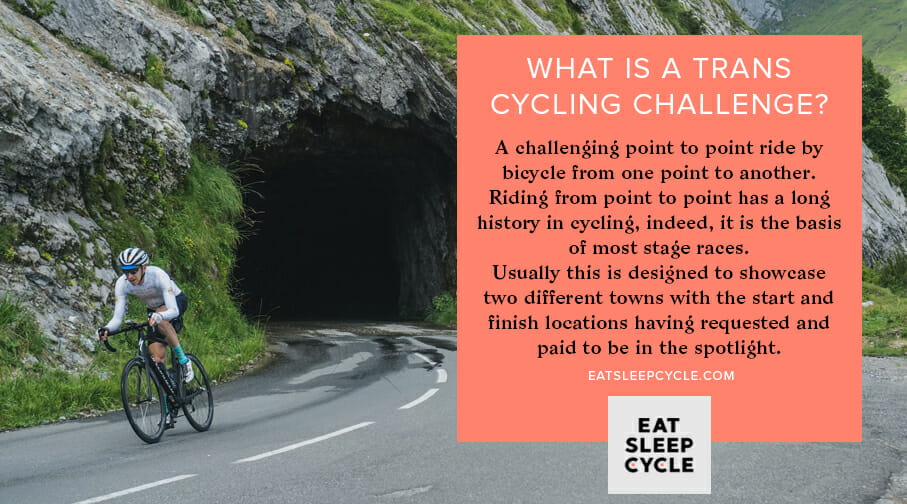
  • Point to Point Trans Cycling Challenges: Journeys of a Lifetime

    Trans Cycling Challenges, Point to Point Challenges, Journeys of a lifetime – there are many different names for them but there is one thing that is consistent: a Trans Cycling Challenge is an unforgettable, epic adventure! In this post we will explore which we think are the best.

    What is a Trans Cycling Challenge?

    A challenging point to point ride by bicycle from one place to another. Riding from point to point has a long history in cycling, indeed, it is the basis of most stage races. Usually this is designed to showcase two different towns with the start and finish locations having requested and paid to be in the spotlight.

    What Is A Trans Cycling Challenge - Eat Sleep Cycle

    Can a Cycling Challenge make a Good Holiday?

    But how do Trans Cycling Challenges translate to cycling vacations? There is a real sense of adventure in riding from A to B, using your bike to propel you from one place to another with an end goal in sight that is very different to simply riding loops out of one location. With the greater sense of adventure comes greater challenge and risk, and with that a huge sense of satisfaction from completing the journey.

    Riding a point-to-point route means you get to see more, each day brings a new challenge, a new location, new scenery to enjoy from the saddle and new cuisine to enjoy post-ride, it is the ultimate way to get the most out of a cycling vacation.

    Our Top Three Trans Cycling Challenges

    So, now that you know what a trans cycling challenge is and that they can make for great holidays let’s now look at our top 3 trans cycling challenges – the Trans Pyrenees, the Trans Dolomites and the new kid in town, the Trans Andalucia!

    Trans Pyrenees Point to Point Trans Cycling Challenges - Eat Sleep Cycle

    Trans Pyrenees

    This is the original Trans Challenge. The first ever Eat Sleep Cycle Tour was a version of our current Trans Pyrenees tour (from Girona to Biarritz) and it remains one of our absolute favourite routes to ride.

    Starting from our base in Girona the journey takes you north to the Catalan Pyrenees and the beautiful La Pobla de Lillet before crossing the border into France the following day. From there, the route covers a total of thirteen cols including some of the most prominent climbs of the Tour de France; the Col du Tourmalet, Col d’Aubisque, Col d’Aspin and more before reaching the final destination – the beautiful coastal city of San Sebastian.

    The characteristics of the Pyrenees mean that the landscape is rugged and varied, making for spectacular views and stunning climbs and descents which then give way to the rolling roads of the Basque Country.

    Trans Pyrenees Tour Highlights

    • La Pobla de Lillet –  a beautiful hidden gem in the Catalan pre-Pyrenees, this picturesque ‘pueblo’ is home to the Artigas Gardens designed by Antoni Gaudi and our accommodation of choice is El Castell de la Pobla de Lillet, a castle from the year 1297!
    • Col du Tourmalet – the iconic Col of the Tour de France is a must-ride for every cyclist looking to challenge themselves. This year featuring as a stage finish promising plenty of excitement!
    • The ‘Cirque du Litor’ – this is incredible section of road links the Col du Soulour to the Col d’Aubisque. Roughly translated as the avalanche circle, this is one of the last roads to open in Spring.

    Looking for more of a Cycling Challenge?
    The Raid Pyrenees is a 100 hour epic ride from the Atlantic to the Mediterranean via set check-points.

    Trans Dolomites - Point to Point Trans Cycling Challenges - Eat Sleep Cycle

    Trans Dolomites

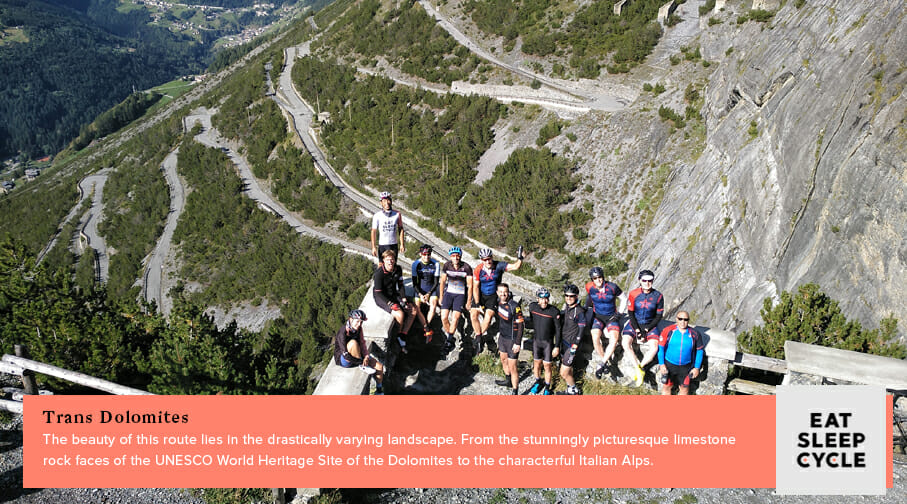
    The Trans Dolomites Challenge traverses the Carnic Alps to the Italian Dolomites and across to the Italian Alps. Bookmarked by the mighty Monte Zoncolan and the legendary Passo Mortirolo and Passo Gavia with a whole host of renowned climbs of the Giro d’Italia and beautiful scenery in between it promises to test and excite in equal measure.

    The beauty of this route lies in the drastically varying landscape. From the stunningly picturesque limestone rock faces of the UNESCO World Heritage Site of the Dolomites to the characterful Italian Alps that contrast with their polished French counterpart.

    Trans Dolomites Tour Highlights

    • Monte Zoncolan – the iconic climb of the Giro d’Italia, this beast is considered by many  to be the toughest climb in cycling!
    • Passo Stelvio – built in the years 1820 – 1825 this 48 km stretch of road connects the Valtellina in the south-west with Val Venosta in the north-east. Over 70 hairpins take the road to a leg-cramping 2,757 m altitude.
    • Passo Gavia – stunning, every changing, scenery and a pitch black tunnel characterise this 17.3 km killer climb. Perhaps best known for the heroic efforts of American Andy Hampsten who battled with apocalyptic, snowy conditions to seal the Giro d’Italia pink jersey in 1988.
    • Passo Mortirolo – synonymous with the late, great El Pirata – Marco Pantani – of whom you will find a tribute on the climb itself as you battle with the 10-20% gradients!

    Meet our local Guide in the Italian Mountains

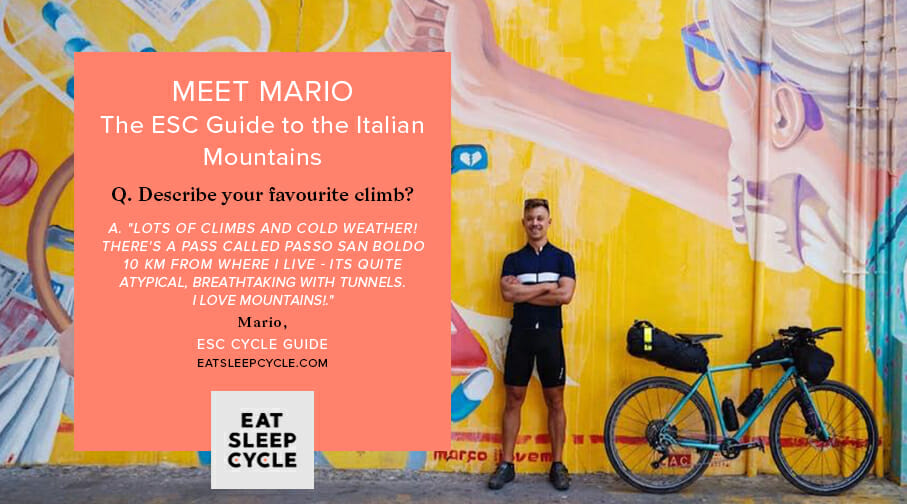
    If you book a Trans Dolomites Tour then there is a good chance you’ll meet Mario, our local guide to the Italian mountains!

    Italian Cycling Tour Guide - Mario - Eat Sleep Cycle

    Name
    Mario

    Where are you from?
    Italy – a little town called Conegliano, 40 km from Venice

    Where do you live?
    In my hometown

    What drew you to cycling and why?
    I’ve always be passionate about the bicycle. I started working for the French brand Mavic & I had to start practicing riding to be able to give feedback on the apparel and products I was selling. Since then it became my biggest passion.

    What’s your favourite thing about guiding?
    That I made a job out of my passion and the fact that I can share my time with people who share my same passion – it comes pretty easy to me.

    Describe your favourite climb?
    Lots of climbs & cold weather! There’s a pass called Passo San Boldo 10 km from where I live – its quite atypical, breathtaking with tunnels. I love mountains!

    Tell me about the best meal you’ve had in Italy
    My Grandma’s – torn between risotto & sausage & potato – she was also from the mountains so its a typical dish.

    What do you do when you’re not cycling?
    In the winter when its too cold to cycle – I’ve been a cross-country skier since I was a kid so when I have a chance I head to the mountains.

    Trans Andalucia - Point to Point Trans Cycling Challenges - Eat Sleep Cycle

    Trans Andalucia

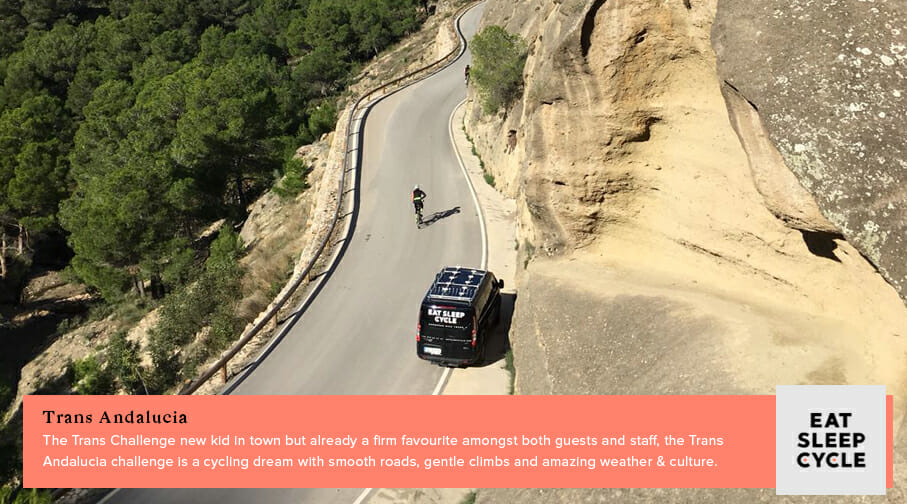
    The Trans Challenge new kid in town but already a firm favourite amongst both guests and staff, the Trans Andalucia challenge is a cycling dream. We recently waxed lyrical on this blog on the beauty of cycling in Andalucia, the smooth roads, the gentle climbs, the weather and the culture together make it a paradise for a cycling holiday.

    Starting from Almeria and heading west to Seville via the Sierra Nevada mountains, Granada, the ancient Moorish city of Antequera, Ronda & Arcos de la Frontera it is a tour filled with as much cultural interests as riding, not to mention the food!

    Trans Andalucia Tour Highlights

    • Caminito del Rey – The 2015 Vuelta was the first road race to visit the ‘Pathway of the King’. Short and sweet is the best way to describe this 4 km climb. With ramps of up to 15% legs are likely to sting as the road winds its way up to a restaurant and a dead end.
    • Ronda – The mountaintop city famous for its Moorish history and the iconic Puente Nuevo bridge over a deep gorge which separates the new and the old town.
    • Granada – There is yet more history to discover in Granada famous for the stunning Alhambra, which started life as a fortress, before being transformed into a palace in the mid 13th century.

    Trans Cycling Challenges – Start Your Journey Now

    Each of the Trans Cycling Challenges about will give a cycling experience like no other and all of our tours can be tailored to your needs. If you’d like to start the journey of a lifetime give us a call now on +34 972 649 131 or contact us online for more info!

    P.S. Enjoyed this blog? Why not sign up to receive notifications every time we post and get regular updates on our latest tours!
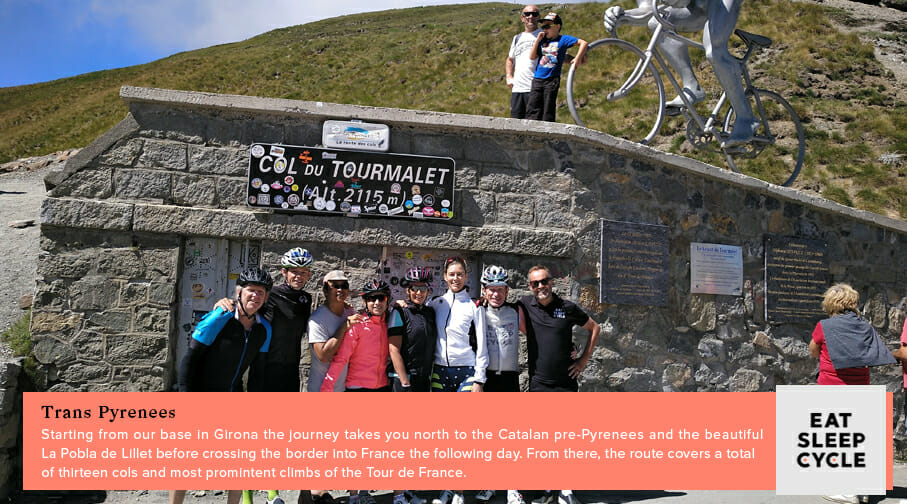
  • Classic Climbs of the Alps

    The Alps have long been a classic destination for those seeking a cycling vacation in Europe. It is, after all the place where the fiercest battles of the Tour are won and lost, where almost every climb is a ‘classic’, the roads are smooth and the terrain is challenging and varied. To that end we have decided we simply must add it to our ever-expanding list of European locations, should you need to be convinced any further as to why the Alps are a must-ride for every cyclist take a look at our run-down of the classic climbs of the Alps!

    Alpe d’Huez

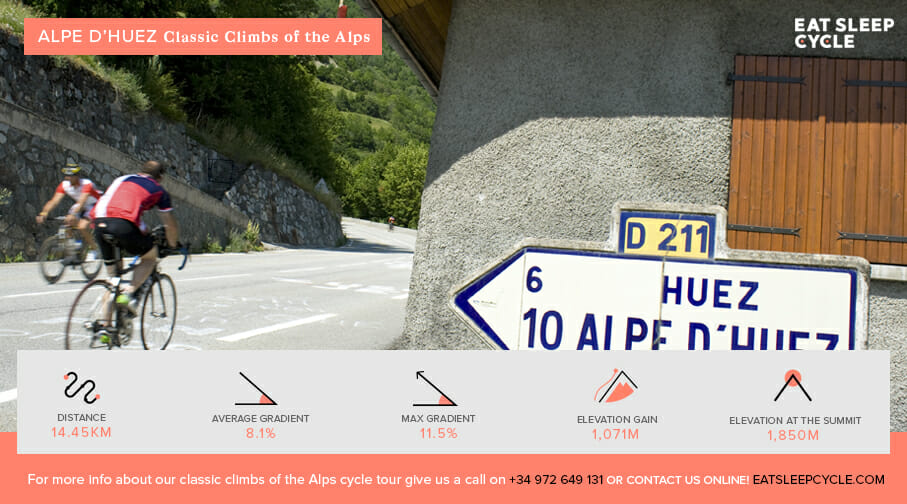
    By far the most famous Alpine climb Alpe d’Huez is known for it’s 21 hairpins.
    It may not be the toughest, steepest, longest or most beautiful of climbs but it provides what must be one of the most iconic stretches of climbing in cycling history. The climb has been used 30 times in the Tour de France so far, usually to dramatic effect. One of the most memorable ascents of Alpe d’Huez was that of 1997 when El Pirata, Marco Pantani, flew past Jan Ullrich on his way to the fastest ever ascent (37 mins 35 seconds). Mere mortals fulled on jam sandwiches and espresso can aim for the hour as being an exceptionally good time.

    Alpe d’Huez Stats:

    • 14.45km
    • 8.1% average gradient
    • 11.5% max gradient
    • 1,071m elevation gain
    • 1,850m elevation at the summit

    Classic Climbs of the Alps - Alpe d’Huez - Cycling-Tour

    Col du Galibier

    From St Michel-de-Maurienne
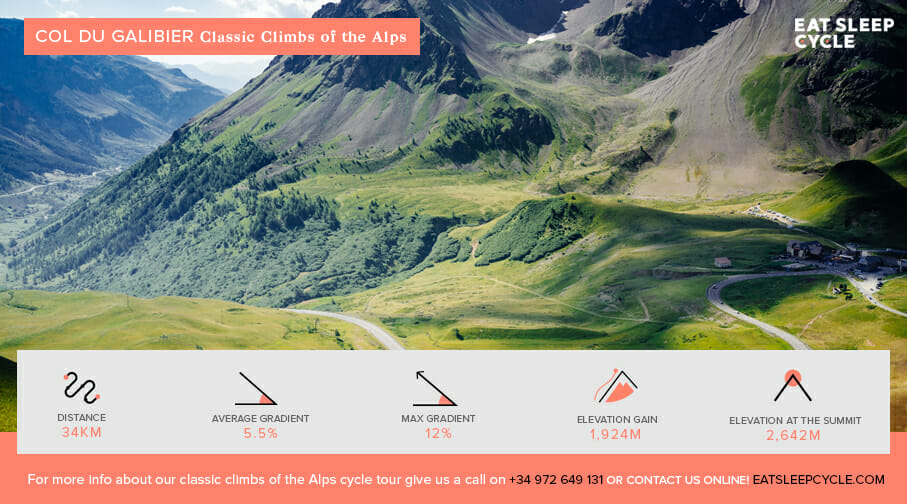
    The Galibier is one of the toughest climbs in cycling. Most famously tackled from the northern side it is an epic 34 km long. To reach the pass you must first climb the Col du Télégraphe (12km at 7%). After a 5km descent to the ski town of Valloire the road gets steeper & steeper en route to a mighty summit at 2,642 m.
    It is the altitude towards the top combined with the length of the climb which make the Galibier so tough. It is the fourth highest paved pass in France at a (literally) breath-taking 2,642m.

    Col du Galibier Stats:

    • 34km
    • 5.5% average gradient
    • 12% max gradient
    • 1,924m elevation gain
    • 2,642m elevation at the summit

    Classic Climbs of the Alps - Col du Galibier Alps - Cycling Tour

    Col de la Colombière

    North from Scionzier
    Featured in the 2018 Tour de France and La Course
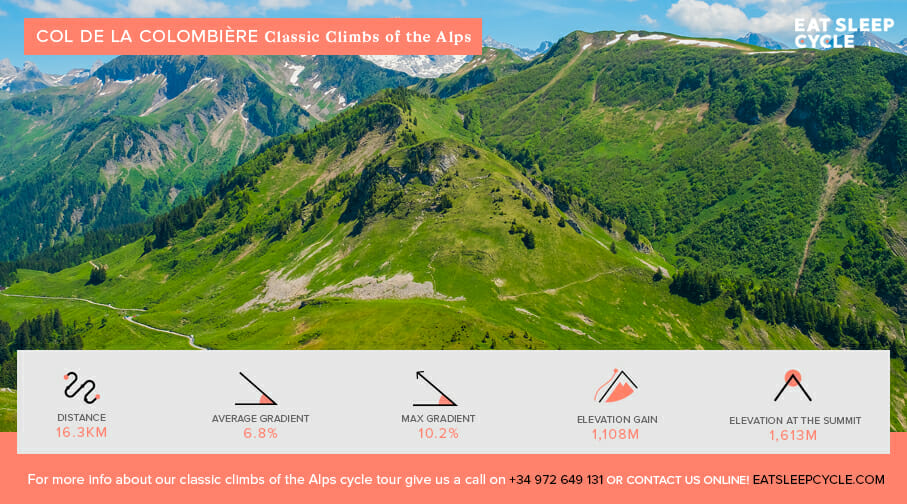
    In the Arve valley near to the town of Cluses, Scionzer is where the Colombière starts proper. The climb can be split into two parts as there is an ‘easier’ point around half way with a plateau. The first section is under the cover of the forest and rises gradually from 3% up to 8% in the last few kilometres before it levels off. After, the road becomes a lot steeper with the gradient rising and rising up to the 10-11% slopes at the top. The rocky landscape gives way to make the summit visible from around 3km to go which can be both a blessing and a curse depending on how long the final few kms feel!

    Col de la Colombière Stats:

    • 16.3km
    • 6.8% average gradient
    • 10.2% max gradient
    • 1,108m elevation gain
    • 1,613m elevation at the summit

    Classic Climbs of the Alps - Col de la Colombière - Alps Cycling Tour

    Col de la Madeleine

    South from la Chambre
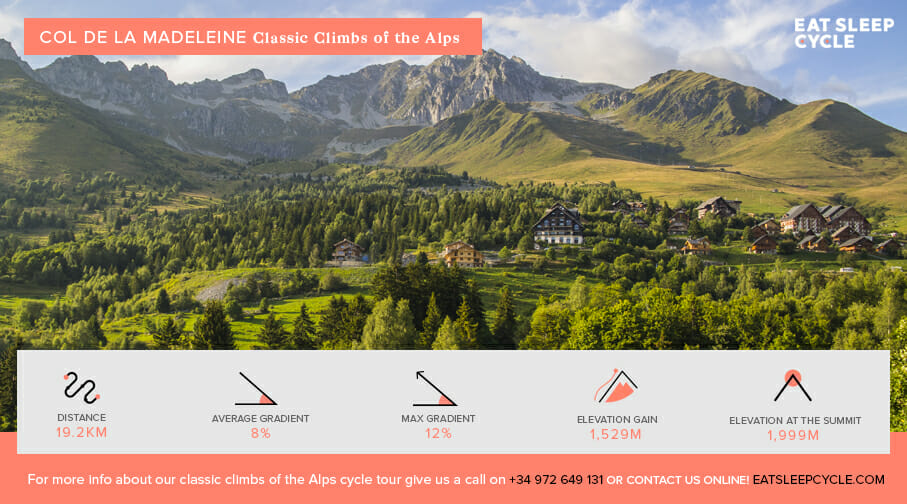
    The Col de la Madeleine is one of the most beautiful climbs in the Alps but it’s also one of the toughest. A brutal 19.2km at an average of 8% with 40 hairpins offers no respite; the saving grace is that the gradient remains pretty constant throughout meaning you can get into a (painful) rhythm.
    The climb regularly features in the Tour de France but was last used five years ago in 2013 on Stage 19 between Bourg d’Oisans and Le Grand-Bornand meaning it’s long overdue a visit!

    Col de la Madeleine Stats:

    • 19.2km
    • 8% average gradient
    • 12% max gradient
    • 1,529m elevation gain
    • 1,999m elevation at the summit

    Classic Climbs of the Alps - Col de la Madeleine - Biking Tour

    Col d’Izoard

    South from Guillestre
    Col d’Izoard is steeped in cycling history, the Tour de France has featured the climb on 35 occasions but surprisingly only one of those was a summit finish. That finish was in 2017 and was won by French rider and polka-dot jersey winner Warren Barguil. On that same day even more history was made as the women’s pro peloton also raced to the summit with Dutch rider Annemiek Van Vleuten taking the win and posting a faster time than all but two male riders that day…
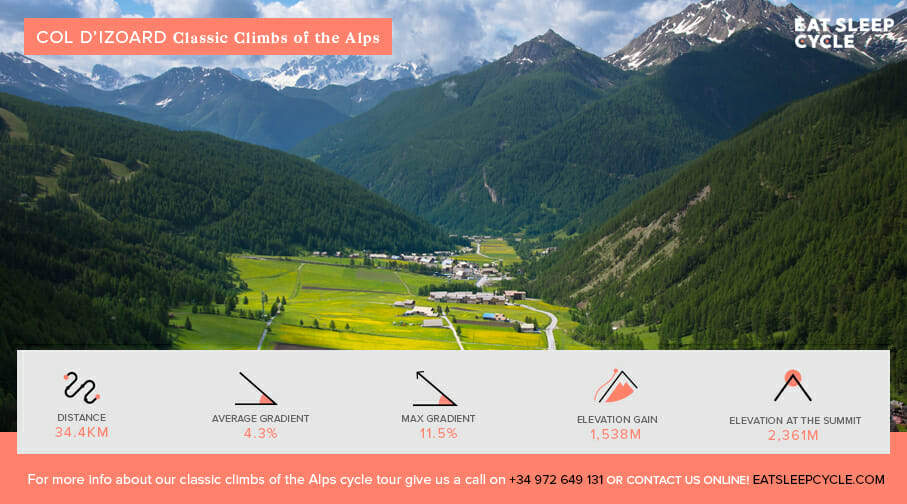
    The climb itself has a deceptively low average gradient of 4.3% which is due to the gradual lower slopes, but the climb proper begins after around 15 kilometres whereafter the gradient pushes up to between 7 and 11%. The scenery alone is worth summiting the Izoard for, from the dramatic Casse Déserte to the panoramic Alpine views that can be seen from the top.

    Col d’Izoard Climb Stats:

    • 34.4km
    • 4.3% average gradient
    • 11.5% max gradient
    • 1,538m elevation gain
    • 2,361m elevation at the summit

    Classic Climbs of the Alps - Col d’Izoard - Biking Tour

    Alps Cycling Tour Guides

    To set up our Alps tours we enlisted the knowledge of two people who know the Alps like we know Girona – inside out – meet our Alps Tour Leaders.

    Ed Greene:
    Two years living in the Alps honing his climbing skills while racing means Ed knows the area like the back of his hand. With racing now behind him he frequents France more for the boulangeries than the climbs and cafè and Croissant are now the most frequently used words in his extensive French vocabulary.

    Christian Vaughan:
    Christian feels very at home in the Alps and considers it his second home. He loves the variation of the small and massive climbs that reward with those fantastic ‘top of the world’ views. Top that off with the fabulous descents and there is no better way to spend a day on the bike. Experience is key in the mountains to ensure that you get the best from the route and weather.  High points—Col d’Izoard, Col de Sarenne, Col du Galibier. Christian also has extensive experience as an athlete, mechanic and coach.

    Cycling Vacation of the Classic Climbs of the Alps

    Cycling Tour of the Classic Climbs of the Alps

    If the these classic climbs of the Alps have peaked your interest then make sure to get in touch with us today! Take on all of these epic climbs and more guided by our expert leaders on our Classic Climbs of the Alps tour. Give us a call on +34 972 649 131 or contact us online for more info.

    P.S. Enjoyed this blog? Why not sign up to receive notifications every time we post and get regular updates on our latest tours!