Blog

  • The Pirinexus 360 – A Different Side of Catalunya

    [vc_row type=”in_container” full_screen_row_position=”middle” scene_position=”center” text_color=”dark” text_align=”left” overlay_strength=”0.3″ shape_divider_position=”bottom”][vc_column column_padding=”no-extra-padding” column_padding_position=”all” background_color_opacity=”1″ background_hover_color_opacity=”1″ column_link_target=”_self” column_shadow=”none” column_border_radius=”none” width=”1/1″ tablet_width_inherit=”default” tablet_text_alignment=”default” phone_text_alignment=”default” column_border_width=”none” column_border_style=”solid”][vc_column_text]Catalunya is well known for its road cycling pedigree by now, the droves of riders that frequent the roads around Girona are testament to that. But if you’re after a different way to explore the region then look no further than the Pirinexus 360. As the name suggests the route is a circular 360 km loop. From Girona, it heads north to Olot, Camprodon & France via the Pyrenees Mountains, before heading south and downhill to the Costa Brava, and looping back around to Girona. The route can be completed in either one monster chunk for the epic riders out there, or in smaller more leisurely rides taking in the beautiful towns and villages along the way.

    The Pirinexus 360 Cycle Route

    The Pirinexus route is divided into 7 stretches of distances between 22 and 73km and is designed to be completed in small segments in order to take advantage of the beautiful surroundings and tranquillity of the off-road riding. The well-signposted route crosses through some of the most beautiful landscapes and charming villages Catalunya has to offer including the coastline of the Costa Brava and charming towns in the south of France.

    Starting from Girona the route is best completed at a leisurely pace over 5 – 8 days to take full advantage of the varied and richly cultured towns and villages interposed throughout. So let’s break down the Pirinexus 360 route!

    Girona – Olot

    The first section is a 57 km stretch that sees you head north-west from Girona to the town of Olot, passing through three ‘comarcas’ and 12 towns and taking in the valleys of the Rivers Fluvià, Brugent and Ter. The first ‘comarca’ is Girones, heading out of the city towards the industrial towns of Salt and Bescanó and Bonmatí to the town of Anglès, which is home to a walled medieval town. The medieval town of Amer is the final town in the Girones comarca before the route enters the ‘Zona Volcanica de la Garrotxa’ of which Olot is the capital, an area of astonishing natural beauty and geological interest. As you pass through Sant Feliu de Pallerols you will be able to spot volcanic rocks parallel to the route. From here both the natural and man-made spectacles are in abundance, from a 9th century castle, to natural springs and gorges, sprawling valleys and beautiful churches.

    Stay in:
    – La Rectoria de Sant Miquel de Pineda, Sant Feliu de Pallerols
    – Mas Rubio, Joanetes

    Eat at:
    – Les Cols, Olot
    – La Rectoría offers a fabulous menu.
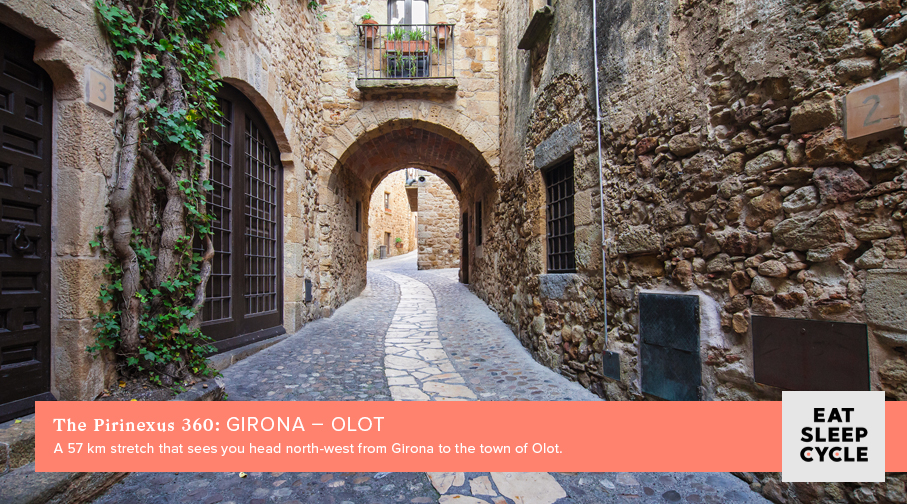
    The Pirinexus 360 Cycle Tour - Girona - Olot

    Olot – Camprodon

    The shortness of this section of the Pirinexus 360 belies its difficulty, it is the hilliest section of the route with 900m of elevation but it is possibly the most beautiful.

    From Olot the climbing begins straight away with the Coll de Coubet, a steady climb of around 9km, at the top the road plateaus to reveal fantastic views of the Pyrenees. From there the route takes a right along the rolling road to the Coll de Santigosa and beautiful comarca of El Ripollès. The route follows the road until the 12th Century Romanesque Church of Sant Pol and then crosses the Gothic bridge into Sant Joan Les Abadeses. From St Joan the tranquil lanes traverse the valley until Camprodon, a picture-postcard town populated mainly by the moneyed Barcelona second home owners and the 12th century Pont Nou bridge. Also home to the Birba biscuit factory, whose produce can be found in most shops in the area.

    Stay in:
    – Alberg Rural Ruta del Ferro, Sant Joan de les Abadesses
    – Hotelet del Bac, Camprodon

    Eat at:
    – Mitic Restauraunt, Camprodon
    – Ca ‘Enric Sant Joan
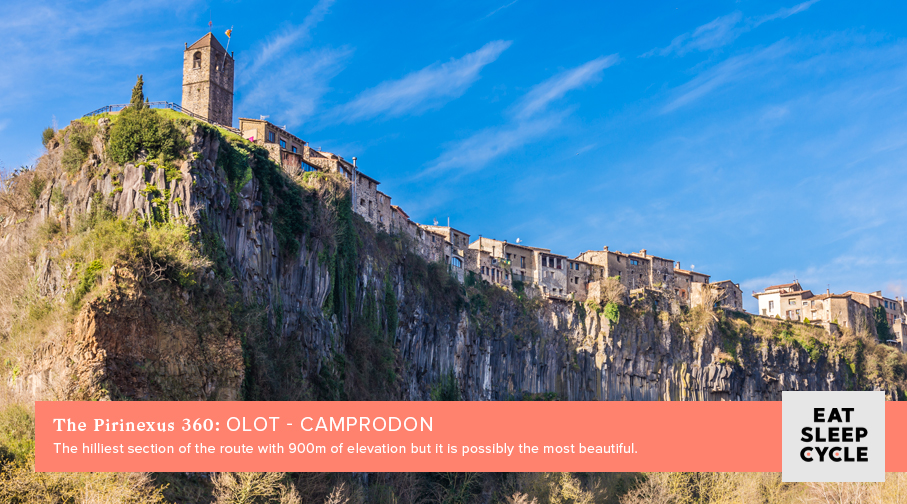
    The Pirinexus 360 Biking Route - Olot - Camprodon

    Camprodon – Ceret

    It is on this section of the route that you will enter France for the first time. Leaving Camprodon, the juxtaposition of the contrasting cultures of medieval Catalunya and the low Pyrenees become apparent. The area is steeped in history with and a wealth of cultures and cuisines to sample. The views from the Coll d’Ares, which marks the border between Spain and France, are breath-taking and stopping to savour them before crossing into France is essential.

    Ceret itself is known as the cherry capital and is also widely considered the home of the Cubism art movement so for art lovers a visit to the Museum of Modern art is a must.

    Stay in:
    – Hôtel Vidal, Céret

    Eat at:
    – L’Atelier de Fred Ceret
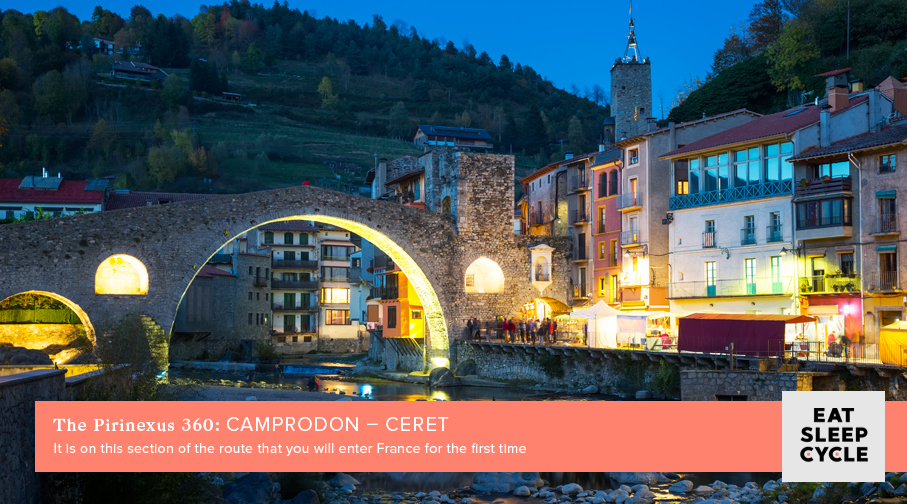
    The Pirinexus 360 Cycling Tour - Camprodon - Ceret

    Ceret – The Costa Brava

    From Ceret the next point of interest is the communce of Le Boulou, where various remains of the old part of the village can be seen including an magnificent 832kg bell-tower, the ornately decorated Eglise Sainte-Marie and the statue ‘du petit tambour’ or little drummer boy which depicts the child mortally wounded in battle. Indeed this entire section of the route is peppered with plenty of historical interest and medieval, historical remains. The area is also known for having been at the forefront of the cork industry throughout the 20th century. Crossing the Coll de Panissars and back into Spain through La Jonquera, a town of dual interest as both a commercial and cultural centre the route eventually reaches Capmany – an integral location within the wine-making trade home to an array of cellars producing D.O Empordà wine.

    Tasting Empordà wine is a must in this area, there are plenty of producers, many of whom offer tours of their vineyards and cellars with tastings. Following the river Llobregat from Capmany comes the town of Peralada which is steeped in history home to the ancient walled settlement of Ibers as well as a castle museum. A short detour from the route on this section of Pirinexus is Figueres a town perhaps most famous for being home to the Salvador Dalí museum dedicated to the surrealist painter who resided in the down. Those interested in nature will enjoy the Aiguamolls Natural Park which is home to an array of local bird life. Crossing the wooden bridge over the River Muga you will reach the coast and Empuriabrava, the largest residential marina in Europe. Following the coast down you will then reach the fishing town of L’Escala famous for its anchovies. Stop just north of the town for a luxurious evening by the Mediterranean.

    Stay in:
    – Hotel Spa Vilamint Garriguella,
    – Hostal Empuries, L’Escala

    Eat at:
    – Hostal Empuries
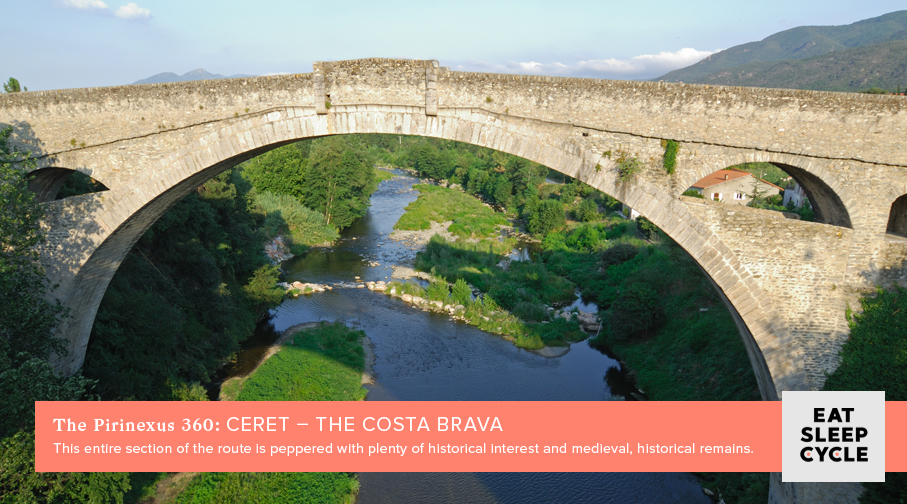
    Pirinexus 360 Bike Route - Ceret - Costa Brava

    L’Escala – Girona

    A large section of this segment runs parallel with the coast taking in the many towns of the Baix or ‘low’ Empordà region including Pals, where yet more medieval remains can be seen. Following on from Torrent is the area of the Gavarres Massif bordered by Palafrugell, a picturesque town characterised by an unfinished bell tower and the Modernist Tower of Can Mario, an old factory which has been converted into the Museum of Contemporary Sculpture. The coastal section comes to an end at the fishng town of Sant Feliu de Guixols, the route then heads north-west and is scattered with towns containing myriad medieval structures and remains before finally re-entering the Girones commarca. Through the corkwood forest comes the town of Lllagostera before crossing the fault lines which created the hot springs that are dotted in the area into Casa de la Selva. From the cork region comes the ceramic region and the town of Quart where a pottery museum can be accessed straight from the Via Verde before heading back to Girona.

    Stay in:
    – Hotel Alga****, Calella de Palafrugell
    – Hotel Sant Pol, Sant Feliu de Guixols
    – Hotel Ultonia, Girona
    – Hotel Peninsula, Girona

    Eat at:
    – Calau, Palafrugell
    – Massana, Girona
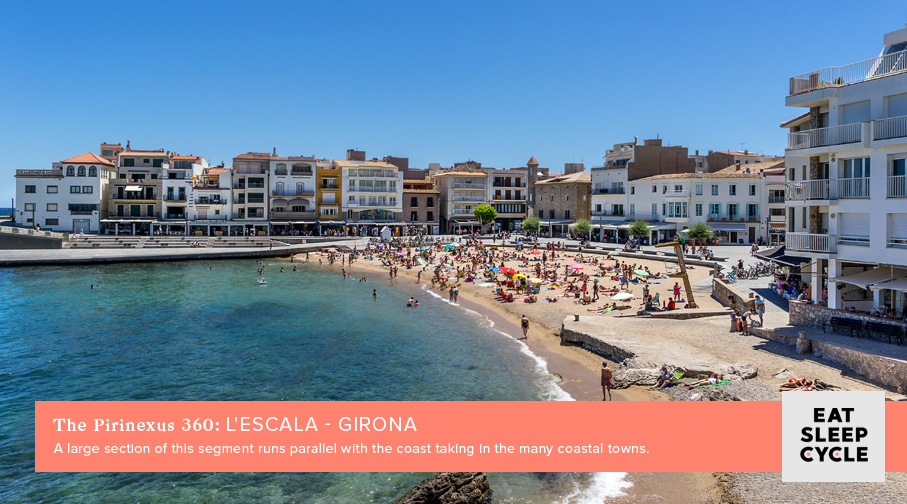
    Pirinexus 360 Cycling Vacation - L'Escala - Girona

    Tailored Pirinexus 360 Cycle Route

    The Pirinexus route provides a fantastic vehicle by which to view an area rich in culture and history from the tranquillity of cycling-specific infrastructure free from traffic. Cycling the Pirinexus allows for a thorough exploration of the area which the road does not always provide and the accessibility of the roads and trails means that it can be enjoyed by riders of all abilities.

    There are a myriad of ways to tailor your cycling tour of the Pirinexus like:

    • Luxury Leisure – Take as many days as you possibly can, stay in the best luxury hotels, enjoy gourmet food experiences. Enjoy the company of a private guide & the back up of a personal support vehicle.
    • Self-Guided Simplicity –Find your way along the trail at your perfect pace. Enjoy the freedom of a light bike and the luxury of luggage transfers – your bags will be waiting for you at your final destination.
    • Bikepacking Cycling Adventure – Go it alone with a GPS (or map and compass for a true adventure), and bike-pack your way to happiness. If you’re time-pressed, pack your tour into 3 or 4 days and up the pace on a lightweight bike, elegantly packed with all your gear.
    • Endurance Challenge – Did you know every year cyclists attempt to ride the whole 360 km loop in under 24 hours? Fancy it? Let us know and we’ll gladly support your valient attempt.

    Tailored Pirinexus 360 Bike Route - Eat Sleep Cycle

    Pirinexus 360 Cycle Tour

    If you think that riding the Pirinexus route sounds like something you would like to take on then make sure to give us a call on +34 972 649 131 or contact us online for more info! We’re now accepting bookings for next season so make sure you secure your saddle now!

    See more information about our Pirinexus Cycle Tour packages.

    P.S. Enjoyed this blog? Why not sign up to receive notifications every time we post and get regular updates on our latest tours![/vc_column_text][/vc_column][/vc_row]
  • Women’s Pyrenees Tour With Eat Sleep Cycle

    This is a guest post by Kath, one of our lovely guests on our recent Women’s Pyrenees Tour who has written all about her experience on her blog.

    Conquering Cols in the Pyrenees with a different edge – we were all women!

    I had signed up to this holiday several months ago – I knew that September would be a bit stressful (moving house!) and a cycle trip to take the edge off would be needed. I’ve done a few cycle trips here and there, either as part of a group or solo, and given the other things going on in my life, a guided trip somewhere exciting was ideal. I’ve wanted to visit the Pyrenees on a bike for a while having spent some previous holidays nearby and looking longingly up at the mountains. But I’ve never ridden a stage of the Tour de France and I really wouldn’t consider myself a mountain climber. I had noticed Eat Sleep Cycle on social media, as they regularly post about their trips and regularly introduce their staff. Their tour of the Pyrenees advertised many of the classic climbs and staying in hotels within beautiful spa towns, but a women-only Tour? What would that be like?

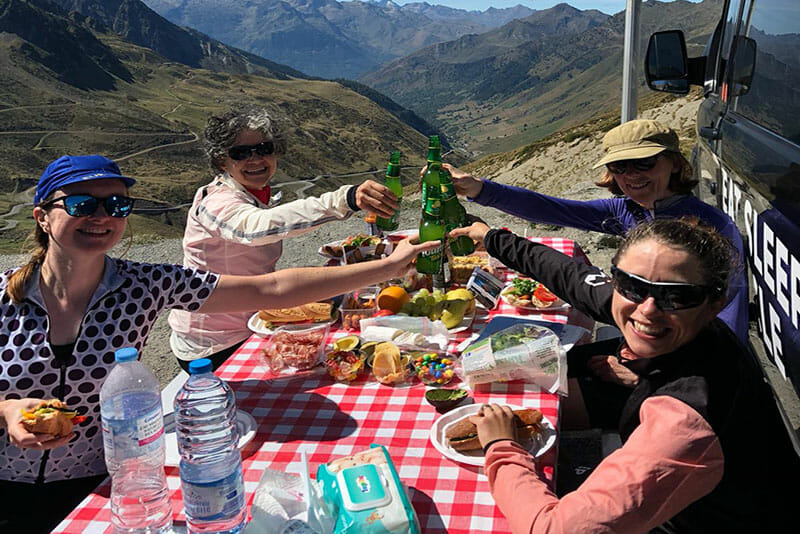
    Womens Cycling Pyrenees Lunch

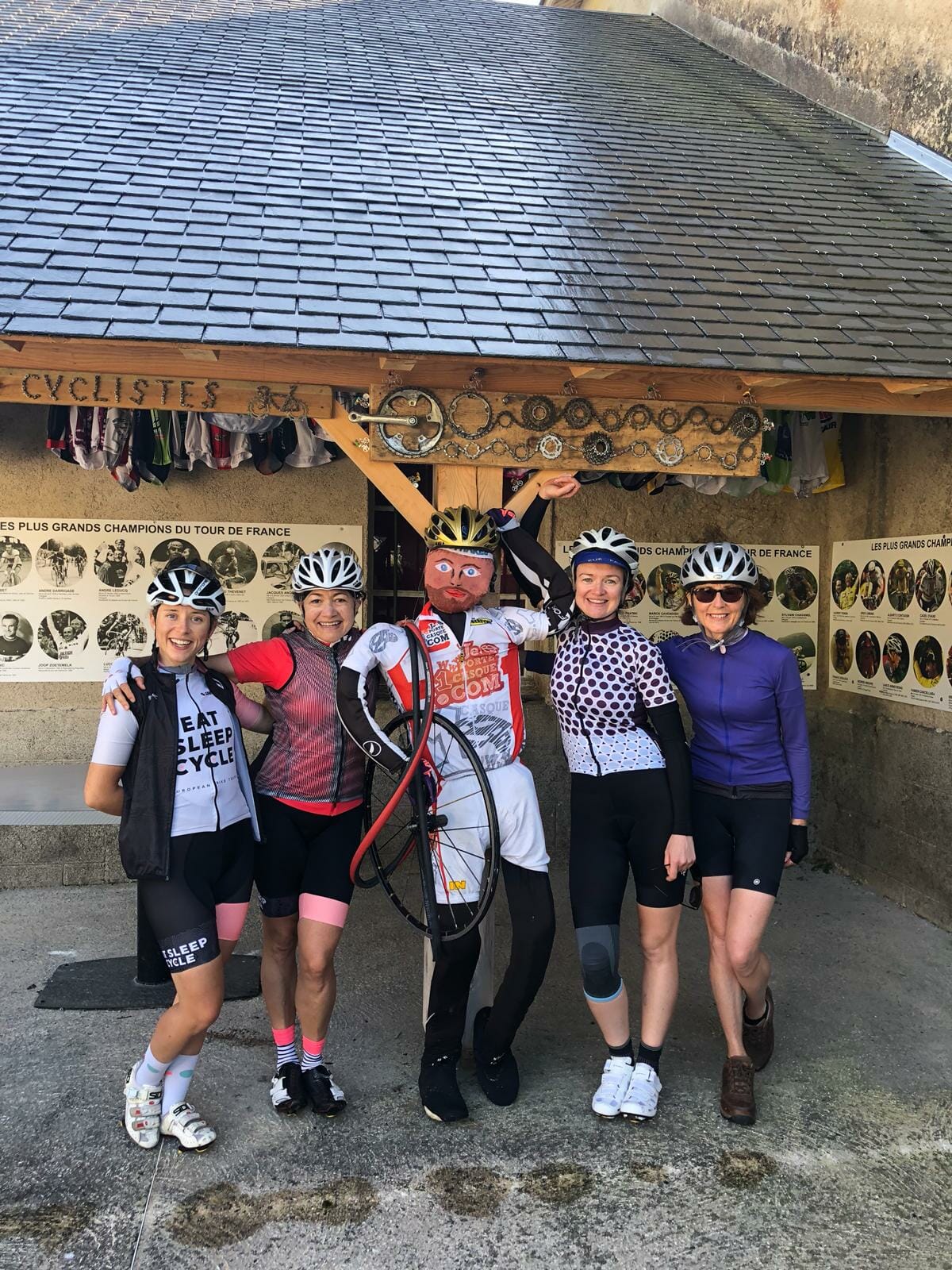
    Having cycled many years in various clubs and with friends, cycling with other women has always been important. There’s nothing wrong with cycling with men, but we are from different planets, and if you’re not an advocate of that idea from popular science we are raised differently and influenced by varying praises and expectations. Cycling with only women is unusual – I’ve probably only had 2 rides consisting of only women and both were organized specifically with this in mind. The riding pace is just as strong as with men, as is the distance, but the conversation and support are totally different. Support is there in many different forms, from providing encouragement on your fellow rider’s ability to sharing stories of your experiences, advice on achieving goals and ambitions, and the trials of cycling with MAMILs. There’s definitely less chat about groupsets – but I’m pretty happy about that!


    Whilst on the holiday we were guided by Louise – owner of ESC and cycling extraordinaire. Louise had taken several groups on a similar tour before, but this was the maiden Women’s Tour outside of Girona. Louise was excellent at providing all the information required during the trip and politely providing the necessary pacing to prevent a blow-out later on and company when the climbs got harder. A description of a forthcoming climb always came with a grin from a woman that loves the challenge. I really appreciated the advice as I regularly wanted to cycle away at the beginning of a climb out of pure excitement, not acknowledging that I had 12km to go at an average of 7%.


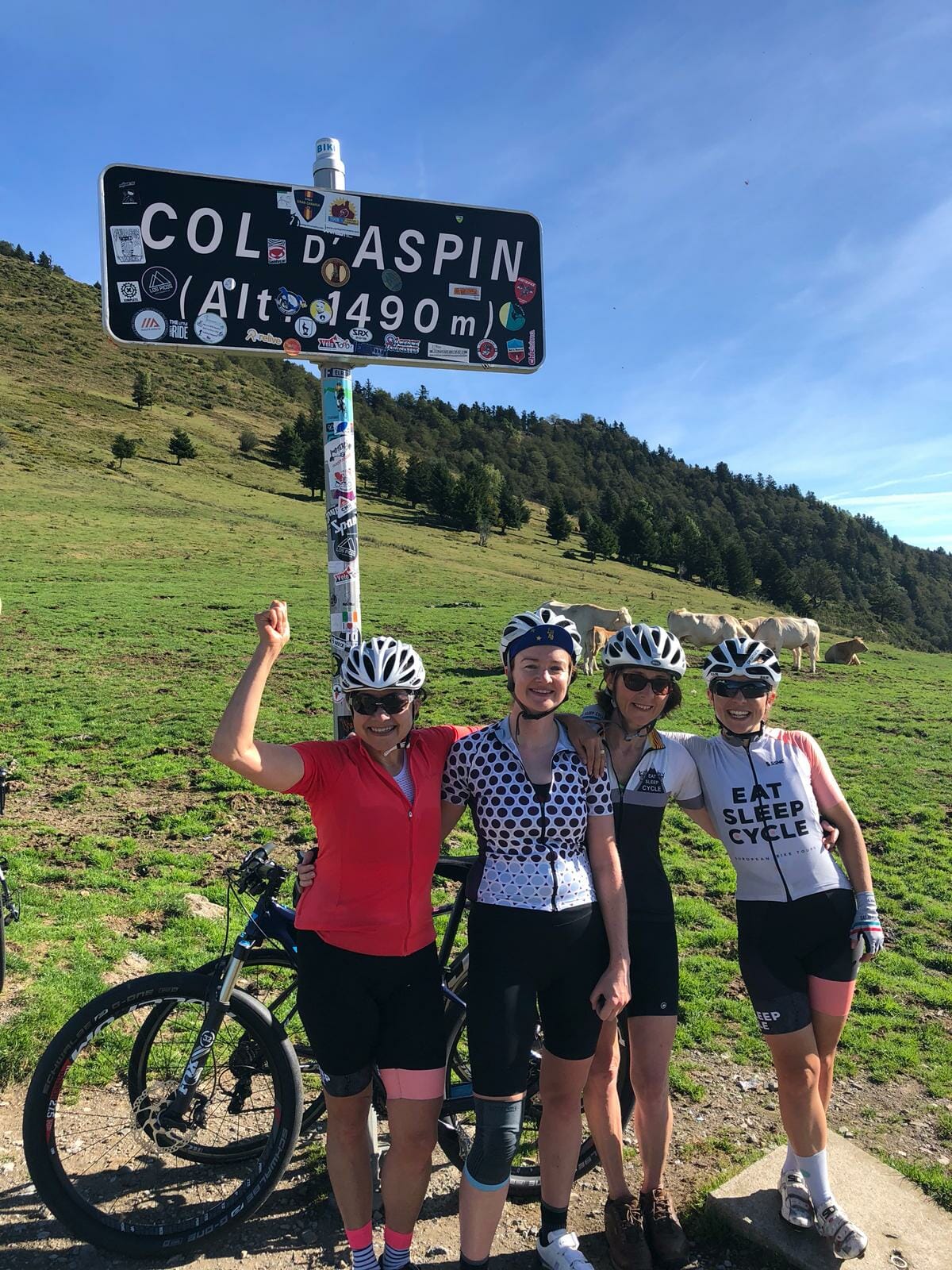
    The first day was a short ride up to Superbagnères, with a strange and foreboding ski hotel up at the top. It was brilliant to be back on some switchbacks, something I love descending much more than climbing. On the descent I was fortunate to have a wildcat cross my path ahead, even in the Pyrenees these creatures are unusual to see. Day 2 covered Col du Ares and Col du Mente, both beautiful climbs into the mountains. Day 3 was short and sharp, covering col du Peyresourde and Val Louron Azet just 44km; there was an optional extra but the hotel pool was calling… This slightly easier day was in preparation for day 4 – Col du Aspen and the iconic Col du Tourmalet.

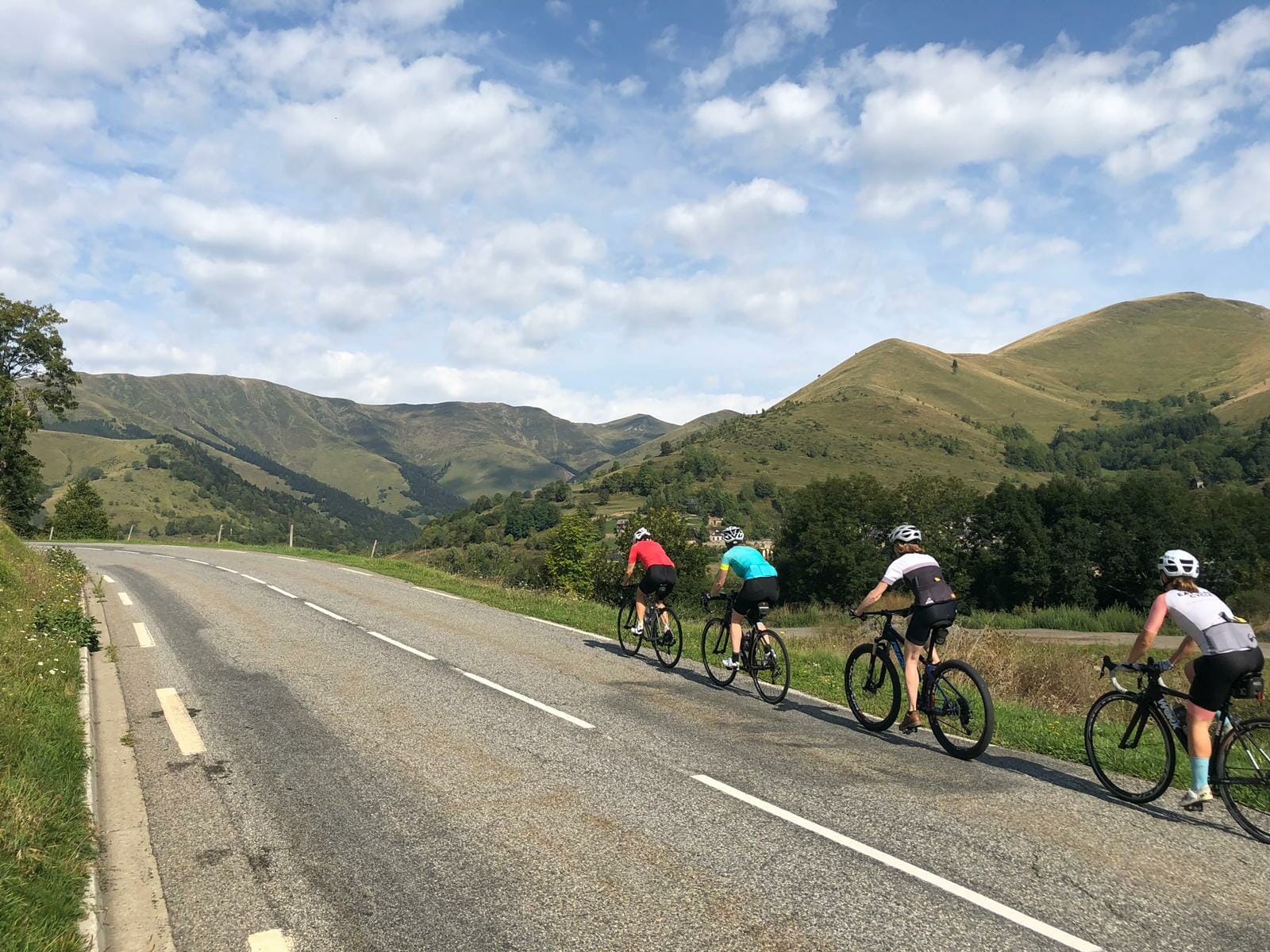
    Most people who we passed were clearly delighted that a group of only women were cycling the Pyrenees. From the locals we had many waves and grins of joy, and perhaps a bit of bewilderment. Most other cyclists were very pleased to see us, and many would stop to engage with us. Perhaps the questions were different; ‘is that an electric bike?’ ‘Did you cycle up here?’ Sigh. But not always; ‘is that a 35-25 groupset?’ ‘Just stunning isn’t it?’ ‘Where are you from?’ The Col du Tourmalet was a pleasure to ride up, one foot in front of the other and just keeping soaking up the exquisite views. By this point my new friends and I had bonded; ‘has is just kicked up again?’ ‘No whingeing on the yacht, Ladies!’. During our ride there was several groups of other cyclists, including a triathlon competition, I’m just in awe of those cyclists whizzing down the Tourmalet to then start running.

    While we were climbing our driver Brooke was putting together a feast for us, often at the top of a Col (we were very lucky with the weather). This was where a guided tour really came into its own; having a spread of salads, cured meats, carbs and juice all ready for you at the top of a mountain you’ve just climbed. We were definitely the envy of everyone else at this point and had several requests to join the table. Brooke also acted as our social media correspondent and gave us all several lessons in the wonderful world of Instagram.


    The choice of hotels was perfect, varying from a traditional French lodge serving classic cuisine through to a ski hotel with a pool to relax by (and plunge into) at the end of the day. Our belongings were transported in the van, again the ease of a guided holiday really made the Tour ideal.

    So what was a women-only Tour like? I came back from holiday really feeling like I had a holiday. The support for each other was brilliant, and this I have found is sometimes harder to identify within mixed groups. And we had a lot of fun; it was an absolute pleasure to cycle with other like-minded women over the five days of riding. Cycling in the Pyrenees was a wonderful experience and I’m already planning for my next trip there. I’ve returned from holiday with more confidence in myself and ability to climb up anything. After-all, I cycled the Queens Stage of my Tour of the Pyrenees.

  • Focus On Factor Bikes

    At Eat Sleep Cycle we are, first and foremost, cyclists and as such we are always searching for the best bike. Therefore when the chance to work with Factor Bikes, a brand founded on years of experience within both the carbon manufacturing industry and the peloton, we jumped at the chance. We like to work with like-minded brands, those who engage with their audience and are closely involved with the delivery or production of their product. It was in this vein that we chose Ridley for our rental fleet in 2018 and with the same ideal in mind that we are collaborating with Factor.

    Factor Bikes – A Winning Combination

    Add to this the input of none other than David Millar and you truly have a winning combination. Indeed, winning is exactly what the professional athletes who have had the privilege to ride bikes made by Factor have gone on to do. In their own words the brand “was conceived from a commitment to innovation, speed and performance through advanced engineering”, commitments for a bike manufacturer. So who are Factor?

    From Formula 1 to Factor

    Factor has an interesting history: despite being a young brand it has years of experience behind it; founded in 2007 by BF1 systems, the Formula 1 engineering company based in Norfolk, UK, the early models were inspired by the supercars and designed to showcase the engineering prowess of the company. The Factor 001 was launched in 2009 and was a concept bike with a built-in computer, disc brakes and an eye-watering £20,000 price tag.

    Nowadays the brand is producing somewhat more attainable but still high-performance models designed for racing. Baden Cooke, a former pro of 14 years and 2003 Tour de France green jersey winner, along with Rob Gitelis, co-founder of Carbon Composite bikes bought the brand during this shift from prototypes to the peloton.

    Factor Bikes Romain Bardet - Factor Bike Hire and Purchase

    Factor Accolades

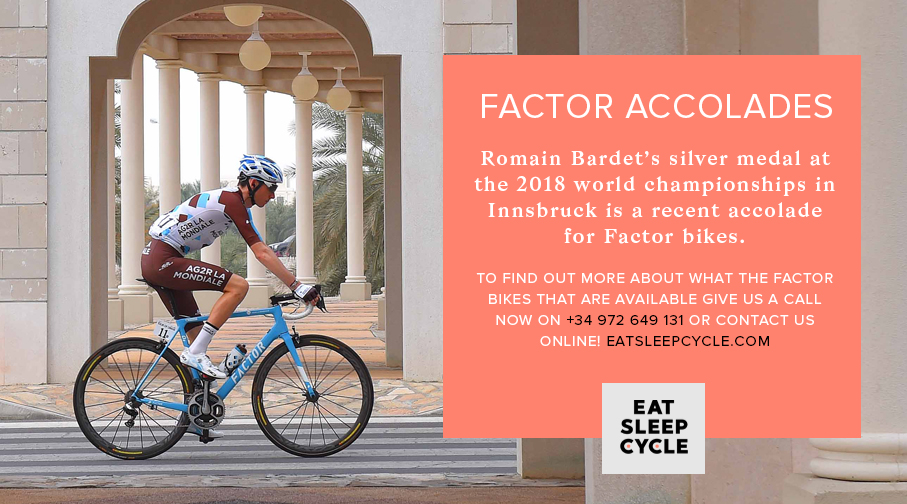
    Thus, with the brand still in its infancy it took up sponsorship of a World Tour team in the form of the French set-up AG2R La Mondiale in 2017. With this came the need to produce a lightweight race bike that complies with UCI regulations and the 6.58kg Factor O2 was born. Since switching to Factor as a bike sponsor AG2R La Mondiale have enjoyed myriad successes in some of the most prestigious races on the cycling calendar including 3rd on GC and a stage win at the 2017 Tour. The most recent success, however, was Romain Bardet’s silver medal at the world championships in Innsbruck. Few bike brands this young can boast the same accolades.

    But Bardet and co. are not the only professional riders involved with Factor. David Millar, former pro cyclist and multiple Tour de France stage winner, has been involved with the brand from early on, developing the design with Cooke and Gitelis having lamented the lack of input he was afforded with regards to the bikes he rode during his career. Millar has since collaborated with Factor via his own brand, CHPT3, on a limited edition One which he described as: ‘the coolest bike I have ever had’.

    Factor Bike Hire and Purchase from Eat Sleep Cycle

    One More Lap Factor 02 Bike Hire & Purchase

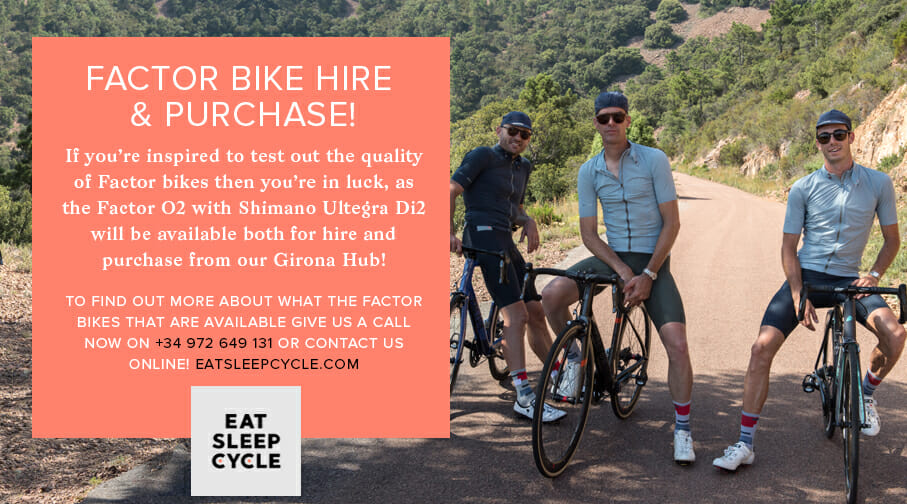
    If you’re inspired to test out the quality of Factor bikes in the high mountains then you’re in luck, as the Factor O2 with Shimano Ultegra Di2 is available both for bike hire and purchase from our Girona Hub and on tours. Take a look at our photo gallery below & give us a call now on +34 972 649 131 or contact us online to book your ride!

    P.S. Enjoyed this blog? Why not sign up to receive notifications every time we post and get regular updates on our latest tours!

  • Classic Climbs of the Alps

    The Alps have long been a classic destination for those seeking a cycling vacation in Europe. It is, after all the place where the fiercest battles of the Tour are won and lost, where almost every climb is a ‘classic’, the roads are smooth and the terrain is challenging and varied. To that end we have decided we simply must add it to our ever-expanding list of European locations, should you need to be convinced any further as to why the Alps are a must-ride for every cyclist take a look at our run-down of the classic climbs of the Alps!

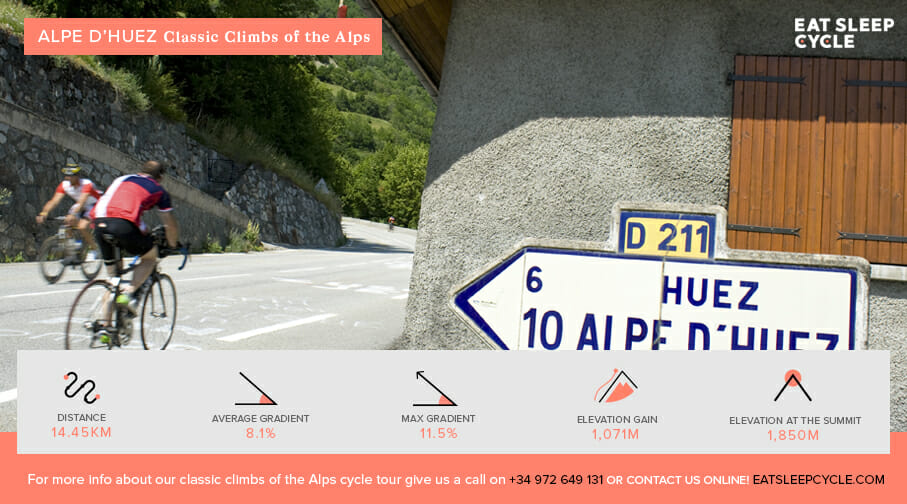
    Alpe d’Huez

    By far the most famous Alpine climb Alpe d’Huez is known for it’s 21 hairpins.
    It may not be the toughest, steepest, longest or most beautiful of climbs but it provides what must be one of the most iconic stretches of climbing in cycling history. The climb has been used 30 times in the Tour de France so far, usually to dramatic effect. One of the most memorable ascents of Alpe d’Huez was that of 1997 when El Pirata, Marco Pantani, flew past Jan Ullrich on his way to the fastest ever ascent (37 mins 35 seconds). Mere mortals fulled on jam sandwiches and espresso can aim for the hour as being an exceptionally good time.

    Alpe d’Huez Stats:

    • 14.45km
    • 8.1% average gradient
    • 11.5% max gradient
    • 1,071m elevation gain
    • 1,850m elevation at the summit

    Classic Climbs of the Alps - Alpe d’Huez - Cycling-Tour

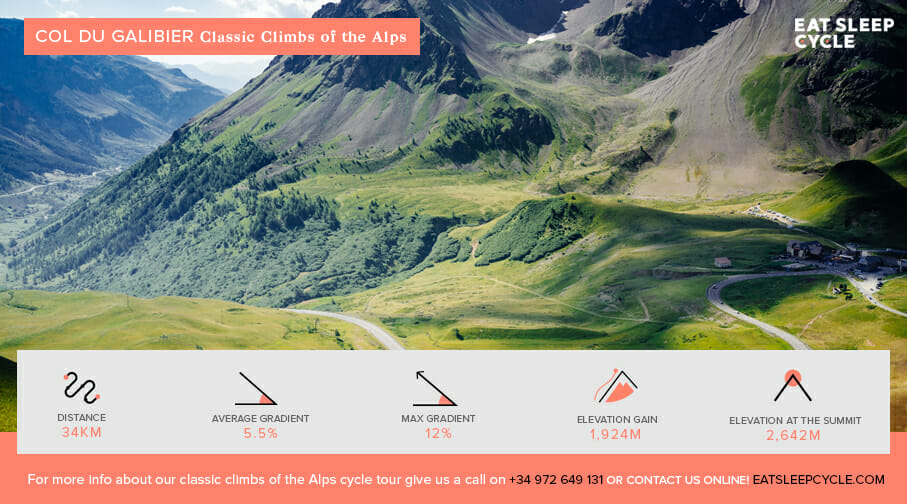
    Col du Galibier

    From St Michel-de-Maurienne
    The Galibier is one of the toughest climbs in cycling. Most famously tackled from the northern side it is an epic 34 km long. To reach the pass you must first climb the Col du Télégraphe (12km at 7%). After a 5km descent to the ski town of Valloire the road gets steeper & steeper en route to a mighty summit at 2,642 m.
    It is the altitude towards the top combined with the length of the climb which make the Galibier so tough. It is the fourth highest paved pass in France at a (literally) breath-taking 2,642m.

    Col du Galibier Stats:

    • 34km
    • 5.5% average gradient
    • 12% max gradient
    • 1,924m elevation gain
    • 2,642m elevation at the summit

    Classic Climbs of the Alps - Col du Galibier Alps - Cycling Tour

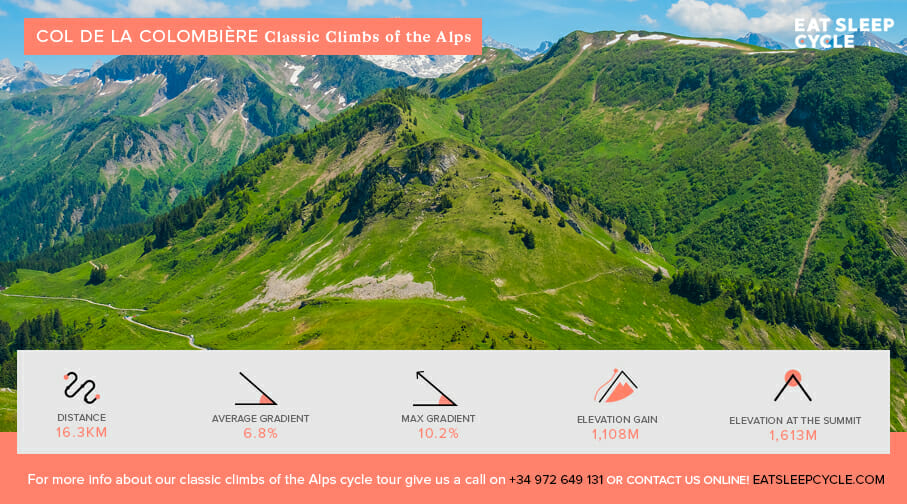
    Col de la Colombière

    North from Scionzier
    Featured in the 2018 Tour de France and La Course
    In the Arve valley near to the town of Cluses, Scionzer is where the Colombière starts proper. The climb can be split into two parts as there is an ‘easier’ point around half way with a plateau. The first section is under the cover of the forest and rises gradually from 3% up to 8% in the last few kilometres before it levels off. After, the road becomes a lot steeper with the gradient rising and rising up to the 10-11% slopes at the top. The rocky landscape gives way to make the summit visible from around 3km to go which can be both a blessing and a curse depending on how long the final few kms feel!

    Col de la Colombière Stats:

    • 16.3km
    • 6.8% average gradient
    • 10.2% max gradient
    • 1,108m elevation gain
    • 1,613m elevation at the summit

    Classic Climbs of the Alps - Col de la Colombière - Alps Cycling Tour

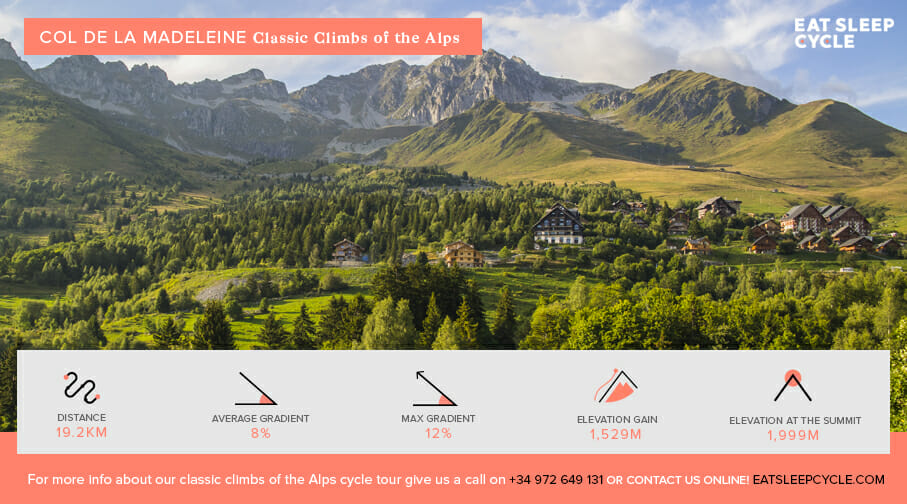
    Col de la Madeleine

    South from la Chambre
    The Col de la Madeleine is one of the most beautiful climbs in the Alps but it’s also one of the toughest. A brutal 19.2km at an average of 8% with 40 hairpins offers no respite; the saving grace is that the gradient remains pretty constant throughout meaning you can get into a (painful) rhythm.
    The climb regularly features in the Tour de France but was last used five years ago in 2013 on Stage 19 between Bourg d’Oisans and Le Grand-Bornand meaning it’s long overdue a visit!

    Col de la Madeleine Stats:

    • 19.2km
    • 8% average gradient
    • 12% max gradient
    • 1,529m elevation gain
    • 1,999m elevation at the summit

    Classic Climbs of the Alps - Col de la Madeleine - Biking Tour

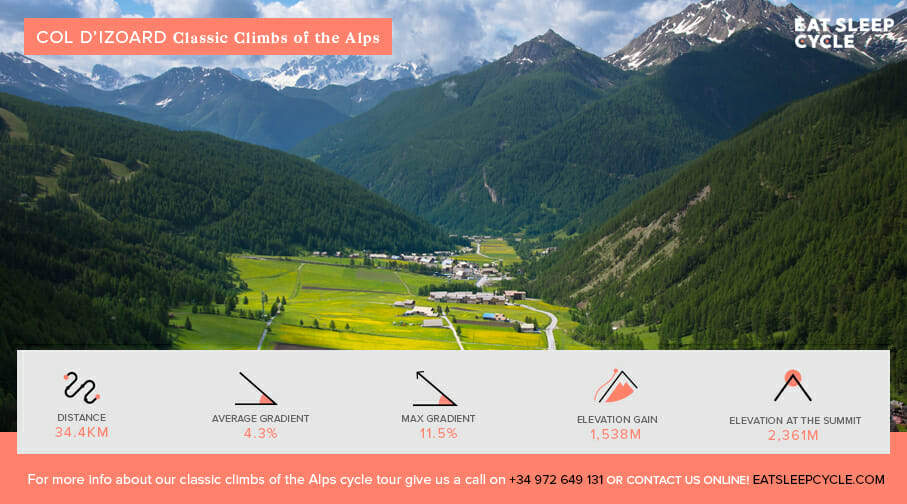
    Col d’Izoard

    South from Guillestre
    Col d’Izoard is steeped in cycling history, the Tour de France has featured the climb on 35 occasions but surprisingly only one of those was a summit finish. That finish was in 2017 and was won by French rider and polka-dot jersey winner Warren Barguil. On that same day even more history was made as the women’s pro peloton also raced to the summit with Dutch rider Annemiek Van Vleuten taking the win and posting a faster time than all but two male riders that day…
    The climb itself has a deceptively low average gradient of 4.3% which is due to the gradual lower slopes, but the climb proper begins after around 15 kilometres whereafter the gradient pushes up to between 7 and 11%. The scenery alone is worth summiting the Izoard for, from the dramatic Casse Déserte to the panoramic Alpine views that can be seen from the top.

    Col d’Izoard Climb Stats:

    • 34.4km
    • 4.3% average gradient
    • 11.5% max gradient
    • 1,538m elevation gain
    • 2,361m elevation at the summit

    Classic Climbs of the Alps - Col d’Izoard - Biking Tour

    Alps Cycling Tour Guides

    To set up our Alps tours we enlisted the knowledge of two people who know the Alps like we know Girona – inside out – meet our Alps Tour Leaders.

    Ed Greene:
    Two years living in the Alps honing his climbing skills while racing means Ed knows the area like the back of his hand. With racing now behind him he frequents France more for the boulangeries than the climbs and cafè and Croissant are now the most frequently used words in his extensive French vocabulary.

    Christian Vaughan:
    Christian feels very at home in the Alps and considers it his second home. He loves the variation of the small and massive climbs that reward with those fantastic ‘top of the world’ views. Top that off with the fabulous descents and there is no better way to spend a day on the bike. Experience is key in the mountains to ensure that you get the best from the route and weather.  High points—Col d’Izoard, Col de Sarenne, Col du Galibier. Christian also has extensive experience as an athlete, mechanic and coach.

    Cycling Vacation of the Classic Climbs of the Alps

    Cycling Tour of the Classic Climbs of the Alps

    If the these classic climbs of the Alps have peaked your interest then make sure to get in touch with us today! Take on all of these epic climbs and more guided by our expert leaders on our Classic Climbs of the Alps tour. Give us a call on +34 972 649 131 or contact us online for more info.

    P.S. Enjoyed this blog? Why not sign up to receive notifications every time we post and get regular updates on our latest tours!

  • Gran Canaria Cycle Routes – A Cyclist’s Paradise

    Gran Canaria is truly a cyclist’s paradise. The third-largest of the Canary Islands looks like it was designed by road cyclists for road cyclists with its smooth tarmac, quiet roads, minimal rainfall and temperatures in the mid twenties year-round. The island is only 100km West of Morrocco and on the same latitude as the Sahara, but while there are sandy beaches in the South it’s no desert, Gran Canaria’s landscape is extremely diverse, from volcanic and barren to green vegetation depending on where you are on the island. It may not be home to the biggest, hardest or most iconic climbs but Gran Canaria has a lot to offer and certainly isn’t lacking when it comes to riding uphill (a compact is essential).

    So why should your next European cycling holiday be in Gran Canaria? Take a look at our highlights and Gran Canaria cycle routes and see for yourself!

    The Valley of the Tears

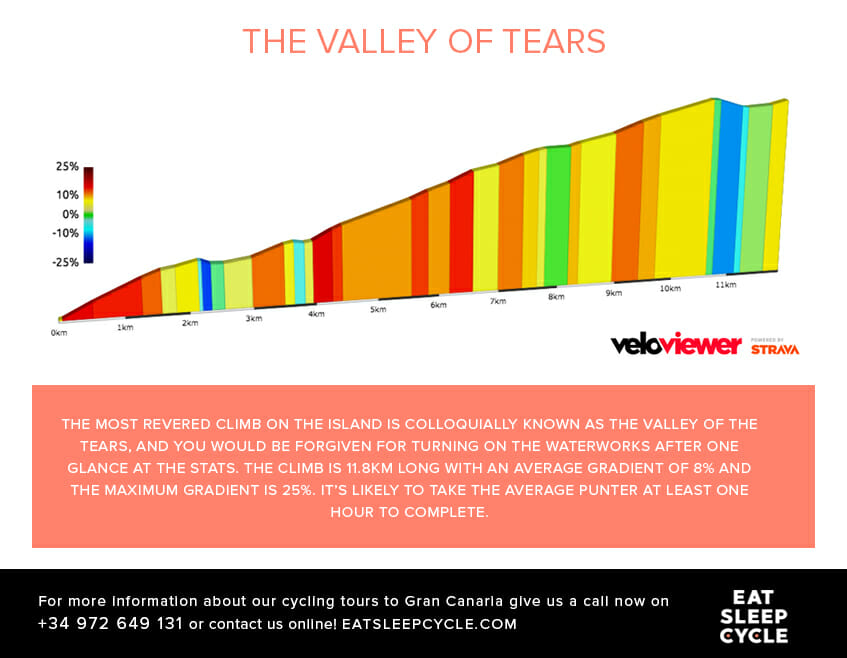
    The most revered climb on the island is colloquially known as The Valley of the Tears, and you would be forgiven for turning on the waterworks after one glance at the stats: The climb is 11.8km long with an average gradient of 8% (bear in mind that this includes sections of descent), the maximum gradient is 25% and it’s likely to take the average punter at least one hour to complete. VOTT starts tough, with 25% gradients; so don’t attack the bottom too hard – you will need that power later on!

    Gran Canaria Cycle Routes - The Valley of Tears

    Pico de Las Nieves

    The highest point on Gran Canaria and most commonly attacked from the town of Maspalomas on the GC60, the climb up to Pico de las Nieves is a long one: 40 km to be precise with an average gradient of 4.7%. The trick to getting through it is to break it up; the road lends itself to this as there are short descents interspersed throughout. With 11 km to go after joining the GC600 comes the hardest part of the climb, the gradients steepen drastically. At this point you will have the top and the Roque Nublo (rock in the clouds),an ancient sacred monument, in sight.

    There are several routes to the top of the island, each offering different views and a sizable challenge. The toughest ascent is via the village of La Pasadilla – it’s a tough climb and it’s rare you’ll have the company of another cyclist. Just what we like!

    Santa Lucia

    The climb up the GC65 through the village of Santa Lucia offers a steady ascent with great views and plenty of cafe stops. As all roads do in Gran Canaria the climb takes the rider to the centre of the island, via the village of San Bartolome (where riders on a shorter day can descend back to the coast) or continue on up to Ayacate where all cyclists congregate before attempting the final kms to the Pico de Las Nieves.

    Soria

    This is a beautiful climb connecting the coastal town of Arguineguin to the Tauro pass. With plenty of switchbacks the road begins with a smooth surface and gets a little rougher towards the top. A sharp left at the top takes the climber away from the village of Soria on a steep, broken & very beautiful road to the Tauro pass, where the cyclist can take a left and descend to Porto de Mogan or take a right and keep on climbing.

    Tauro Pass

    One of the prettiest climbs on the island this pass begins in Mogan. The views unfold as you climb the valley, with switchbacks galore and plenty of cyclists make for a friendly atmosphere of suffering as cyclists of all shapes and sizes & all types of bikes haul themselves up the road.

    Tenerife & Mount Teide

    For an ultimate day out consider taking the ferry to Tenerife & take on the tarmac to the summit of Mount Teide. At 3,718 m the volcano is the highest point in Spain & a mecca for pro & amateur cyclists from around the world. There are 5 routes up from sea-level, each one offering delightful 40 km routes through lunar landscapes & rock formations.

    Whilst some riders choose to base themselves entirely on Tenerife, Gran Canaria offers more variety & options, especially if you have the flexibility to explore the north of the island. Check out our Gran Canaria & Tenerife Experience for the ultimate Canary island exploration.

    Where to Stay

    Maspalomas

    The popular resort of Maspalomas has an eclectic feel, with golfers, an LGBT community, families, sun-worshipers & cyclists from all over the world all choosing Maspalomas as their base. In terms of cycling the resort offers the best location for riding unsupported with access to the widest variety of routes. There are good quality cyclist-friendly hotels offering spotless rooms and good customer service and is overall the best place to stay for a DIY cycling holiday.

    Porto de Mogán (above right)

    Porto de Mogan, known as the “little Venice of Gran Canaria”, is a fishing port home to many hotels and restaurants and of course, the beach! Take some well-deserved post-ride recovery time on the beach followed by dinner with a sea view. This is an idyllic spot and with only one road in and out makes for a tranquil spot to enjoy when not cycling. There are some great rides from Porto de Mogan but from a cyclist-perspective only 2 or 3 days worth of routes without taking a transfer or hiring a car to ride from a different spot.

    Agaete (above left)

    A lovely coast-side town in the northwest of the island, Agaete offers a peaceful place to stay away from the masses on the south. There is a volcanic beach and incredible saltwater rock pools which people bathe in all year around. The cycling from here is varied and there are lots of options. The north of the island typically experiences cooler weather than in the south with the chance of rain a little higher. But if you’re the type of cyclist looking for more of a tranquil retreat this is a great option for a base.

    Las Palmas

    The captial of the island is packed with history and culture and well worth visiting for a couple of days. There are some cycling routes in and out of the city but traffic is fairly heavy and so staying in Las Palmas if you’re purely looking for a cycling trip is not to be advised. Local cyclists tend to drive a few kms out of town to the coast and ride from there.

    Cruz de Tejeda (above centre)

    For a completely different experience stay for a night or two in the mountains in the centre of the island where there’s a Parador hotel. The hotel offers an amazing spa, infinity pool into the mountains an truly spectacular views. The variety of riding from this spot is second to none but pretty much every road starts downhill from the hotel which could make for a chilly start each morning. The temperatures are also cooler away from the beaches but could be well worth the sacrifice for the ultimate experience in relaxing places to stay.

    A Perfect Winter Cycling Destination

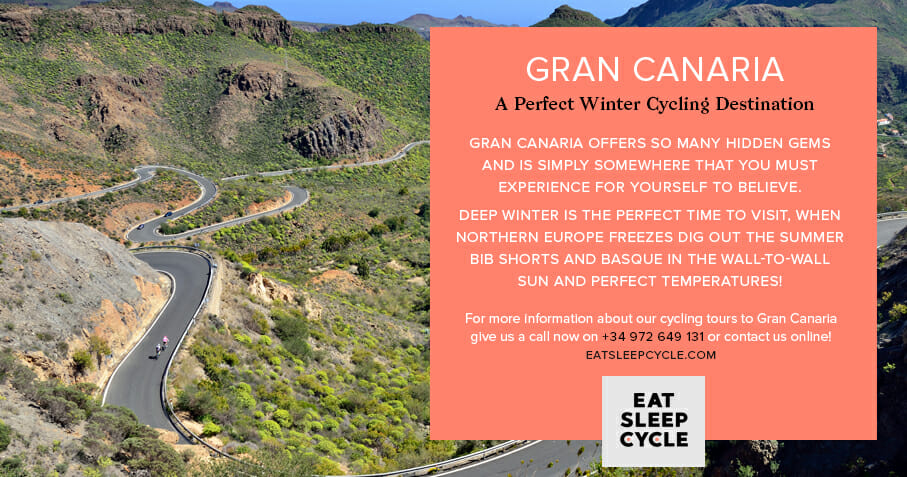
    Gran Canaria offers so many hidden gems and is simply somewhere that you must experience for yourself to believe. Deep winter is the perfect time to visit, when Northern Europe freezes dig out the summer bib shorts and basque in the wall-to-wall sun and perfect temperatures! Check out some top European winter cycling destinations here!

    Gran Canaria Cycle Routes - Winter Cycling Destination - Eat Sleep Cycle

    Gran Canaria Cycling Vacation

    If Gran Canaria sounds like your next European cycling vacation then take a look at our Gran Canaria Ride Camp tour. Give us a call on +34 972 649 131 or contact us online to find out more about a cycling tour to Gran Canaria!

    P.S. Enjoyed this blog? Why not sign up to receive notifications every time we post and get regular updates on our latest tours!

  • Let Down By Rapha Travel Cancellation? We Have A Solution For You..

    Have you had your 2019 Rapha Travel tour cancelled? At Eat Sleep Cycle we see ourselves as part of a wider global cycling community united by a shared passion for the freedom of riding. We understand what these bucket-list trips mean to hard-working cyclists all over the world who look forward to visiting some of the most famous cycling destinations. That’s why we’re extending a €100 discount on all 2019 tours to guests who have had a Rapha Travel trip cancelled*.

    Cycling Tours Similar to Rapha Travel

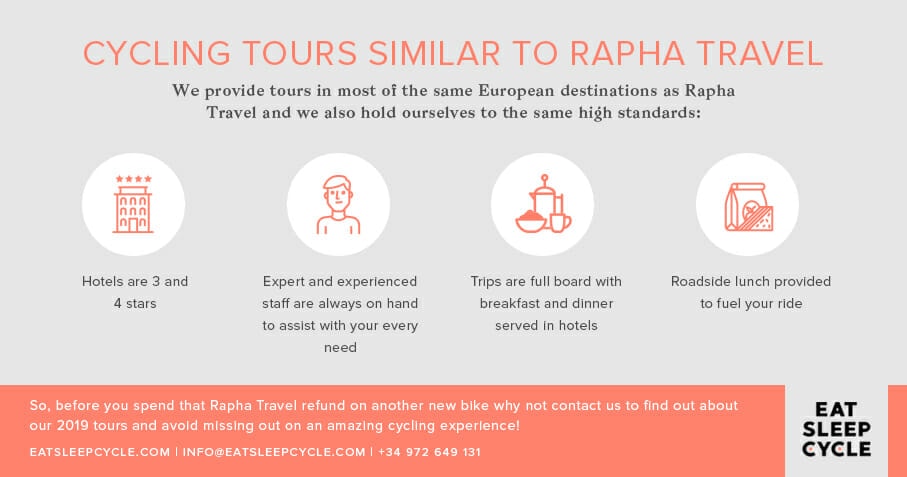
    We provide tours in most of the same European destinations as Rapha Travel and we also hold ourselves to the same high standards; hotels are 3 and 4 stars and our expert and experienced staff are always on hand to assist with your every need, trips are full board with breakfast and dinner served in hotels and a roadside lunch provided to fuel your ride.

    European Cycling Tours for 2019

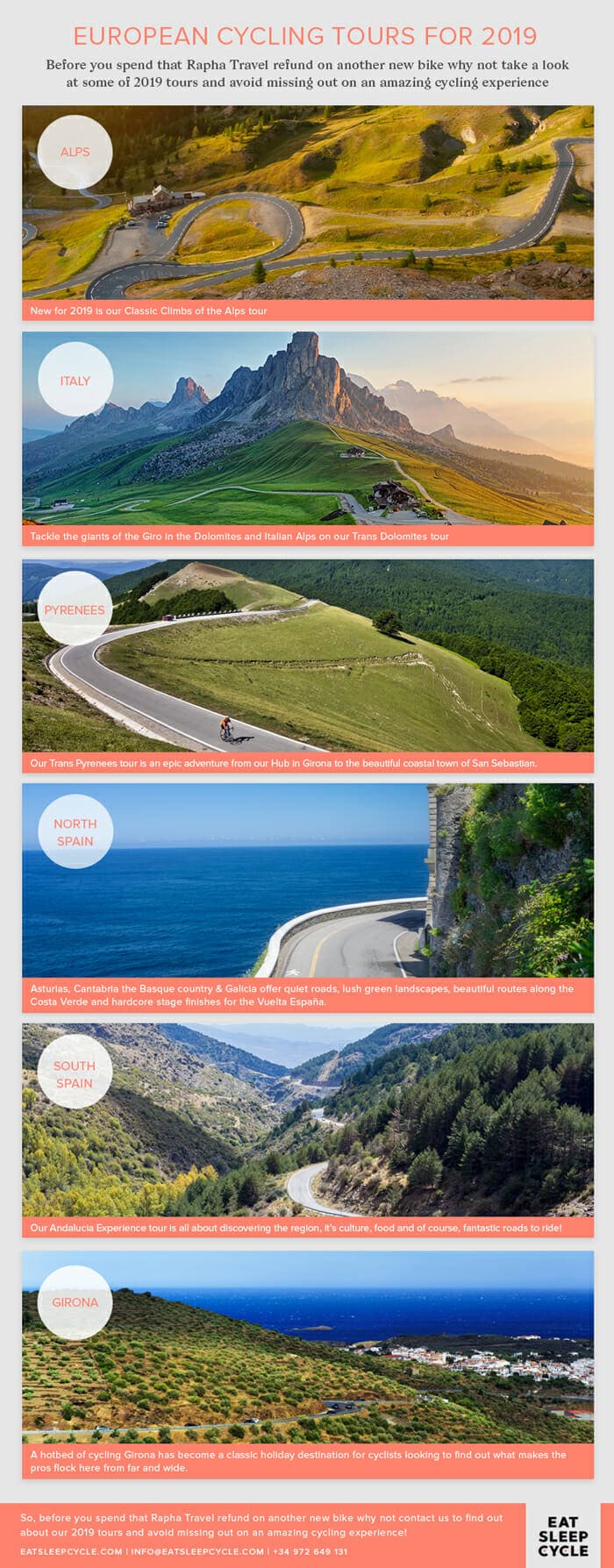
    So, before you spend that Rapha Travel refund on another new bike why not take a look at some of 2019 tours and avoid missing out on an amazing cycling experience:

    Alps
    New for 2019 is our Classic Climbs of the Alps tour: 7 days of fully supported guiding, stay in the best hotels and guesthouses in the region & sample delicious Alpine food. Highlights include the legendary Alpe d’Huez, Col du Galibier, and the beautiful lake Annecy.

    Italy
    Tackle the giants of the Giro in the Dolomites and Italian Alps on our Trans Dolomites cycling tour covering all of the classic history-soaked climbs including the Passo Dello Stelvio and the Zoncolan and of course, plenty of pizza!

    Pyrenees
    The Pyrenees are right in the back yard of our Girona base and provide some of the most varied and exciting terrain for cycling there is. Our Trans Pyrenees cycling tour is an epic adventure from our Hub in Girona to the beautiful coastal town of San Sebastian across some of the most stunning Pyrenean landscapes and including some classic Tour de France climbs such as the Tourmalet and Aubisque. Other tours we offer in the Pyrenees include our Womens’ Pyrenees, and Tour de France Experience.

    North Spain
    Asturias, Cantabria the Basque country & Galicia offer quiet roads, lush green landscapes, beautiful routes along the Costa Verde and hardcore stage finishes for the Vuelta España. The people of Northern Spain are open and friendly, the food hearty and delicious, making this unique region perfect for a cycling tour. We offer two tours in this region: Trans Asturias from Cangas de Onis to the Angliru, and Trans-Picos de Europa from Cantabria to Asturias.

    South Spain
    Southern Spain is the perfect destination for a winter getaway, when the rest of Europe is still stuck in the depths of winter look no further than Andalucia for some sunshine. Our Andalucia Experience cycling tour is all about discovering the region, it’s culture, food and of course, fantastic roads to ride! Alternatively, Trans Andalucia takes you from Grenada via the highest paved road in Europe, Pico de Veleta, through the Costa del Sol and to the coastal town of Nerja.

    Girona
    The heartland of Eat Sleep Cycle and a hotbed of cycling, Girona has become a classic holiday destination for cyclists looking to find out what makes the pros flock here from far and wide. Discover it for yourself on our Girona Cycling Experience tour and uncover the unique charms of Girona and it’s fantastic riding.

    European Cycling Tours for 2019 - Eat Sleep Cycle

    A Rapha Travel Alternative

    If you’ve been let down by a Rapha Travel cancellation then don’t fret, with our European cycling tours we’ve got you covered! For our full selection of 2019 tours visit our European Cycling Tours page for more details. For more information or to request a brochure contact us online or email us at info@eatsleepcycle.com and we’ll get back to you asap.
    Happy riding!

    *Proof of booking & cancellation with Rapha must be presented to claim discount.

    P.S. Enjoyed this blog? Why not sign up to receive notifications every time we post and get regular updates on our latest tours!

  • Guide to Cycling Rocacorba, Girona

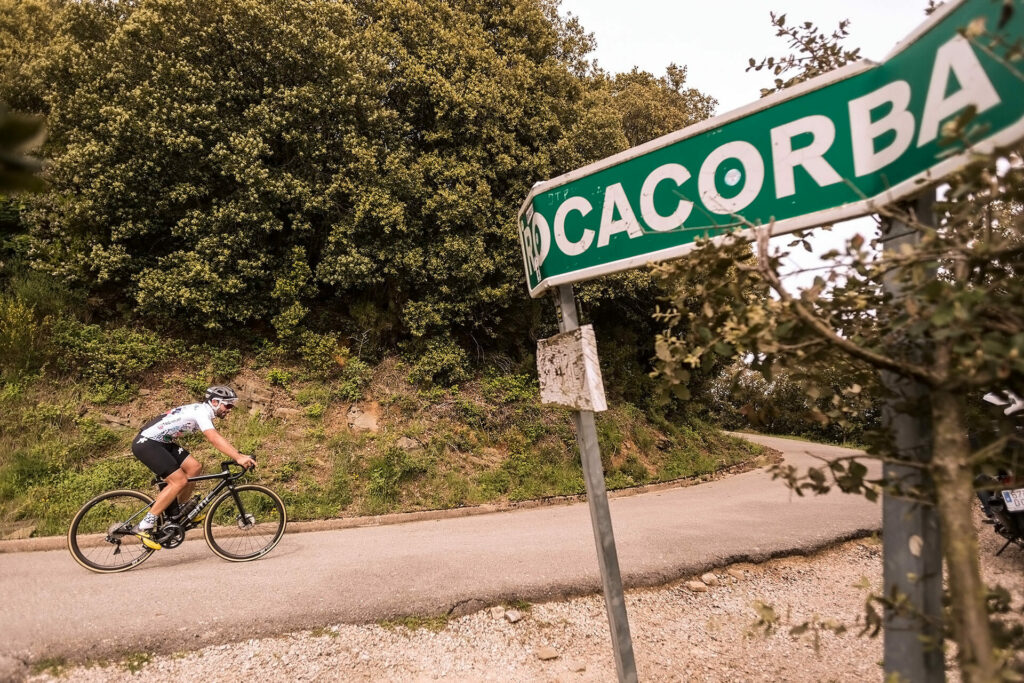
    20 km from Girona on a nondescript road in the outskirts of the town of Banyoles, overlooking the sparkling blue lake is the mountain of Puigsou, also known as the climb of Rocacorba. Once a well-kept secret amongst those in the know and only fully paved in 2006 it is now arguably one of the most infamous climbs in the Girona area and one of the first places people head to when visiting the city on two wheels.

    Rocacorba Cycling Climb History

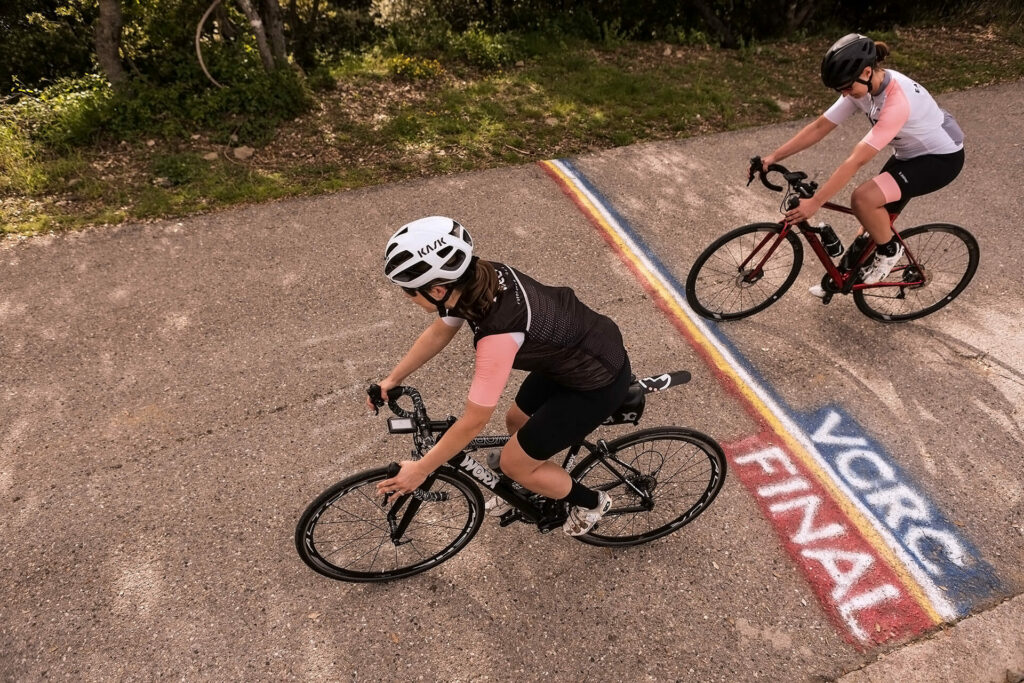
    Like many of the climbs in Girona the popularity of Rocacorba comes not from its association with huge grand tours and TV coverage but from a slowly built up reputation amongst the professionals who live and have lived here, perhaps none quite so much as David Millar, who founded the Velo Club Rocacorba. As the number of riders in Girona both amateur and professional continues to expand the so-called ‘secrets’ of the area become less so and Rocacorba is no exception.

    The fact that the proverbial cat is well and truly out of the bag with regards to Rocacorba is no surprise, the location itself carries enough of an appeal. Banyoles is worth riding to in itself, simply to soak in the beauty of the lake and surrounding area. In addition to its location, part of Rocacorba’s appeal is the challenge of the climb itself, there are few climbs in the area that begin to match it for the gradient and length. When you take the full 14 km into account the average gradient of 5.6% is laughably deceptive and hides the brutal reality of slopes of up to 15% for long periods. However, take the climb as 10 km, starting from the stone bridge over the Matamors river, cutting out the flatter bottom section and the average gradient is a far less forgiving 7%.

    Rocacorba Cycling Guide on You Tube

    Read on or watch our Rocacorba YouTube video here:

    Rocacorba Road Cycling Climb Profile

    Lets talk about the shape and profile of Rocacorba.  On the Strava segment it climbs 740 meters over 9.8 km at an average gradient of 8.4 %  While that sounds pretty good on paper, it isn’t a consistent gradient all the way up. One of the most challenging parts of the climb is the constant changes in gradients, making it difficult to find a nice rhythm.

    The first few kms are nice and steady, the road is shaded and follows the course of a river. Then the first of three tough sections kick in. The first two are around 4 km long each and the last one is 1.5 kms. The road is small and the tarmac is not in the best condition, it’s a climb that forces you out of the saddle to keep moving. In summer it’s like an oven and important to start the climb with two full bottles.

    The road ends at a metal gate, there’s space to pull over, a sign to take your photo at and a jump point for hang gliders. The view at the top is great – you can see out to the coast on a clear day and down to Banyoles Lake too. 

    Getting down requires special caution. It’s a dangerous descent that people regularly crash on.

    Road KOM / QOM

    Strava Segment: https://www.strava.com/segments/616746 The KOM is 26:20 and the QOM belongs to World Tour Pro and local who lives at the base of the climb. She is the only woman to break the 30 min mark at 29:16.

    How to Cycle to Rocacorba

    You’ll see a few ways to get to the base of the climb online.  There’s a really quick but less scenic way to get there when people want to use it as part of their training.  But, if you want a quieter and more scenic way to get there are a few alternatives. 

    1. My favourite way is via the backroads to Banyoles via Medinya, you still have to ride a few kms on the N-11 but it’s on a section with a wide hard shoulder. There’s also a new bike path on hard packed gravel which some road cyclist with wider tyres may be ok on.
    2. For a bigger day on the bike you can loop it in with other popular climbs in the area like Els Àngles or Mare de Deu del Mont.
    3. For a huge day out come and join us at our annual summer 3 Peaks Challenge, we ride Els Àngels, Mare de Deu del Mont and Rocacorba in one ride!

    Here’s the link to download the classic Banyoles Lake & Rocacorba loop: https://ridewithgps.com/routes/50433954

    Best Time to Climb Rocacorba

    When the roads are perfectly dry! And not in the heat of summer. When the road is wet it’s extremely dangerous and is best avoided completely.  With an altitude of 1,000 m the climb does not get snowy in winter, but can be icy, so the best time to climb is on a dry day in Spring or Autumn.

    Rocacorba Gravel Alternative

    If you’re feeling more adventurous and like REALLY steep grades there is a lesser known gravel route up Rocacorba. 

    To get to the gravel climb, ride out of Girona to the village of Canet d’Adri. After the village of Adri take a right turn onto the Cami de Biert and climb to the base of the track up. The climb is 5 km, with a tough average gradient of 10% and altitude gain of 500 m. The track climbs through the forest and max gradients can get up to 23%. The corners on the switchbacks are concrete which helps with traction. Join the road climb with 1.5 km to go. 

    Gravel KOM / QOM

    Here’s the Strava Segment for the gravel climb: https://www.strava.com/segments/13227628 The current records are 24:15 KOM / 30:05 QOM

    Coffee Stops On the Rocacorba Ride

    With a lakeside town of Banyoles not too far away, grabbling a post-climb coffee or cake is a great way to “refuel”.  My favorite place to stop in Banyoles is Banys Vells, the bar on the lake! It’s also really nice to pop to Banyoles town square where there are some great coffee places!

    Thanks to Bike Office Espana, Tomas Montes @arriere_du_peleton, Rocacorba Food Truck & Sergi Mas de Xaxars @de_xaxars for the fabulous photos.

    Want to take on Rocacorba yourself?

    No cycling trip to Girona is complete without an ascent of Rocacorba. To experience the challenge of Rocacorba yourself why not sign up to our Classic Climbs of Girona tour or simply hire a bike and book a local guide to show you the way.

  • Is the Vuelta better than the Tour? Here’s 6 Reasons Why We Think It Is

    It’s late summer in Europe, the season is drawing to a close, the classics are a distant memory, the excitement of the Giro and the Tour are behind us and something needs to fill the void: step forward La Vuelta a España. However, La Vuelta is more than just the poor relation to the other grand tours; Spain provides a fantastic landscape for cycling. Here’s why we think La Vuelta is better than it’s Gallic counterpart:

    1. It’s Unpredictable:

    A mix of those for whom luck or form wasn’t on their side at the Tour and are seeking that missing win, those searching form for the world championships and young guns itching to show off their ability makes for explosive racing. There have been 8 different winners of La Vuelta in the past 10 years, which is a testament to the variety of the racing.

    2. The Parcours:

    There’s no such thing as a siesta in La Vuelta! The Vuelta is known for being the preferred parcours of the climbers for good reason: shorter, punchier stages make for aggressive and exciting racing. Those who cured their insomnia during the 200 km+ formulaic sprint stages of the Tour can expect no such rest from it’s Spanish counterpart. Only one stage of the 2018 Vuelta is over 200 km in length and there are also 9 summit finishes to look forward to. Stage 20, up to the Coll de la Gallina in Andorra, looks to be the deciding stage with 4,000 metres of ascent in just 105.8 km.

    3. Crazy new climbs:

    Of the aforementioned 9 summit finishes in this year’s race 3 are brand new, the first is on Stage Four in the form of the 16 km long La Alfaguara climb in the Sierra de Huétor Natural Park. Next comes Les Praeres de Nava on Stage 14: 4.7 km at a grueling 13.5% average which is sure to get the pure climbers out of the saddle off the front. Lastly, the conclusion of Stage 17 will feature the debut of Balcon de Bizkaia after 166.5 km through the Basque Country.

    4. Riders are more accessible:

    La Vuelta’s marginally lower profile coupled with Spain’s rather more chilled attitude to life means that riders are not fielded around in such a tightly controlled environment compared to the Tour, which is good news for media and spectators alike as it makes contact with riders at the start and finish areas more accessible meaning chatting to riders and getting the obligatory selfie is easier…

    5. The weather!

    The Spanish late summer weather is perfect for both racing and spectating. The oppressive heat of mid-summer has dissipated but autumn cold is yet to draw in. If the Giro is known for adverse weather affecting the outcome and the Tour for its scorching July heat then the weather at the Vuelta is barely newsworthy when it comes to the race as you can expect middle-ground temperatures and sunshine. That being said look out for any Pyrenean and Basque stages where weather is never dependable!

    6. Emerging riders

    Younger riders who have performed well throughout the season are generally given a chance to prove themselves over three weeks at the Vuelta meaning we get to see the potential future stars in action. These riders also generally light up the race as they are keen to ride aggressively and justify their place on the roster.

    Like the sound of the Vuelta climbs? Here’s how to ride them with Eat Sleep Cycle:

    • La Gallina, Andorra – get up close and personal with the riders on our Vuelta Tour this September
    • Les Praeres – a feature in our Trans-Asturias epic.
    • The Balcon of Bizkaia – check out our soon to be released Tour of the Basque Country

    Liked this blog? Subscribe to receive weekly updates & don’t miss our Vuelta Series coming at you from the end of August.

  • Classic Climbs of Girona #4: Mare de Déu del Mont

    Girona is renowned as a cyclist’s paradise for a reason: the city provides the perfect base from which to explore the myriad climbs of the surrounding area as well as being home to a plethora of cafes and restaurants – and as we know, cyclists love coffee and food just as much as riding bikes! This is the first of a forthcoming series of blogs on the cycling highlights of the Girona area, and what better way to start than with one of the most iconic local climbs and a real favourite: Mare de Déu Del Mont.

    Let us first dispense with the problematic mouthful that is its name: Mare de Déu Del Mont literally translated, means ‘mother of God of the mountain’ and is actually the name of the shrine located at the top. A HC behemoth and one of the longest climbs in the area you would be forgiven for issuing forth a ‘Mare de Déu!’ of your own upon tackling the gradients of it’s upper slopes.

    There are two ways to take on Mare de Déu, the ‘easier’ route is from Cabanelles: 18.54km with an avg grade of 5%. The gradient is more constant and less gruelling on this side but there are also short descents and flats in places, which do provide welcome breaks but can mess up your rhythm (this is true of both sides). The bottom slopes are surrounded by woodland so there’s nothing much to look at but your own stem or whoever happens to be in front. As you gain elevation, however, the trees give way to some of the most stunning views around which coincides nicely with the most painful part of the climb so you can concentrate on picking out where you just climbed from instead of your burning legs. Indeed, one of the draws of climbing Mare de Déu del Mont is the spectacular scenery from the very top of its 1,093m summit which include panoramic vistas of the surrounding area including the Pyrenees in the distance, Banyoles Lake and, on a clear day, the Costa Brava coastline.

    The second route is through the Medieval town of Besalú, the charms of which make it worthy of its own blog, and I would recommend posing for the obligatory photos with the 12th century Romanesque bridge before Mare de Déu leaves you looking sweaty and knackered. From this side it’s 20km in length and the average gradient is still 5% although much of that comes from the flatter bottom section. After taking a right turn in Besalú the road edges upwards slightly before you reach the tiny town of Beuda where the climb begins proper. From there you need to choose your gear selection wisely as the narrow road can go from a descent to a 10%+ slope in a matter of one corner. After a few kilometres of this and a series of hairpins comes a junction – it will be very tempting to take a right and descend the other side down to Cabanelles but that won’t get you any glory or kudos from your mates so take the left and continue the climb following the same road as the Cabanelles side for the remaining 6.6km of 7-10% gradient to the top.

    It’s worth adding that, once you’ve enjoyed your fill of the scenery on offer from the top, the descent should be treated with great respect and care as the roads are narrow, steep, and twisty and there may be oncoming traffic.

  • Paddy Bevin Tour de France Diary; “Getting in the break is about skill, horsepower and luck”

    Tour de France Diary Stage 13, Bourg d´Oisans to Valence, 170k

    We´re edging higher into the double digits for stages completed and thankfully, yesterday offered a little more respite than the three days previous.

    There was more downhill than uphill, which is rare, but don´t think for a second we were out for a Sunday ´bunchy´!

    Yes, we covered 170k in an eye-watering 3 hours and 45 minutes….at an average speed of 45kph, bringing my saddle time up to a tidy 55 hours for the race so far.

    It was just about trying to keep my legs as fresh as possible in the hope I can get in a break soon.

    The long, hot stages in the Alps have taken their toll and the peloton is definitely tired now, and some more tired than others.

    Yesterday we managed to get Michal in the break and what a relief that was that the move went by the time we hit the base of the  cat three climb after 30k!

    In fact, the break went very early when escape artist Thomas de Gendt (Lotto Soudal) finally cleared the field with my Kiwi countryman Thomas Scully (EF Education First-Drapac).

    Michael and Dimitri Claeys (Cofidis, Solutions Credits) stormed across, the peloton gave them the green light and they were gone for much of the day.

    The fact they were gone before the cat three climb meant there was no real race up it and we in the bunch were all spared a big effort!

    Getting in a break is a complex mix of blind luck,  timing and skill.

    A rider high on GC is unlikely to get away, as is a sprinter because nobody wants to go to the line with them.

    Guys who have had their heads down in the race are given more slack, and Michael is one  of those. He skipped across at a perfect time, so his timing was right. 

    In short, if you´re strong as a horse you don´t need as much luck. If you´re not so strong, you need to be in the right place at the right time and get the nod from the bunch.

    Michael was the last man standing yesterday as the other three dropped off one by one. 

    Groupama-FDJ-led were among those really driving it on and with 25k to go it was clear Michael was never going to stay out there as his lead was cut to 30 seconds.

    He made one last effort to try and stay away by going really deep over a small climb but with a hungry pack containing Sagan, it needed a lot more than what Michael had left to survive.

    Still, he ended the day as the most combative rider and that was very fitting, given his efforts.

    Greg gave the sprint a decent crack and took fifth, which proves he is far more than a one-trick pony!

    Today we´ve another hilly one with an uphill finish on the cards. We start in Saint-Paul-Trois-Chateaux and finish in Mende with a total of 188k and 4 categorised climbs to get through.

    The stage is too hilly for a pure sprinter to win and could be one for the break so I´ll be trying to get in this!

    The categorised climbs are Cote du Grand Chataignier (Cat. 4, with an average of 7.4% and a distance of 1km), Col de la Croix de Berthel (Cat.2 with an average of 5.3% and a distance of 9.1km), Col du Pont Sans Eau (Cat.3 with an average of 6.3% and a distance of 3.3km) and Cote de la Croix Neuve (Cat.2 with an average of 10.2% and 3 km long).

    Let´s see how we go.

    Paddy