Category: Italy

  • A Guide to Summer Cycling Tours in the High Mountains of Europe

    A playground like no other. Explore the endless roads of Europe’s most impressive mountain ranges and discover giants such as the Col du Tourmalet, Col du Galibier and Vršič Pass. 

    Summer Cycling Tours in the High Mountains of Europ

    Preparing for a cycling tour in the European mountains is an exciting prospect: the jaw-dropping scenery, colossal climbs, breath-taking descents, the après-ride endorphins, and not to mention the chance to ride in the tyre-tracks of the best cyclists in the world… That’s some prime day-dreaming material. 

    This guide will provide an insight into some of the most renowned mountain ranges in Europe, including the Pyrenees, the Alps, the Julian Alps, and the Dolomites, and the Eat Sleep Cycle tours that could turn those daydreams into a quad-burning reality. You’ll also find essential information on weather conditions, packing tips, and the best bike for conquering these majestic mountains.

    Pyrenees Cycling Tours

    First of all, the Pyrenees Mountains. A natural border between Spain and France, home to Andorra and summiting at an impressive 3,404 metres, the Pyrenees promise some exhilarating riding. Cycling in the Pyrenees offers challenging ascents, rewarding descents and awe-inspiring vistas.

    Some of the best professional cyclists in the world train on its legendary climbs. These include the Col du Tourmalet, whose summit brushes the clouds at 2,115 m (one of the highest paved roads in the Pryenees), or Col d’Aubisque, a near 17-km climb that reaches at 1,709 m above sea level. These roads are buzzing with the sound of tyres on smooth tarmac and an orchestra of freehubs as riders descend at speed, and there’s no shortage of friendly competition.

    Alps Cycling Tours

    Next up, the Alps, Europe’s most renowned mountain range that each summer beckons cyclists from all over the world. Some of the iconic mountain passes, such as Col du Galibier and Col de l’Iseran, are often featured in the Tour de France. These alpine giants are two of the most well-pedalled climbs in this mountain range, standing at dizzying altitudes of 2,645 m, and 2,764 m above sea level respectively.

    Stunning views reward anyone who ventures up these Cols to get a taste of the deep-seated cycling culture that permeates these mountains in summer. The roads are literally painted with history, and summer transforms this landscape into a cyclist’s paradise. Drivers are respectful and the hotels are filled with other riders as the exciting prospect of the Tour de France looms just around the corner…

    Julian Alps Cycling Tours

    The Julian Alps border both Italy and Austria and are nestled in the heart of Slovenia. This often-overlooked mountain range is a hidden gem for cyclists of all disciplines and offers a true paradise for climbers, with picturesque peaks and valleys, pristine lakes such as Lake Bled and charming alpine villages.

    The Vršič Pass, Slovenia’s highest mountain pass, sits within the Triglav National Park and stands at an impressive 1,611 m. It’s around 10 km in length with an average gradient of 6.9% (cranking up to 14% on some sections), and boasts incredible views of teetering limestone rock formations, unexpected cobbled sections, tunnels cut through the mountainside and classic hairpin bends. 

    Dolomites Cycling Tours

    A UNESCO World Heritage Site, the Dolomites are a cyclist’s paradise. Located in north-eastern Italy, this impressive mountain range is renowned for its jagged peaks, dramatic cliffs and winding roads, and is just as popular in winter among skiers as it is in summer among cyclists.

    This alpine wonderland is home to world-famous climbs such as the Passo Pordoi and Passo Giau. The former stretches for 12.4 km (on the northern side), and culminates in a summit 2,239 m above sea level. The Passo Giau reaches similar heights, with an average gradient of around 9%. Both often feature in the gruelling Giro d’Italia. 

    When to cycle in the European mountains

    When preparing for a cycling tour in the high mountains of Europe, it is essential to look carefully at forecasted weather conditions. Although summer in these regions is generally mild, with cool mornings and warm afternoons, the weather can be unpredictable and is known to change from one climb to the next. In the days leading up to your visit, and on the morning of each ride, make sure to check the local weather forecast and dress accordingly. 

    Packing for a summer cycling tour in the high mountains of Europe

    The key concept to bear in mind here is… layers. Even in summer, weather conditions can be unpredictable, so it’s important to be able to layer up when temperatures drop, and shed layers when things heat up.

    Here’s a quick list of the basics you’ll need on your cycling tour in the high European mountains:

    • Short-sleeved jerseys and short culottes
    • Waterproof wind breaker
    • Gilet
    • Neck, leg and arm warmers
    • Gloves (for cooler temperatures and for protection) 
    • Socks (enough for a fresh pair each day)

    Some other essentials:

    • High-factor suncream and good-quality sunglasses
    • Two or three water bottles
    • Basic tools, a mini pump and spare inner tubes
    • Your favourite snacks and energy gels

    The best bike for mountainous terrain

    The right bike can make all the difference when riding in the mountains, and that means the right bike for you. In general, you’ll want a lightweight road or gravel bike with a wide range of gears to tackle steep ascents and varying gradients, and stay in control on the long descents.

    Make sure your bike is in excellent condition with recently-serviced brakes, a clean, well-oiled chain and good tyres suitable for varied road surfaces. You might even want to get a professional bike fitting done before the tour to ensure your saddle and pedals are positioned correctly to make riding will be as comfortable as possible.  

    Feeling inspired?

    Cycling in the high mountains of Europe is something you will remember for the rest of your life. In summer, these majestic passes and peaks come alive with the spirit and tradition of cycling culture given their prominence in world tours, such as the Giro d’Italia or the Tour de France. You’ll also need to be used to climbing to tackle the ascents and enjoy the experience, so make sure you get some training in before your visit.

    Take a look at our Eat Sleep Cycle tours for more inspiration:

    Trans-Pyrenees Challenge

    Classic Climbs of the Pyrenees

    Classic Climbs of the Alps

    Trans Dolomites Challenge

    Tour of Slovenia

    And if you’re inspired to ride, contact our travel experts for more information.

  • Cyclist’s Guide To Italy

    Italy has a special place in Eat Sleep Cycle history and we cannot wait to return to bring more of our amazing guests to this incredible country in the not too distant future. Italy has cycling deeply embedded in its culture & history. Capturing the depth of riding, the variety of terrain, the passionate cycling culture, the incredible food, the cycling industry in just one blog is pretty much impossible. But here I hope to give a tantaslising taste of what Italy can offer for the cyclist.

    Italian Cycling Regions

    Italy is packed with beautiful regions to explore by bike – there are high mountains & sparkling lakes in the north, beautiful vineyards, rolling landscapes & rustic farmhouses in the central region of Tuscany & stunning flat lands, mediterranean coast & whitewashed villages in the southern region of Puglia. Plus the Apennine mountains, the islands of Corisca, Sardina & Catania, the incredible Cinque Terre… the list is endless!

    Cycling in Northern Italy: Lakes & Mountains

    The north of Italy holds many delights and challenges for the cyclists. Not a place for beginners, the Alps, the Dolomites, Veneto, Piemonte & Lombardy offer off-the-scale-awesome riding.

    To the north of the lagoon city of Venice lie the towns of Conegliano, Basso del Grappa & Feltre, all fabulous bases for riding. From Bassano discover the beautiful Veneto region & climb the Monte Grappa, a great warm up for the high mountains.

    In the north east corner of Italy is a climb which inspires terror amongst the pro’s – Monte Zoncolan. The Zoncolan is a regular feature in the Giro d’Italia & the climb from Ovaro features a leg-busting 6km section which averages 15%.

    To the west lie the picturesque Dolomites, known around the world for stunning rock formations. A must-ride loop is the 54 km Sella Ronda from Corvara – one of the most beautiful rides in the world which features four mountain passes. The Sella Ronda loop forms a part of the annual Maratona del Dolomiti sportive – an epic ride which also features the iconic Passo Giau & Passo Falzarego.

    Continuing west we reach the Italian Alps, high mountains which include the 47 switchbacks of the Passo Stelvio, the eye-watering gradients of the Passo Mortirolo & the mighty Passo Gavia. These climbs are where the key battles of the Giro d’Italia are fought every year & are where cyclists become legend; remember Andy Hampsten cresting the Gavia in a snow storm to take the maglia rosa in 1988 & in 1994 the legend of Il Pirata was born when a young Marco Pantani launched a breathtaking attack on the Mortirolo.
    After the Alps it’s wise to head to the Italian Lakes and enjoy some rest & relaxation. But don’t be fooled – from lakeside hotels the only way to ride is around the lake or up & out. Be sure to pay homeage to the Patron Saint of Cycling at the Madonna del Ghisallo shrine & test your legs on the short but brutally steep Muro di Sormano. As well as regular vists from the Giro d’Italia the Lakes of Como, Garda & Maggiore also play host to the final monumnet of the season, the Giro de Lombardia.

    If you have any energy left, continue the adventure & head west again to Piemonte. Climb the gravel slopes of the Colle de Finestre, as well as the epic cols of Nivolet & Agnello. Drop down back to the Barolo wine region & savour the rolling roads & indulge in a spot of wine tasting to round off the northern Italian experience.

    Want to experience Northern Italy? 

    If you’ve got 3 or 4 weeks to spare this would be an incredible Grand Tour: fly into Venice, ride Trans Dolomites, hit the Italian Lakes for a week in Lombardy, then continue west to tour Piemonte. Fly out of Milan.

    Cycling in Central Italy: Tuscany

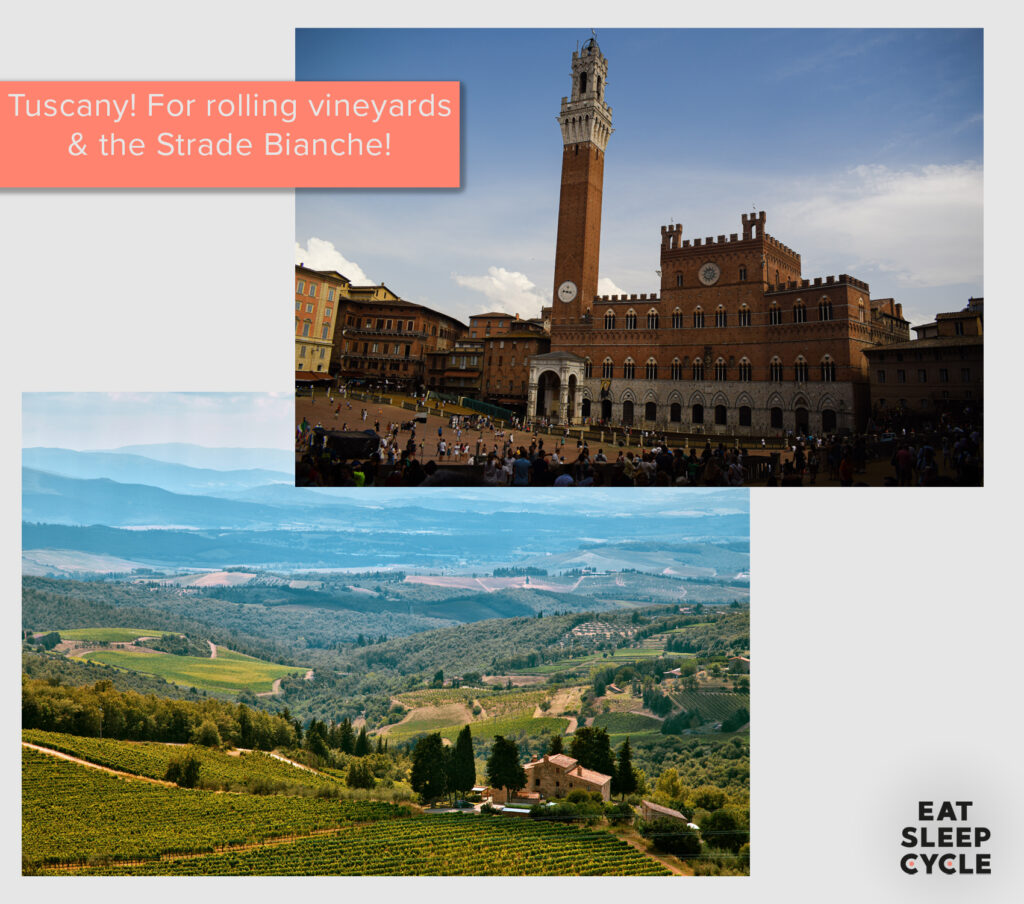
    For something altogether more relaxed explore the rolling landscapes of Tuscany. As well as making a great training ground for legendary Italian cyclists Bettini, Cipollini & Bartali, Tuscany is also well suited to lesiure riders & gravel lovers.

    Cycling-Tuscany-Eat-Sleep-Cycle-Strade-BiancheEvery year the city of Siena hosts the Strade Bianche, the southernmost Spring Classic of the calendar. Riders tear across the white gravel roads of the Crete Senesi region, tackle short, steep climbs & a fabulously technical parcours. The first rider to make it to the Piazza del Campo in the centre of Siena takes the honours.

    Tuscany is home to fabulous hotels, restored castles, Italian villas & rustic farmhouses. It’s the perfect place for cyclists who love food & culture to visit.

    Want to cycle in Tuscany?

    Join us for a long weekend of cycling in Siena for the Strade Bianche or ask us about our brand new Tour of Tuscany!

    Italian Cycling Heritage & Racing

    Giro d’Italia

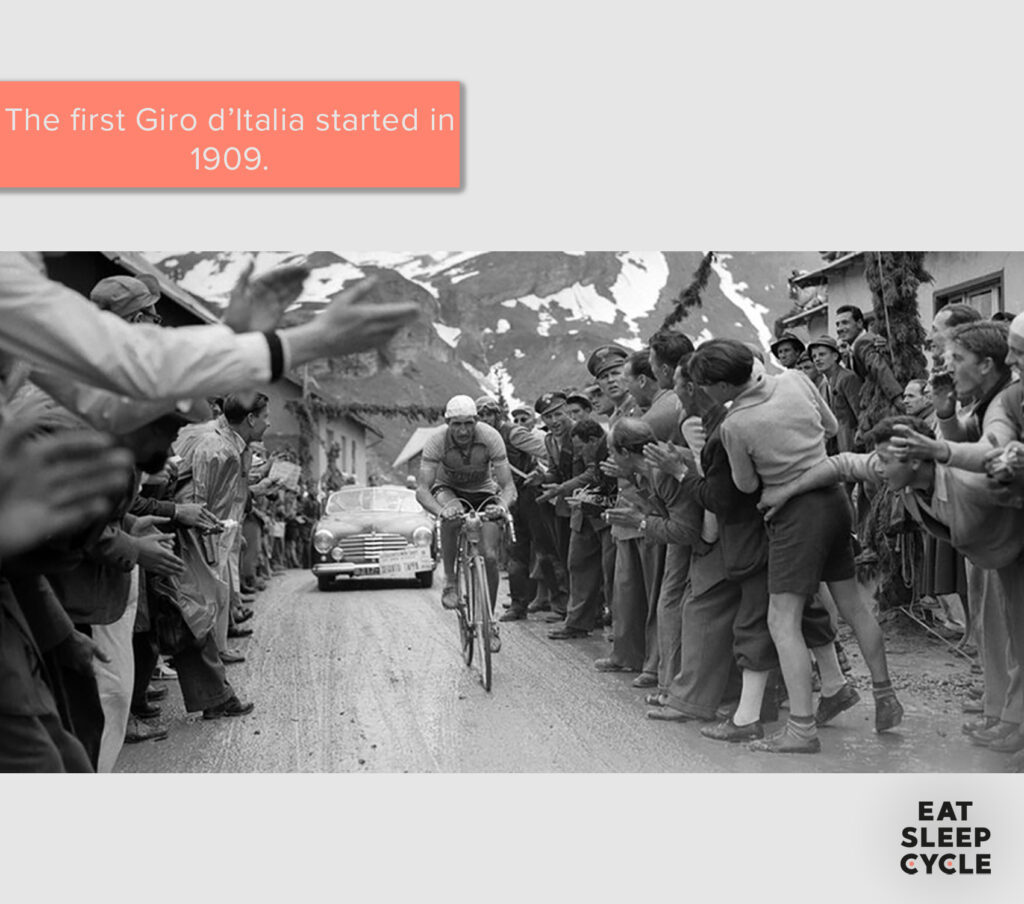
    Italy’s Grand Tour is usually a highlight of life in May. The race started in 1909 and grew from a an Italian-only race to include riders & teams from all over the world. A total of 49 riders won the first 2,448 km race, with Luigi Ganna taking first place. In the 1920’s Alfredo Binda was the dominant rider, and it took the Ironman of Tuscany, Gino Bartali to defeat him. Bartali’s dominance was only challenged in 1940 by his 20 year old teammate, the great Fausto Coppi. 10 years later, in 1950, Hugo Koblet of Switzerland became the first non-Italian to win the Giro. American Andrew Hampsten became the first non-European winner in 1988, and the first South American winner was Nairo Quintana of Colombia in 2014.

    Ask us about following the Giro d’Italia on a custom tour. 

     Italian-Cycling-Heritage-Race-History-Giro-d-ItaliaStrade Bianche

    L’Eroica Strade Bianche (“Heroic race of the white roads”) was created in 1997 as a granfondo for vintage bikes on the white gravel roads around Siena. The concept was to recreate cycling’s so-called “heroic era” from the first half of the 20th century, when most bike races were ridden on dirt or unpaved roads.

    The Strade Bianche is Italy’s youngest race on the World Tour calendar, but it’s quickly become a classic. The peleton races across the Tuscan countryside across a mix of country lanes & white gravel roads. The first edition rolled out in 2007, with a womens edition starting in 2015.

    Milan – San Remo

    One of the five monuments of cycling, Milan-San Remo was first held in 1907. The 298 km race is the longest one-day race in professional cycling and its flat(ish) course makes it a favourite of the sprinters. The course runs from the city of Milan across the plains of Piemonte & Lombardy, to the Liguran coast. The entire second half of the course has a view of the mediterranean as the race makes its way to the fashionable seaside resort of San Remo.

    Giro Lombardia

    If Milan-San Remo is the sprinters classic, the Giro Lombardia is the climbers classic, and the last monument of the season. Held in the autumn the race is also called the race of the falling leaves and started in 1905. The route has changed many times, with the only consistent features being Lake Como and the iconic Madonna del Ghisallo climb.Other famous climbs include the short but tough San Fermo della Battaglia and the 9.6 km Colma di Sormano.

    Made in Italy

    Italy in one of the major fashion houses of Europe & the same goes for cycling clothing. Itlay produces some of the world’s best fabrics & its no surprise that a multitude of cycling clothing is made in Italy and use this fact as a part of their marketing as a sign of quality.

    As well as clothing, Italy has several highly regarded bike brands. Institutions like Campagnolo, Bianche & Pinarello are proud of their Italian routes. Family run business Basso Bikes continue to proudly make their frames in a factory in Bassano del Grappa – a step up from the family garage where Alcide Basso produced his first frames.

    There is so much more to write about cycling in Italy – watch this space for our upcoming features on our favourite Italian cycling climbs & recommendations for the best places to stay, eat & drink!

    Do you want to find out more about cycling in Italy?

    As soon as you’re ready to travel we would love to show you around Italy! Check out our Italian Tours or give us a call now on +34 972 754 301 or contact us online for more info!

    P.S. Enjoyed this blog? Why not sign up to receive notifications every time we post and get regular updates on our latest tours!


  • Cyclist’s Guide to Cycling in the Dolomites

    In this post we’ll give you the lowdown on where to stay when cycling in the Dolomites, the climbs to tackle and the best time of the year to go.

    Nestled in the north-eastern region of Italy lie the majestic, jagged peaks of the Dolomites. These ‘Monte Pallidi’ or Pale Mountains consist of magnesium-rich limestone rock which glows a shade of pink or even orange in the light of a sunrise or sunset and are truly a sight to behold. The UNESCO World Heritage Site is also home to some fantastic cycling with the Giro d’Italia having taken more than 40 trips there since it first graced the region in 1937. Never boring, there’s barely a flat road in sight between the saw-like rocks which ensures that you can get a lot of bang for your buck in terms of elevation per km.

    Where to Stay While Cycling In The Dolomites

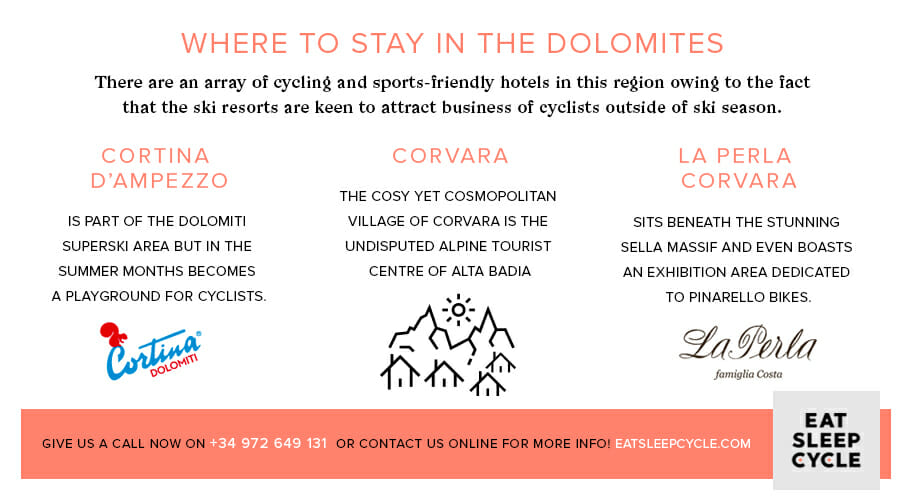
    There are an array of cycling and sports-friendly hotels in this region owing to the fact that the ski resorts are keen to attract business of cyclists outside of ski season.

    Cortina d’Ampezzo
    Cortina d’Ampezzo is part of the Dolomiti Superski area but in the summer months becomes a playground for cyclists, it is home to the Passo Tre Croci, Passo Giau and Passo Falzarego climbs.

    Corvara
    The beauty of Corvara and the surrounding area was discovered in the 18th century by mountaineers who would accompany the first hikers up to the peaks of the Dolomites. These visitors were mostly geologists and natural scientists from Great Britain who were interested in the unique landscape of the Dolomites. Nowadays the cosy yet cosmopolitan village of Corvara is the undisputed Alpine tourist centre of Alta Badia.

    La Perla Corvara
    La Perla Corvara sits beneath the stunning Sella Massif and even boasts an exhibition area dedicated to Pinarello bikes.

    Cyclist’s Guide to the Dolomites - Where to Stay in the Dolomites

    Bormio
    Whilst not technically in the Dolomites, Bormio is just a stone’s throw away and right on the doorstep of the legendary climbs of the Passo dello Stelvio, Passo Gavia, and the Mortirolo, so if you’re travelling to the Dolomites it’s well worth adding this area on.

    Cyclist’s Guide to the Dolomites - Where to Cycle in the Dolomites

    Where to Cycle in the Dolomites

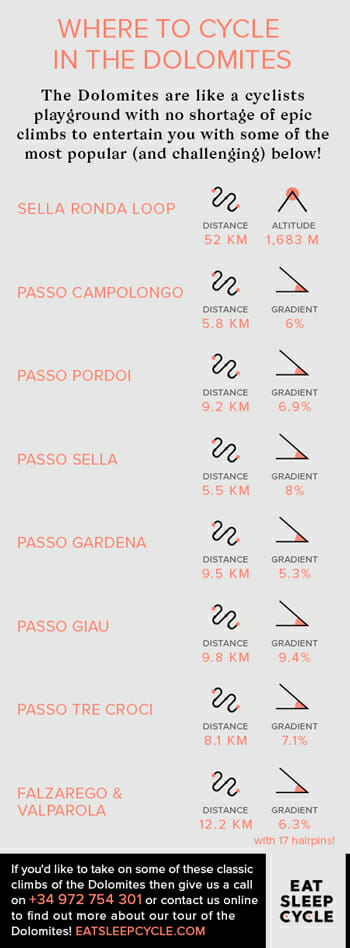
    The Dolomites are like a cyclists playground with no shortage of epic climbs to entertain you with some of the most popular (and challenging) below!

    • Sella Ronda Loop: 52km, 1,683m – perhaps the most famous ride in the Dolomites, the Sella Ronda Loop
    • Passo Campolongo: 5.8km at an average of 6% the Campolongo has some really unique and uncommon characteristics that set it apart.
    • Passo Pordoi: 9.2km at an average of 6.9% and never more than 7%. It also has a section of 22 hairpins in just 4.5km! Fausto Coppi memorial.
    • Passo Sella: 5.5km at 8% Passo Sella offers fabulous scenery including the Sella Massif walls and the magnificent Sassolungo Group
    • Passo Gardena: 9.5km at 5.3% average save your legs for this last climb of the day!
    • Passo Giau: Frequently featured in the Giro and also used as the penultimate climb in the famous Maratona del Dolomites sportive the Giau is a real challenge of a climb at 9.8km at an average of 9.4%.
    • Passo Tre Croci: 8.1km at 7.1%
    • Falzarego & Valparola: 12.2km at 6.3% with 17 hairpins!

    Climbs in The Bormio Area

    If you can travel to the Bormio area these climbs are well worth checking out!

    • Gavia: 17.3km at 7.9% rising to 2,621m of altitude.
    • Mortirolo: 12.1km at 10%
    • Stelvio: The Stelvio is one of the most iconic climbs of the Giro d’Italia and usually plays a pivotal role in the race. There are 20 hairpins on the climb from Bormio and 48 on the other side with steep ramps in between them!
    • From Bormio: 21km at 7%
    • From Prato: 24km at 8%
    • Umbrail Pass: 18.3km at 7.1%

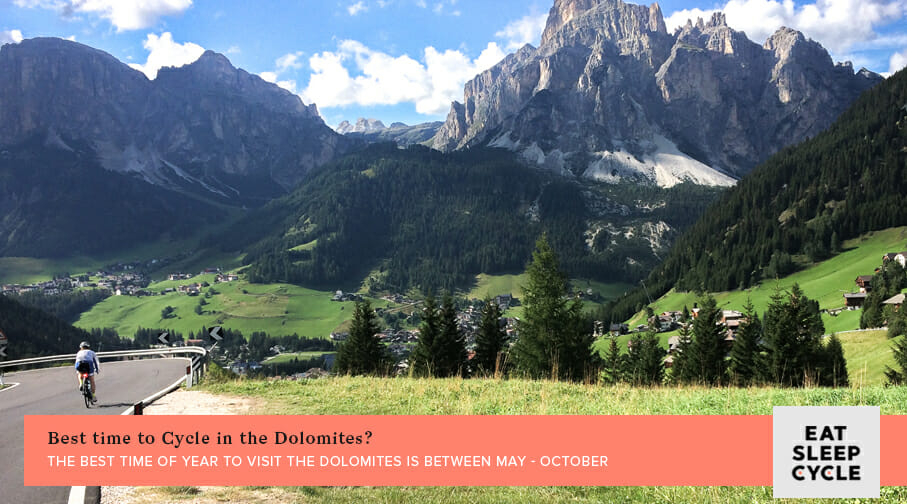
    Best time to Cycle in the Dolomites?

    The best time of year to visit the Dolomites is between May – October

    Cyclist’s Guide to the Dolomites - Best time to cycle in the dolomites

    Dolomites Cycling Tours – Packing A Punch

    The rich history and epic parcours that the Dolomites have to offer make it a perfect choice for those looking for a European cycling tour that packs a punch. As cyclists we seek out the suffering and the Dolomites bring it in spades – with high gradients and long ascents you are spoiled for choice. In addition to the fantastic riding, being in Italy means you are situated in the land of cycling-friendly cuisine as carb-laden Italian staples such as pizza and pasta are perfect pre-ride choice to make sure you never have to worry about bonking!

    To find out more about our Dolomites Cycling Tour give us a call now on +34 972 754 301 or contact us online!

    P.S. Enjoyed this blog? Why not sign up to receive notifications every time we post and get regular updates on our latest tours!

  • Point to Point Trans Cycling Challenges: Journeys of a Lifetime

    Trans Cycling Challenges, Point to Point Challenges, Journeys of a lifetime – there are many different names for them but there is one thing that is consistent: a Trans Cycling Challenge is an unforgettable, epic adventure! In this post we will explore which we think are the best.

    What is a Trans Cycling Challenge?

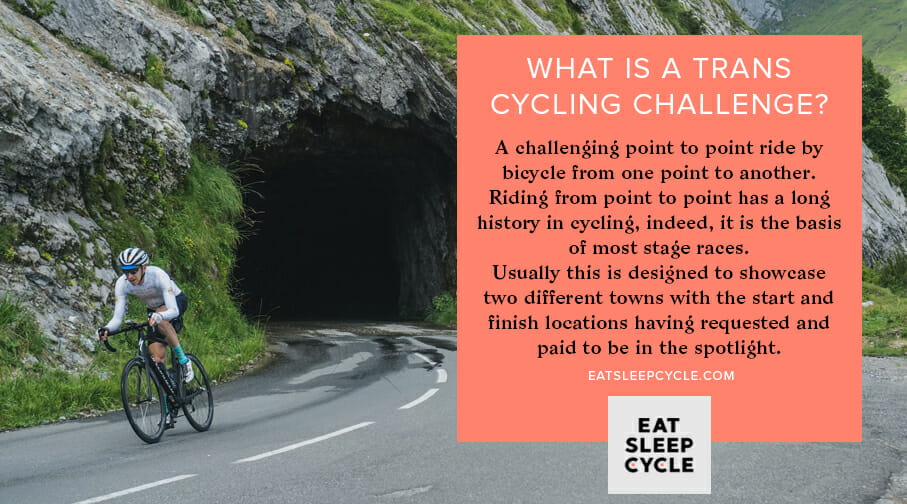
    A challenging point to point ride by bicycle from one place to another. Riding from point to point has a long history in cycling, indeed, it is the basis of most stage races. Usually this is designed to showcase two different towns with the start and finish locations having requested and paid to be in the spotlight.

    What Is A Trans Cycling Challenge - Eat Sleep Cycle

    Can a Cycling Challenge make a Good Holiday?

    But how do Trans Cycling Challenges translate to cycling vacations? There is a real sense of adventure in riding from A to B, using your bike to propel you from one place to another with an end goal in sight that is very different to simply riding loops out of one location. With the greater sense of adventure comes greater challenge and risk, and with that a huge sense of satisfaction from completing the journey.

    Riding a point-to-point route means you get to see more, each day brings a new challenge, a new location, new scenery to enjoy from the saddle and new cuisine to enjoy post-ride, it is the ultimate way to get the most out of a cycling vacation.

    Our Top Three Trans Cycling Challenges

    So, now that you know what a trans cycling challenge is and that they can make for great holidays let’s now look at our top 3 trans cycling challenges – the Trans Pyrenees, the Trans Dolomites and the new kid in town, the Trans Andalucia!

    Trans Pyrenees Point to Point Trans Cycling Challenges - Eat Sleep Cycle

    Trans Pyrenees

    This is the original Trans Challenge. The first ever Eat Sleep Cycle Tour was a version of our current Trans Pyrenees tour (from Girona to Biarritz) and it remains one of our absolute favourite routes to ride.

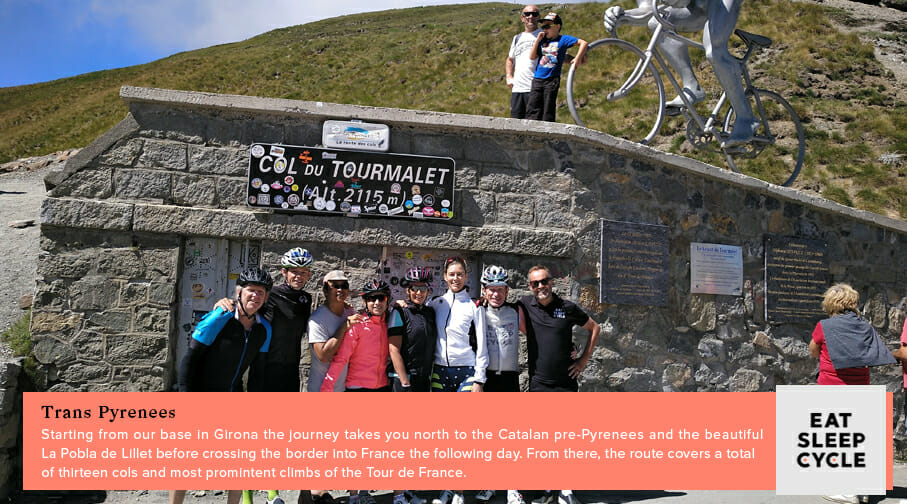
    Starting from our base in Girona the journey takes you north to the Catalan Pyrenees and the beautiful La Pobla de Lillet before crossing the border into France the following day. From there, the route covers a total of thirteen cols including some of the most prominent climbs of the Tour de France; the Col du Tourmalet, Col d’Aubisque, Col d’Aspin and more before reaching the final destination – the beautiful coastal city of San Sebastian.

    The characteristics of the Pyrenees mean that the landscape is rugged and varied, making for spectacular views and stunning climbs and descents which then give way to the rolling roads of the Basque Country.

    Trans Pyrenees Tour Highlights

    • La Pobla de Lillet –  a beautiful hidden gem in the Catalan pre-Pyrenees, this picturesque ‘pueblo’ is home to the Artigas Gardens designed by Antoni Gaudi and our accommodation of choice is El Castell de la Pobla de Lillet, a castle from the year 1297!
    • Col du Tourmalet – the iconic Col of the Tour de France is a must-ride for every cyclist looking to challenge themselves. This year featuring as a stage finish promising plenty of excitement!
    • The ‘Cirque du Litor’ – this is incredible section of road links the Col du Soulour to the Col d’Aubisque. Roughly translated as the avalanche circle, this is one of the last roads to open in Spring.

    Looking for more of a Cycling Challenge?
    The Raid Pyrenees is a 100 hour epic ride from the Atlantic to the Mediterranean via set check-points.

    Trans Dolomites - Point to Point Trans Cycling Challenges - Eat Sleep Cycle

    Trans Dolomites

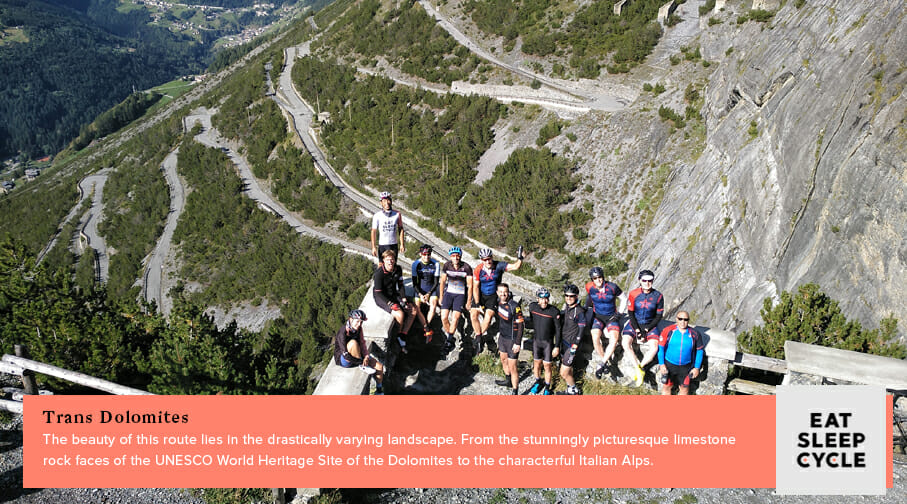
    The Trans Dolomites Challenge traverses the Carnic Alps to the Italian Dolomites and across to the Italian Alps. Bookmarked by the mighty Monte Zoncolan and the legendary Passo Mortirolo and Passo Gavia with a whole host of renowned climbs of the Giro d’Italia and beautiful scenery in between it promises to test and excite in equal measure.

    The beauty of this route lies in the drastically varying landscape. From the stunningly picturesque limestone rock faces of the UNESCO World Heritage Site of the Dolomites to the characterful Italian Alps that contrast with their polished French counterpart.

    Trans Dolomites Tour Highlights

    • Monte Zoncolan – the iconic climb of the Giro d’Italia, this beast is considered by many  to be the toughest climb in cycling!
    • Passo Stelvio – built in the years 1820 – 1825 this 48 km stretch of road connects the Valtellina in the south-west with Val Venosta in the north-east. Over 70 hairpins take the road to a leg-cramping 2,757 m altitude.
    • Passo Gavia – stunning, every changing, scenery and a pitch black tunnel characterise this 17.3 km killer climb. Perhaps best known for the heroic efforts of American Andy Hampsten who battled with apocalyptic, snowy conditions to seal the Giro d’Italia pink jersey in 1988.
    • Passo Mortirolo – synonymous with the late, great El Pirata – Marco Pantani – of whom you will find a tribute on the climb itself as you battle with the 10-20% gradients!

    Meet our local Guide in the Italian Mountains

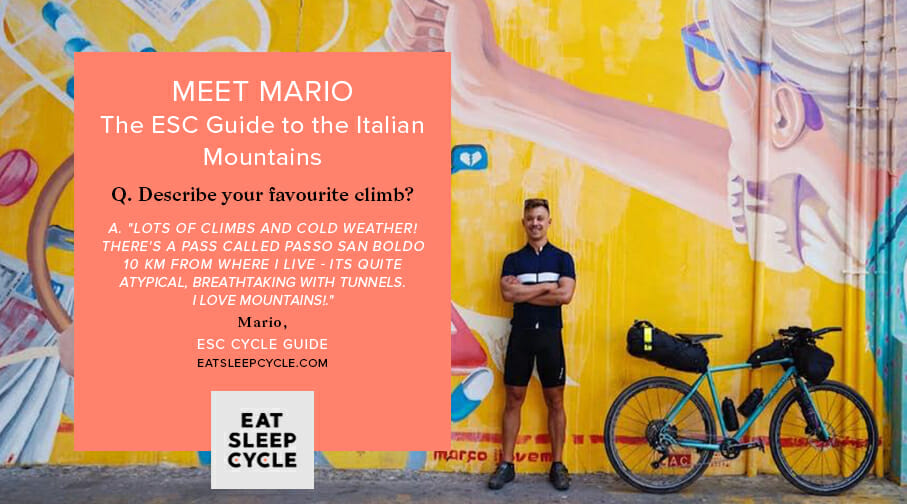
    If you book a Trans Dolomites Tour then there is a good chance you’ll meet Mario, our local guide to the Italian mountains!

    Italian Cycling Tour Guide - Mario - Eat Sleep Cycle

    Name
    Mario

    Where are you from?
    Italy – a little town called Conegliano, 40 km from Venice

    Where do you live?
    In my hometown

    What drew you to cycling and why?
    I’ve always be passionate about the bicycle. I started working for the French brand Mavic & I had to start practicing riding to be able to give feedback on the apparel and products I was selling. Since then it became my biggest passion.

    What’s your favourite thing about guiding?
    That I made a job out of my passion and the fact that I can share my time with people who share my same passion – it comes pretty easy to me.

    Describe your favourite climb?
    Lots of climbs & cold weather! There’s a pass called Passo San Boldo 10 km from where I live – its quite atypical, breathtaking with tunnels. I love mountains!

    Tell me about the best meal you’ve had in Italy
    My Grandma’s – torn between risotto & sausage & potato – she was also from the mountains so its a typical dish.

    What do you do when you’re not cycling?
    In the winter when its too cold to cycle – I’ve been a cross-country skier since I was a kid so when I have a chance I head to the mountains.

    Trans Andalucia - Point to Point Trans Cycling Challenges - Eat Sleep Cycle

    Trans Andalucia

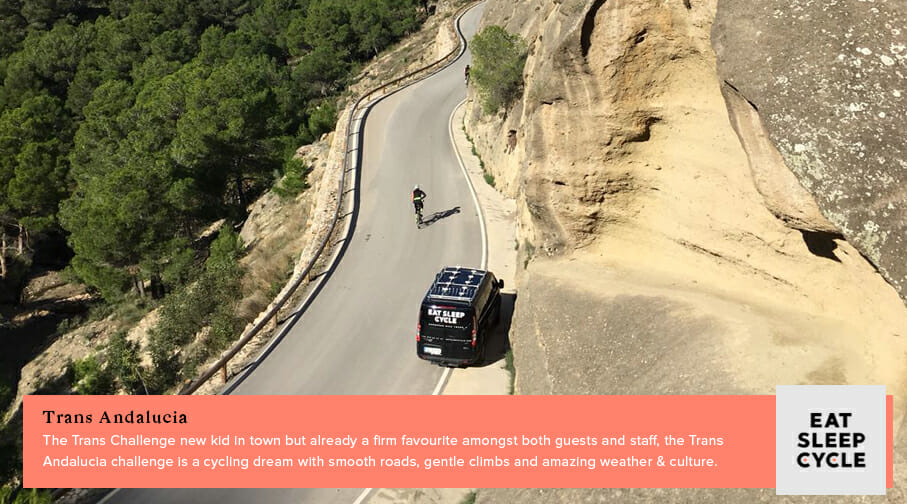
    The Trans Challenge new kid in town but already a firm favourite amongst both guests and staff, the Trans Andalucia challenge is a cycling dream. We recently waxed lyrical on this blog on the beauty of cycling in Andalucia, the smooth roads, the gentle climbs, the weather and the culture together make it a paradise for a cycling holiday.

    Starting from Almeria and heading west to Seville via the Sierra Nevada mountains, Granada, the ancient Moorish city of Antequera, Ronda & Arcos de la Frontera it is a tour filled with as much cultural interests as riding, not to mention the food!

    Trans Andalucia Tour Highlights

    • Caminito del Rey – The 2015 Vuelta was the first road race to visit the ‘Pathway of the King’. Short and sweet is the best way to describe this 4 km climb. With ramps of up to 15% legs are likely to sting as the road winds its way up to a restaurant and a dead end.
    • Ronda – The mountaintop city famous for its Moorish history and the iconic Puente Nuevo bridge over a deep gorge which separates the new and the old town.
    • Granada – There is yet more history to discover in Granada famous for the stunning Alhambra, which started life as a fortress, before being transformed into a palace in the mid 13th century.

    Trans Cycling Challenges – Start Your Journey Now

    Each of the Trans Cycling Challenges about will give a cycling experience like no other and all of our tours can be tailored to your needs. If you’d like to start the journey of a lifetime give us a call now on +34 972 649 131 or contact us online for more info!

    P.S. Enjoyed this blog? Why not sign up to receive notifications every time we post and get regular updates on our latest tours!

  • The Charms and Challenges of Northern Italy

    It may have been a few weeks since the mountain passes of Northern Italy brought drama to the Giro d’Italia but the impact of the iconic climbs remains just as strong. It’s difficult to separate them from the three week grand tour as they never fail to incite gripping racing but you don’t have to steam through them at the pace of a World Tour peloton to appreciate their might.

    Just as the Giro is considered the ‘hipsters’ grand tour, the Italian Alps and the Dolomites, although hugely popular, are somewhere to go for something different. Many people have experienced the French Alps and the Pyrenees, which are considered some of the more traditional European locations for cycling tourism, but those who seek the road somewhat less peddled are looking to Northern Italy for their next two-wheeled adventure. The region offers a plethora of mountain passes which are both stunning and challenging in equal measure. Here’s a lowdown of some of the most iconic climbs Northern Italy has to offer:

    Passo di Gavia

    Over 20km long, with a maximum gradient of 16% and an average of 7% it is perhaps most noted for the 14th stage of the 1988 Giro in which American rider Andy Hampsten cemented his place in cycling legend by tackling a blizzard to ride to victory.

    Passo Stelvio

    The Stelvio is the highest peak in the Eastern Alps at 2,757m and if you climb it from Prato dello Stelvio there are a whopping 48 hairpins! This is a climb that should be on every cyclist’s bucket list but at 24.3km long with an average gradient of 7.4% it’s not for the faint hearted!

    Passo di Mortirolo

    The Moritrolo is synonymous with Marco Pantani and there is even a monument honouring “Il Pirata” located in Piaz de l’Acqua, 8km from the summit. The climb is 12.8km at an average of 11% with pitches up to 18% – Lance Armstrong described it as “the hardest climb I have ever ridden” for a reason!

    Monte Zoncolan

    Known for its steepness, Monte Zoncolan is the climb that shook up this year’s Giro d’Italia with Chris Froome taking an unexpected win after seemingly suffering up until that point. Dubbed “The Pink Dragon” after it was featured in the 2003 Giro it is definitely fiery!

    Passo Giau

    Frequently featured in the Giro and also used as the penultimate climb in the famous Maratona del Dolomites sportive the Giau is a real challenge of a climb at 9.8km at an average of 9.4%. The road is in fact relatively ‘new’, only built and paved in 1986 but nevertheless it is still just as revered as the other great climbs.

    The rich history and epic parcours that the Dolomites have to offer make it a perfect choice for those looking for a cycling tour that packs a punch. As cyclists we seek out the suffering and the Dolomites bring it in spades – with high gradients and long ascents you are spoiled for choice. In addition to the fantastic riding, being in Italy means you are situated in the land of cycling-friendly cuisine as carb-laden Italian staples such as pizza and pasta are perfect pre-ride choice to make sure you never have to worry about bonking!

    So, if you’ve already attacked the French Alps and passed through the Pyrenees or you’re looking for something a little different or challenging look no further than Northern Italy!

  • Passo Stelvio & Eat Sleep Cycle

    Stevio has a special place in Eat Sleep Cycle history. Eat Sleep Cycle founder Lee shares why on our recent recce tour of the Dolomites.

    Yesterday was a very special day for Louise and I and also a turning point for Eat Sleep Cycle.

    At the crack of dawn and in single digit temperatures, we rode from Bormio into the clouds to reach the snow capped Stelvio peak. Since we rode this climb 3 years ago we have admired the photo canvas of it on our lounge wall and said “we need to go back there”. It is jaw dropping and beautiful, epic and so hard! I just love the way the scenery changes through the valley, after one set of switch backs and another and another…

    Three years ago I had invited Louise to Italy for a cycling trip. It was the end of the race season and we wanted to get away and enjoy some leisure cycling. So I planned the Stelvio and Maratona routes of course. Louise had no idea what she was in for, but mountains would quickly become an important part of our lives.

    The first morning of our trip we loaded up with my mountain powder (a horrible concoction of pure electrolyte and fructose) and hit the climb. The night before I’d had nightmares of her smashing me on the climb (which later became the inspiration for our Eat Sleep Cycle logo). At the top, Louise was freezing so we huddled up in the cafe up the steps. We rode down the other side and after some cake and 2 espressos shared our first kiss.

    Yesterday was our one year anniversary and riding up Stelvio together was the best anniversary present for both of us. We rode up side by side from the Prato side and as a commitment to our future together stayed together the whole way up. This was all possible because Brian is back at base managing the HQ – without this man none of this would be happening.

    Our trip to Italy has also opened a new door for Eat Sleep Cycle and we are excited about the future. We have been working in Girona and the Pyrenees and now we will work in the Italian alps and Dolomites too. These mountains are what made our brand and it’s where Louise and I forged our relationship so it feels exactly the right thing to do.

    A few years later… our Classic Climbs of the Giro tour is up and running, as well as our epic Trans Dolomites Challenge. You heard it here first why Eat Sleep Cycle loves Italia!