Blog

  • Classic Girona Cycling Routes

    Girona is an inexhaustible playground for cyclists with myriad quiet roads to explore and challenging climbs to tackle. There’s a lot to be said for going off the beaten track here and exploring the hidden gems of the area. However if you’re here on a European cycling holiday with minimal time then you’re going to want to make the most of your stay, and that means ticking off the some of the classic Girona cycling routes on road & gravel!

    Girona Road Cycling Routes

    Leisure Girona Road Cycling Route – Sant Andreu Salou Lanes

    The Sant Andrey Salou Lanes loop is for those who enjoy flat terrain, peaceful countryside and rural Catalan villages. The ride traverses South through Plaça Catalunya and across the river to exit Girona towards Quart and on to the completely quiet roads of Llambilles and Campllong. After around 20km you will reach Cassa de la Selva which is the biggest town on the route and therefore the best chance for a coffee stop! After, head to Sant Andreu Salou before riding along the peaceful road to the picturesque town of Caldes de Malavella. From here, the route loops back up towards Campllong into Fornells de la Selva and back into Girona. This is also a perfect warm-up ride for those starting a week of riding.

    Sant Andreu Salou Lanes – Route Info

    Intermediate Girona Road Cycling Route – Els Angels & Santa Pellaia

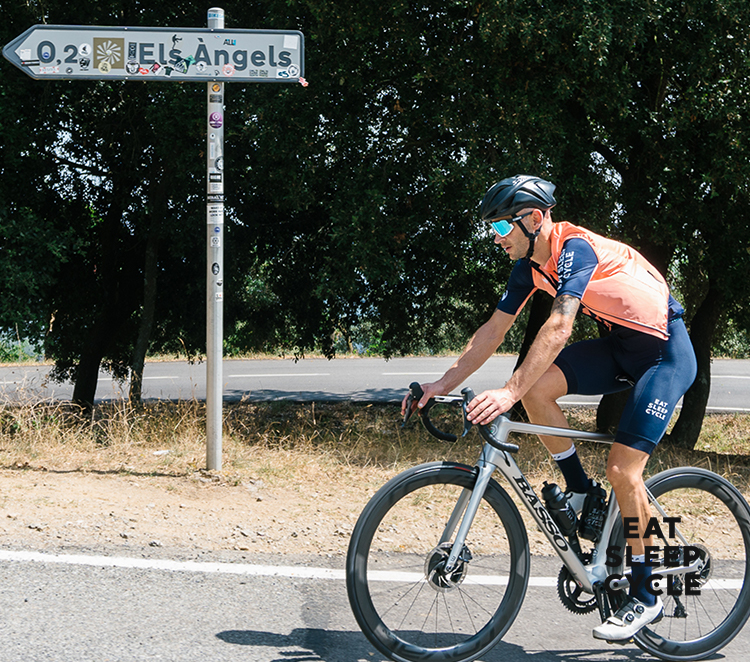
    This is a real Girona favourite among pros and leisure cyclists alike, the two climbs are both gentle on the legs and surrounded by beautiful scenery. Ride out of Girona keeping the river on your right and take a left at the roundabout to start the first climb: Els Àngels: a gentle 10km at 3.4% average gradient. Be sure to grab a coffee at the top and take in the stunning views of Girona before descending down the other side into the medieval town of Madremanya and onto the rolling country lanes to Monells. After the village of Sant Sadurní comes the next steady climb: Santa Pellaia, which consists of 6km at an average gradient of 4%. After enjoying the views from the top descend into Cassà and towards Caldes de Malavella via the two charming towns of Sant Andreu Salou and Fornells de la Selva.

    Els Angels & Santa Pellaia – Route Info

    Advanced Girona Road Cycling Route – Costa Brava Classic

    A bona-fide Girona classic, leaving Girona without riding the Coast Loop is like going to Paris without seeing the Eiffel Tower – it’s a must ride! The route heads South out of town before reaching the tranquil roads through Fornells de la Selva and Sant Andreu Salou and onto Caldes de Malavella. Head towards the town of Llagostera from where, shortly after you will reach the 10km climb of Sant Grau which reaches 8-9% in places. After Sant Grau comes one of the highlights of this route: the descent along the coast road with fantastic views of the sea. At the bottom of the descent you will be heading towards Tossa de Mar and cruise along the beach front or stop for ice cream or lunch. However, it’s best not to overfill your stomach as you will be tackling an 8 km climb out of Tossa towards Girona. The remaining 35 km is on the familiar roads from the way there.

    Costa Brava Classic – Route Info

    Girona Road Cycling Route Map

    To see more routes & download the tracks, follow the QR codes below to our route bank on Wikiloc:
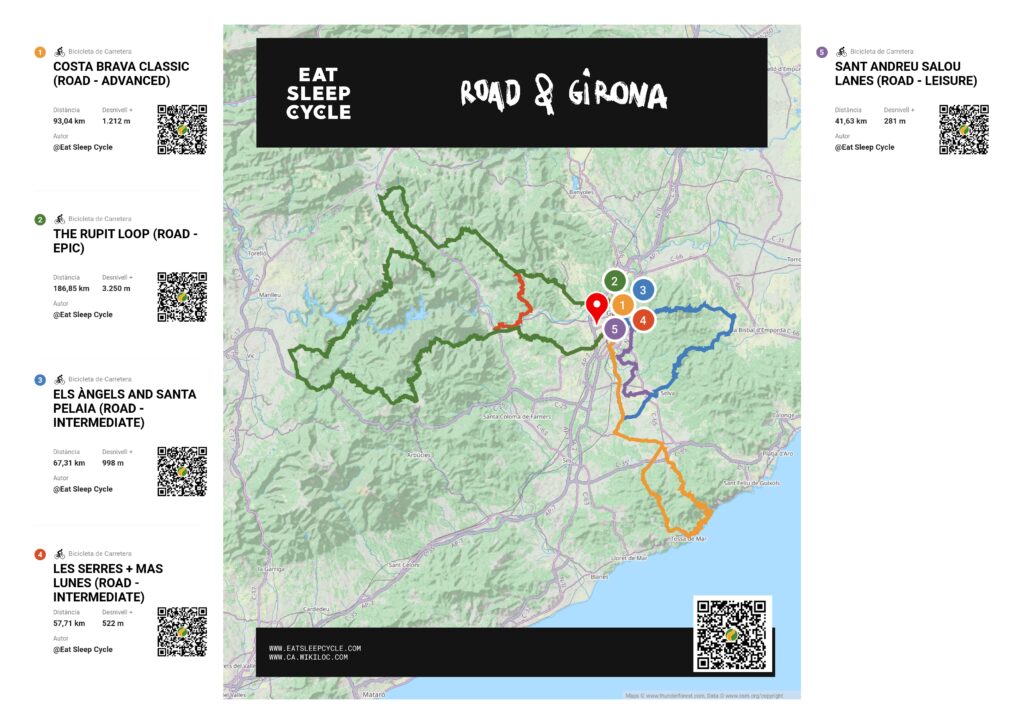
    Girona-Road-Cycling-Routes-Eat-Sleep-Cycle

    Ride Girona’s Classic Road Routes with Eat Sleep Cycle

    If you’re looking to take the stress out of planning and navigation then take a look at our Girona Bike Tour packages. Choose one of our classic itineraies or contact us to tell about what your dream trip to Girona would look like – we specialise in custom tours!

    Girona Gravel Cycling Routes

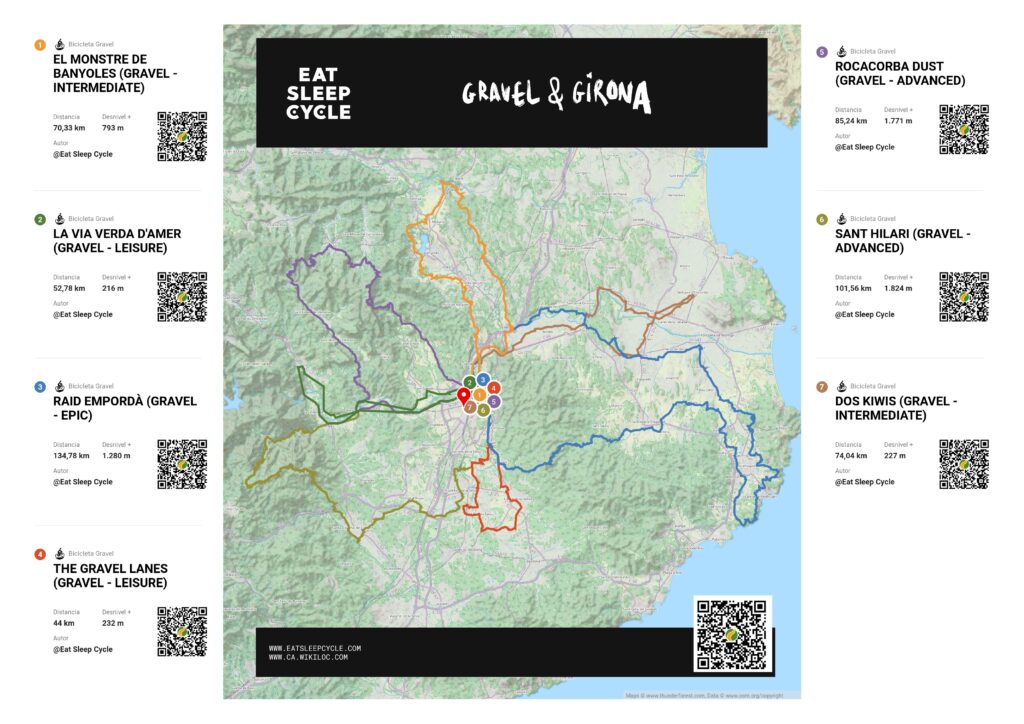
    Leisure Girona Gravel Route – Amer

    This is a route ideal for a hot day – follow bike paths out of town and follow the river upstream. Ride through teh village of Bonmati and continue to Amer – stop for coffee & food in the historic town square, then return back through Àngles and Bescano.

    Amer – Route Info

    • Distance: 52 km
    • Elevation: 216m
    • Fitness Level: Intermediate 2/4
    • Skill Level: Easy 1/4
    • Download: Eat Sleep Cycle Wikiloc

    Intermediate Girona Gravel Route – Rustik & Dos Kiwis Empordà Classic

    A stunning ride that is as flat as they come. Roll out of Girona along the banks of the River Ter. Ride through forests & across farmlands to Rustik – the coffee is great & so are the snacks! Return through picturesque villages and consider a stop at the Dos Kiwi’s brewery at km 50. There are delicious beers & kombuchas as well as a food truck in the garden. Return back through ‘stick farm’.

    Rustik & Dos Kiwis Empordà Classic – Route Info

    • Distance: 74 km
    • Elevation: 227m
    • Fitness Level: Intermediate 2/4
    • Skill Level: Intermediate 2/4
    • Download: Eat Sleep Cycle Wikiloc

    Advanced Girona Gravel Route – Rocacorba Dust

    This is a route for experienced gravel riders looking for a serious challenge. Rocacorba is tough enough on road, but on gravel it’s eye-watering. Ride out of Girona west along the via verde to Bonmati. Climb on the road over Les Serres and drop down into the Vall de Llemena. Continue all the way to the end and the tiny village of Sant Aniol. Climb to the first summit of the day, descend and then take on Rocacorba proper. Descend through Sant Llorenc and emerge in Canet d’Adri for the final descent to Girona.

    After Bonmati (km 15) there is nowhere to stop for food & drink. Carry everything you need for the ride!

    Rocacorba Dust – Route Info

    • Distance: 85 km
    • Elevation: 1,771 m
    • Fitness Level: Intermediate 4/4
    • Skill Level: Intermediate 4/4
    • Download: Eat Sleep Cycle Wikiloc

    Girona Gravel Cycling Route Map

    To see more gravel lroutes & download the tracks, follow the QR codes below to our route bank on Wikiloc:
    Girona-Gravel-Cycling-Routes-Eat-Sleep-Cycle

    Ride Girona’s Gravel Routes with Eat Sleep Cycle

    If you’re looking to take the stress out of planning and navigation then take a look at our Girona Bike Tour packages. Choose one of our classic itineraies or contact us to tell about what your dream gravel trip to Girona would look like – we specialise in custom tours!
  • Gravel cycling on the Canary Islands: A new perspective

    The Canary Islands, located just off the coast of North Africa, have long been renowned for their spectacular landscapes, beautiful beaches and year-round mild climate. So inspiring is this natural wonderland that artists such as César Manrique have created artwork, sculptures and architecture incorporating its characteristic natural formations, which reflect the islands’ wild beauty. 

    Whilst the archipelago has always been a popular destination for beach-goers and hikers, a new trend is emerging across the islands: year-round gravel cycling. With their rugged terrain and vast network of gravel roads, the Canary Islands are the new favourite destination for gravel cyclists seeking a fresh perspective on European riding. Think lunar landscapes, ancient volcanoes, dune-filled deserts and immense climbs. What’s not to love?

    Gravel cycling on Gran Canaria

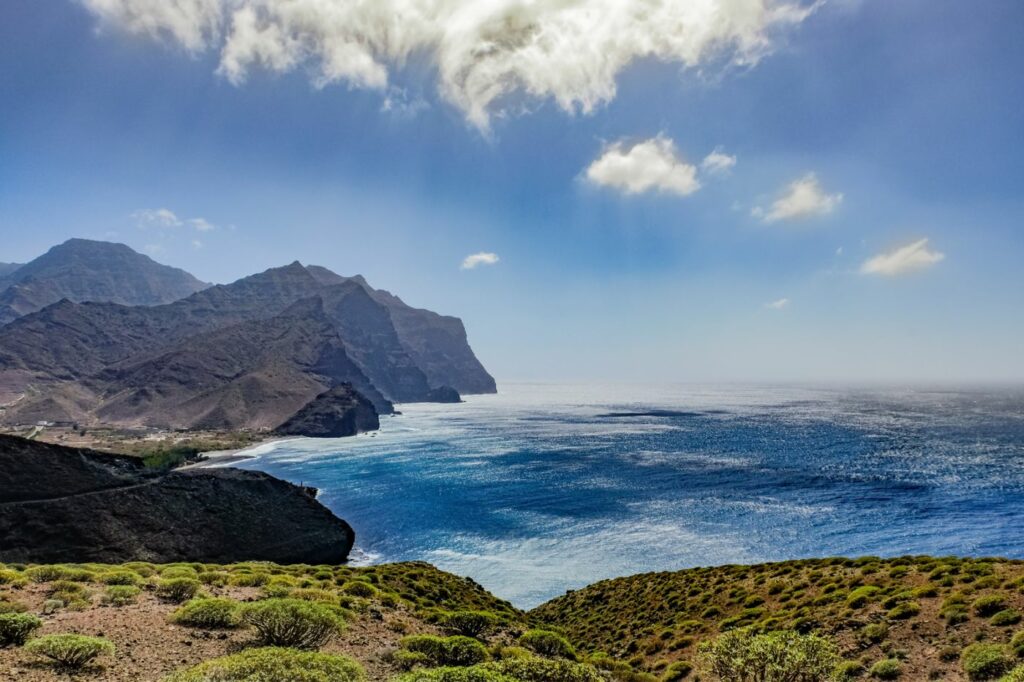
    Gravel cycling on Gran Canaria, the third-largest island in the archipelago, is a never-ending list of opportunities for gravellers looking for picturesque riding mixed with some real tests of strength. The island boasts an impressive variety of landscapes, from the majestic Maspalomas Dunas on the coast to the mighty Pico de las Nieves, the highest peak on the island with panoramic views of the neighbouring islands and the vast Atlantic Ocean.

    The well-maintained gravel roads criss-crossing the island offer the perfect routes to get up close and personal with other natural wonders, such as the Caldera de Bandama, an impressive crater located near Las Palmas; the Barranco de Guayadeque, a deep ravine renowned for its rugged cliffs, lush vegetation and ancient caves; or Roque Nublo, an iconic volcanic rock formation offering views over the surrounding countryside.

    How demanding is gravel cycling on Gran Canaria?

    Despite the more demanding routes on Gran Canaria, such as Pico de las Nieves, reaching almost 2,000 m above sea level, the Valley of the Tears (think steep gradients and challenging terrain) and Roque Nublo (around 1,800 m above sea level), the island offers a plethora of routes suitable for all levels, including the Tirajana Valley, taking you through rolling countryside and pine forests, or the Ayagaures Valley, with its charming villages and yet more beautiful countryside.

    Gran Canaria
    Canary Islands landscape
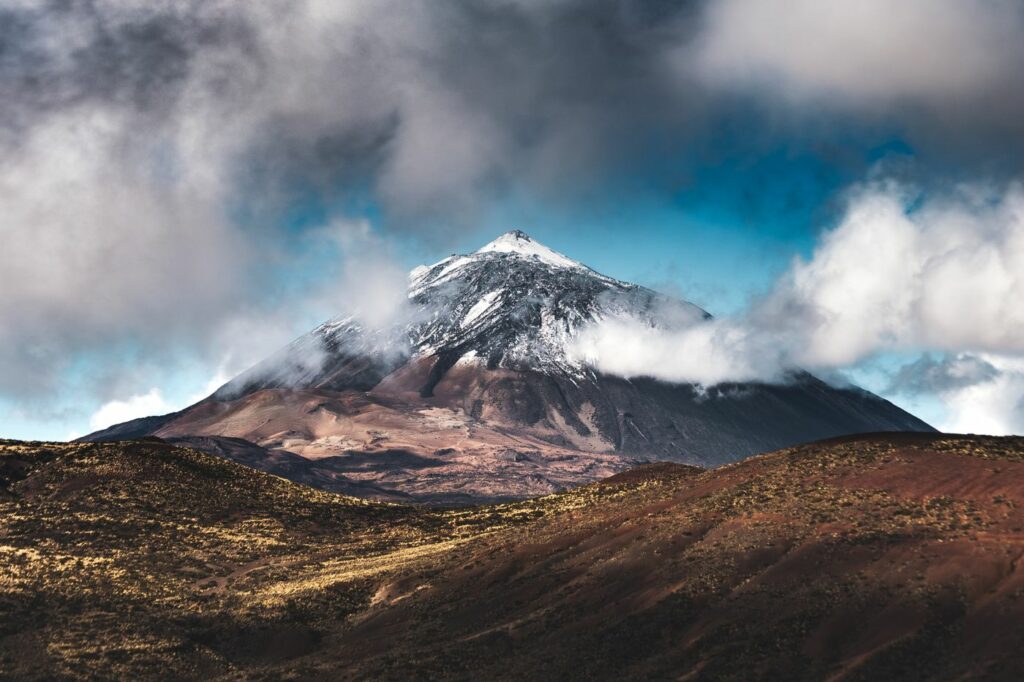
    Tenerife brown rocky mountain

    Gravel cycling on Tenerife

    Tenerife, the largest and most populated island in the Canary archipelago, is another gravel cycling paradise. The island’s volcanic terrain, dramatic landscapes and stunning coastline make it an ideal destination for gravellers looking for adventure, and who might even be tempted by some downtime on the beach. 

    Generally speaking, most routes will involve at least 1,000 m of elevation given the island’s undulating and mountainous terrain (it is a volcano, after all). The south is predominantly dry and rocky, whereas the north tends to be wilder and greener. The earth beneath your tyres will also range in colour and tones, from rich reds, oranges and browns, to intense grey and even black in some places, given the volcanic rock.

    Mount Teide by gravel bike

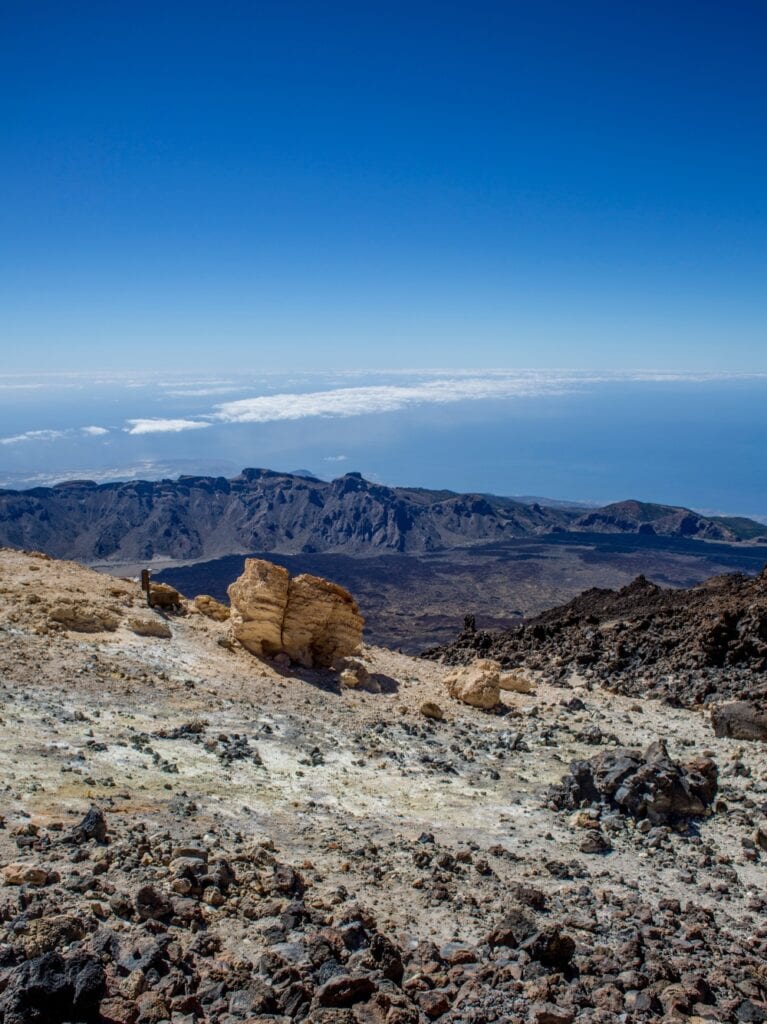
    We can’t talk about Tenerife without talking about Mount Teide, the highest peak in Spain. This iconic volcano, standing at an elevation of 3,718 metres, offers an epic climb for gravel riders seeking an unforgettable challenge. Ride between cacti and vineyards, through vast pine forests and up to the edge of the Teide National Park, a UNESCO World Heritage Site. 

    Mount Teide is not only a physical test of strength but also a mental and emotional challenge, which nonetheless showcases the raw beauty of the Canary Islands that rewards every cyclist to take on this unforgettable climb.

    Mount Teide
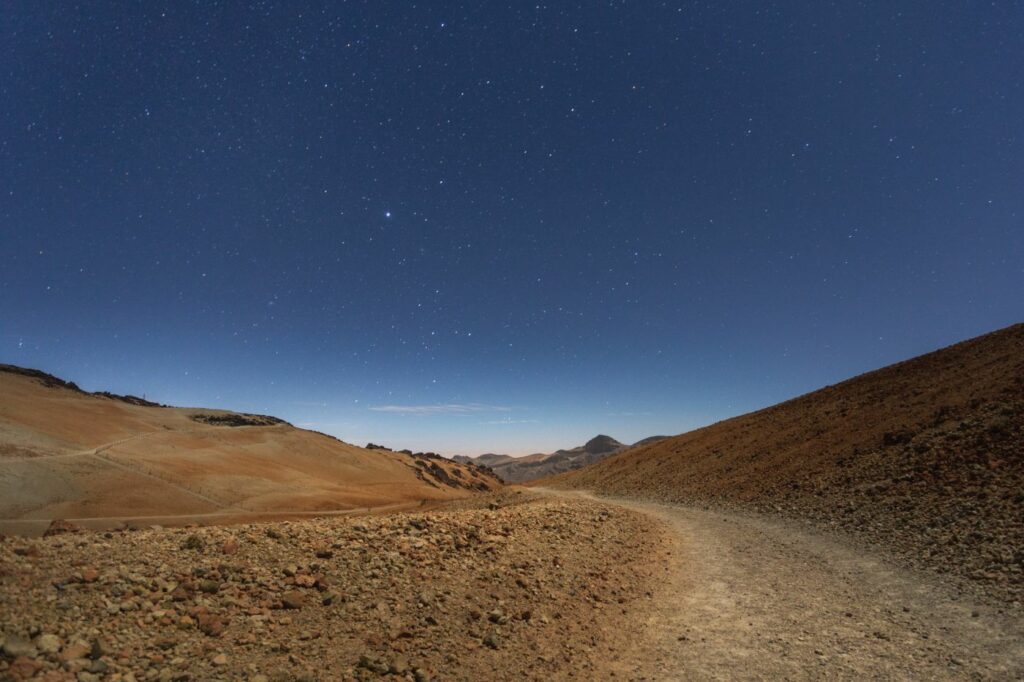
    Tenerife dirt road in the mountains
    Tenerife dirt road in the mountains

    GranGuanche: unsupported endurance cycling

    An ode to gravel cycling and bikepacking at its wildest and most challenging, the GranGuanche Audax endurance gravel cycling race is a 700 km, +16,000 m route across five of the Canary Islands, including Gran Canaria and Tenerife. Pushing the limits of their mental and physical strength, cyclists ride through lush rainforests, across dusty deserts and over black lave fields by day, and camp where they can by night, to make the ferry leaving for the next island before the time limit.

    Audax, which means “brave” in Latin, is what you have to be to take on this almighty yet magical challenge. “It doesn’t matter which bike you have, it doesn’t matter if you’re a man or a woman […] you can do it, if you want to do it, because a lot of it is just a mental thing”. Canary Island landscapes inspire awe; the reward that keeps riders coming back year after year and the reason cyclists are venturing to these stunning islands to discover their endless gravel tracks for the first time. 

    The best time of year to visit the Canary Islands

    The best time of year for gravel cycling on the Canary Islands depends on your preferences regarding weather and crowds. Spring and autumn are popular seasons for cycling adventures as the temperatures are pleasant (between 17 ºC and 25 ºC) and there are fewer tourists compared to the peak summer months. 

    However, the mild winter months can also be great for riding, especially for those seeking a break from cooler climates. Look out for the occasional shower and check the forecast before each ride in case there is a storm brewing on the horizon. Whenever you travel, keep in mind that the wind can pick up, so check the forecast before each ride and pack a windbreaker, gloves and sunglasses to protect your eyes on particularly dusty routes.

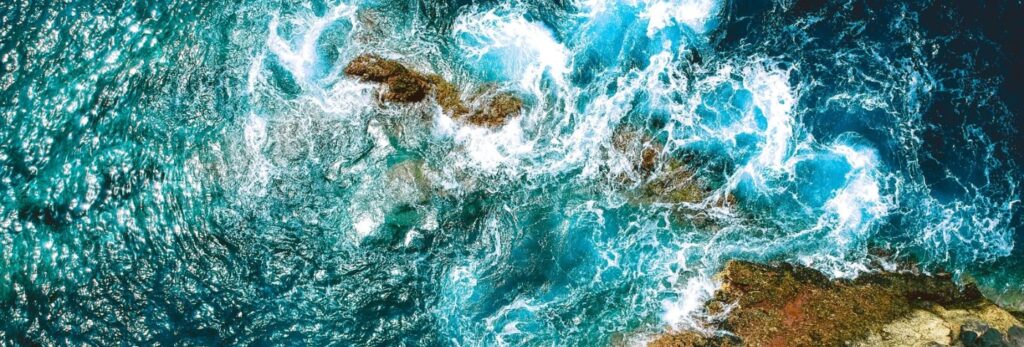
    Coast of Tenerife, aerial view

    The main take-aways: Gravel Cycling on the Canary Islands

    The Canary Islands have it all, climbs, coastline and climate… Gran Canaria and Tenerife’s unique terrain and warm temperatures make these islands a veritable playground for gravellers, MTB-ers and roadies alike. So, load the track and charge your phone, and we’ll see you in the Canaries!

    Take a look at our Canary Island Gravel tour for more inspiration. And if you’re inspired to ride, contact our travel experts for more information.

  • A Guide to Summer Cycling Tours in the High Mountains of Europe

    A playground like no other. Explore the endless roads of Europe’s most impressive mountain ranges and discover giants such as the Col du Tourmalet, Col du Galibier and Vršič Pass. 

    Summer Cycling Tours in the High Mountains of Europ

    Preparing for a cycling tour in the European mountains is an exciting prospect: the jaw-dropping scenery, colossal climbs, breath-taking descents, the après-ride endorphins, and not to mention the chance to ride in the tyre-tracks of the best cyclists in the world… That’s some prime day-dreaming material. 

    This guide will provide an insight into some of the most renowned mountain ranges in Europe, including the Pyrenees, the Alps, the Julian Alps, and the Dolomites, and the Eat Sleep Cycle tours that could turn those daydreams into a quad-burning reality. You’ll also find essential information on weather conditions, packing tips, and the best bike for conquering these majestic mountains.

    Pyrenees Cycling Tours

    First of all, the Pyrenees Mountains. A natural border between Spain and France, home to Andorra and summiting at an impressive 3,404 metres, the Pyrenees promise some exhilarating riding. Cycling in the Pyrenees offers challenging ascents, rewarding descents and awe-inspiring vistas.

    Some of the best professional cyclists in the world train on its legendary climbs. These include the Col du Tourmalet, whose summit brushes the clouds at 2,115 m (one of the highest paved roads in the Pryenees), or Col d’Aubisque, a near 17-km climb that reaches at 1,709 m above sea level. These roads are buzzing with the sound of tyres on smooth tarmac and an orchestra of freehubs as riders descend at speed, and there’s no shortage of friendly competition.

    Alps Cycling Tours

    Next up, the Alps, Europe’s most renowned mountain range that each summer beckons cyclists from all over the world. Some of the iconic mountain passes, such as Col du Galibier and Col de l’Iseran, are often featured in the Tour de France. These alpine giants are two of the most well-pedalled climbs in this mountain range, standing at dizzying altitudes of 2,645 m, and 2,764 m above sea level respectively.

    Stunning views reward anyone who ventures up these Cols to get a taste of the deep-seated cycling culture that permeates these mountains in summer. The roads are literally painted with history, and summer transforms this landscape into a cyclist’s paradise. Drivers are respectful and the hotels are filled with other riders as the exciting prospect of the Tour de France looms just around the corner…

    Julian Alps Cycling Tours

    The Julian Alps border both Italy and Austria and are nestled in the heart of Slovenia. This often-overlooked mountain range is a hidden gem for cyclists of all disciplines and offers a true paradise for climbers, with picturesque peaks and valleys, pristine lakes such as Lake Bled and charming alpine villages.

    The Vršič Pass, Slovenia’s highest mountain pass, sits within the Triglav National Park and stands at an impressive 1,611 m. It’s around 10 km in length with an average gradient of 6.9% (cranking up to 14% on some sections), and boasts incredible views of teetering limestone rock formations, unexpected cobbled sections, tunnels cut through the mountainside and classic hairpin bends. 

    Dolomites Cycling Tours

    A UNESCO World Heritage Site, the Dolomites are a cyclist’s paradise. Located in north-eastern Italy, this impressive mountain range is renowned for its jagged peaks, dramatic cliffs and winding roads, and is just as popular in winter among skiers as it is in summer among cyclists.

    This alpine wonderland is home to world-famous climbs such as the Passo Pordoi and Passo Giau. The former stretches for 12.4 km (on the northern side), and culminates in a summit 2,239 m above sea level. The Passo Giau reaches similar heights, with an average gradient of around 9%. Both often feature in the gruelling Giro d’Italia. 

    When to cycle in the European mountains

    When preparing for a cycling tour in the high mountains of Europe, it is essential to look carefully at forecasted weather conditions. Although summer in these regions is generally mild, with cool mornings and warm afternoons, the weather can be unpredictable and is known to change from one climb to the next. In the days leading up to your visit, and on the morning of each ride, make sure to check the local weather forecast and dress accordingly. 

    Packing for a summer cycling tour in the high mountains of Europe

    The key concept to bear in mind here is… layers. Even in summer, weather conditions can be unpredictable, so it’s important to be able to layer up when temperatures drop, and shed layers when things heat up.

    Here’s a quick list of the basics you’ll need on your cycling tour in the high European mountains:

    • Short-sleeved jerseys and short culottes
    • Waterproof wind breaker
    • Gilet
    • Neck, leg and arm warmers
    • Gloves (for cooler temperatures and for protection) 
    • Socks (enough for a fresh pair each day)

    Some other essentials:

    • High-factor suncream and good-quality sunglasses
    • Two or three water bottles
    • Basic tools, a mini pump and spare inner tubes
    • Your favourite snacks and energy gels

    The best bike for mountainous terrain

    The right bike can make all the difference when riding in the mountains, and that means the right bike for you. In general, you’ll want a lightweight road or gravel bike with a wide range of gears to tackle steep ascents and varying gradients, and stay in control on the long descents.

    Make sure your bike is in excellent condition with recently-serviced brakes, a clean, well-oiled chain and good tyres suitable for varied road surfaces. You might even want to get a professional bike fitting done before the tour to ensure your saddle and pedals are positioned correctly to make riding will be as comfortable as possible.  

    Feeling inspired?

    Cycling in the high mountains of Europe is something you will remember for the rest of your life. In summer, these majestic passes and peaks come alive with the spirit and tradition of cycling culture given their prominence in world tours, such as the Giro d’Italia or the Tour de France. You’ll also need to be used to climbing to tackle the ascents and enjoy the experience, so make sure you get some training in before your visit.

    Take a look at our Eat Sleep Cycle tours for more inspiration:

    Trans-Pyrenees Challenge

    Classic Climbs of the Pyrenees

    Classic Climbs of the Alps

    Trans Dolomites Challenge

    Tour of Slovenia

    And if you’re inspired to ride, contact our travel experts for more information.

  • Eat Sleep Cycle Wins Travel Award

    Eat Sleep Cycle named as Europe’s Most Innovative Cycling Tour Providor by LUXlife magazine

    The travel and tourism industry is one of the biggest in the world. It employs millions of individuals and generates trillions for the world’s economy. We all enjoy travel throughout our lives and, leaving no stone unturned, our winners create magical moments for us to enjoy either solo or with loved ones.

    Recognising and Showcasing the best in Travel & Tourism

    Now in its seventh year, the LUXlife Travel & Tourism Awards aim to recognise and showcase those within the industry that go above and beyond for their clients. The winners reflect the plethora of businesses providing excellence within the sector, from hotels and spas to tour operators and excursion managers, and many more.

    Commenting on the winners of this year’s awards programme, Coordinator Jessie Wilson stated:

    It is with pride that we present our winners within this year’s Travel & Tourism Awards. It’s great to see them flourishing in such a prevalent industry that helps us to create precious memories. I want to congratulate each and every one of them.

    Jessie Wilson

    Pause for Reflection and Celebration

    The Eat Sleep Cycle team are equally proud to achieve recognition for their hard work in growing their cycling tour business since 2016. Read our ‘How a Cycling Business Can Adapt in the Face of a Crisis’ blog to hear the story how we adapted through Covid. We went on to expand and realise a long held dream of creating a true Cycling Hub.

    Now we’re back to business as normal and it’s wonderful to see returning guests coming back to enjoy cycling trips with us again. Winning this award gives us space to step back and reflect on what we’ve achieved. A huge thank you goes to our amazing team and wonderful guests who’ve made this all possible.

    Louise Laker, Eat Sleep Cycle Founder

    Want to learn more about our cycling tours?

    Browse our range of tours on our tour finder, check out what guests have to say about their expereinces and… get in touch! We love to hear from anyone out there thinking about their next cycling adventure.

  • Traka 2023 – Basso x Eat Sleep Cycle After Party!

    The party after the ride before. What better way to celebrate an epic weekend of riding with a terrace party in the rain! Some of the world’s best gravel riders (& winners of the Traka!) joined us mere mortals to enjoy an afternoon of epic tunes, beers & prosecco. This was Girona at it’s finest. See you next year?

  • Guide to Cycling in the Algarve

    For some, there’s nothing more inviting than cycling alongside the deep blue Atlantic Ocean. And whilst Highway 101 is some way away, Europe, and more specifically Portugal has its own cliff-side, ocean-view routes that stretch for around 200 km, from the Spanish border to Cabo de São Vicente… let’s talk about the Algarve. 

    The Algarve is Portugal’s southern-most region and is arguably best-known for its warm climate, stunning beaches and dramatic cliffs that plunge into the Atlantic. But once you engage your cycling-radar, it’s easy to see how the Algarve offers some equally fantastic riding opportunities for all levels of ability and disciplines. 

    Geography of the Algarve

    The region’s diverse terrain, with everything from the rolling hills nearby the coast, to the higher ground and mountains in the north, present a veritable adventure playground for anyone exploring on two wheels. The roads are smooth and well-maintained, and whilst the coastal roads can get busy in the peak seasons, once you leave the N125 and A22 highways behind and head north, the Algarve countryside offers haven of calm and miles of backroads to ride to your heart’s content. 

    When to Cycle in the Algarve

    Summer in the Algarve is peak season and the roads are busy with tourists and locals heading to and from the glorious beaches. Therefore, in order to enjoy cycling in the Algarve to the fullest, it is best to visit outside these summer months, in spring, autumn or even winter, as the region offers a pretty much year-round pleasant climate, with highs of 15 to 20 ºC in winter. In spring and autumn, the temperatures can reach between 25 and 30 ºC, but always pack a windbreaker as given its exposed location beside the Atlantic Ocean, the Algarve can get breezy during these shoulder seasons, and even in summer. 

    Climbing in the Algarve

    Whilst you won’t reach the dizzying altitudes of the Alps, the cycling in the Algarve can still get pretty challenging. The region’s highest point with an altitude of 900 m is the Serra de Monchique Foia, located in the west around 25 km from Portimão. Setting off from the village of Monchique, the ascent is 7.7 km long and climbs 456 m, with an average gradient of 5.9%. Enjoy ocean views from the top. The hills surrounding Monchique are also a haven for mountain bikers, as is the Vicentina Natural Park, with plenty of dusty trails and challenging ramps to sink your tyres into. 

    Another popular climb is Alcaria do Cume, not far from the city of Tavira. It’s a 10.6 km climb with an average gradient of 3%. This ride is more about the views than it is about gaining elevation. And finally, there’s Malhão, a short but very sweet climb with an average gradient of 12%, as well as sections that reach a stinging 20%! This one is commonly featured in the Volta ao Algarve (Tour of the Algarve), and once you’ve ridden it, it’s easy to see why!

    Where to Stay

    There are plenty of opportunities to ride both long and short routes in the Algarve, adding in climbs as you go and gradually gaining in elevation as you traverse the endless rolling hills. Some popular ‘hubs’ among cyclists in the Algarve are Salgados (central Algarve), Tavira (in the east) and Lagos (in the west), offering great starting points for many road and mountain routes around the region that combine flatter coastal rides with more hilly inland options. These are also great stop-over options if you’re thinking of planning a cycling road trip, giving you the chance to enjoy the length and breadth of the Algarve and the wealth of the opportunities for cycling along its 200 km of stunning coastline.

  • Guide to Cycling in Slovenia

    If it’s not already on there, Slovenia should be at the top of every cyclist’s list of must-ride locations. Also known as the ‘green heart of Europe’, around 50% of its land is covered by lush forests and vegetation, a theme which also extends to its many cities, including the capital, Ljubljana, which was officially named as “Europe’s Greenest Capital” in 2016.

    This relatively small country borders Austria, Croatia, Hungary and Italy and offers cyclists of all disciplines a wealth of terrains, routes landscapes and townscapes to discover and explore on two wheels. The rolling hills of the vineyard hills and eastern plains near the Croatian border are an excellent playground for road cyclists, with miles of quiet backroads that snake between vineyards, rivers and traditional Slovenian hamlets. Whilst the Julian Alps in the north-west of the country offer some demanding climbs for keen riders looking for a challenge.

    Slovenia: A new Generation of Cycling Pro’s

    Slovenia is well represented in the professional cycling ranks, too, with Slovenian riders such as Primož Roglič, Tadej Pogačar and Matej Mohorič cycling for some of the best teams in the world and competing in the Tour de France.

    Slovenian Vineyards and quiet country roads

    The Alpine foothills and the Vipava Valley are incredibly beautiful areas for road cycling in Slovenia, the latter just a 45-minute drive from Ljubljana. Not far from the Italian border, more undulating routes abound as the terrain gradually starts to steepen and morph into the dramatic mountain landscape of the Julian Alps. In keeping with Slovenia’s green character, the land is blanketed in vineyards, wildflower meadows and yes, even more trees, creating a wonderful aura of calm and respect for flora and fauna alike. It is not uncommon to see cyclists riding these stunning routes, and drivers are happy to share the road.

    The Julian Alps: A Climber’s Paradise

    Slightly further north of the Vipava Valley, sit the impressive Julian Alps, bordering both Italy and Austria, the highest peak of which is Mount Triglav, brushing the clouds at an altitude of 2,864 m. This region of the country is a climber’s paradise, with ascents such as the Vršič Pass and Mangart’s Saddle, the latter presenting a 10-km climb to the top, gaining almost 1,000 m along the way (at an average of around 8.8%). The Vršič Pass is Slovenia’s giant, its highest mountain road pass, stands at an impressive 1,611 m. It is around 10 km in length and has an average gradient of 6.9%, offering riders incredible views of teetering limestone rock formations (reminiscent of the Dolomites), unexpected cobbled sections, tunnels cut through the mountain, deep, dramatic valleys and classic hairpin bends.

    The landscape in the Julian Alps is not unlike its other Alpine neighbours, with dramatic, rocky cliff-faces, expansive meadows covered in lush green vegetation and wildflowers, and of course, stunning lakes such as Lake Bled, nestled within the Triglav National Park. This Lake is probably one of the most photographed scenes in Slovenia, and once you’ve witnessed its beauty, there’s no surprise as to why! In the middle of the Lake there is a tiny island, home to the Pilgrimage Church of the Assumption of Maria surrounded by trees that reflect off the pristine waters below.

    Slovenia’s Cycling Season: The Best Time of Year to Ride

    As a tourist, Slovenia is a fantastic country to visit at any time of year. But as a cyclist, unless you enjoy the cold, it is probably a good idea to look for dates in spring, summer and autumn. These are the ideal seasons for cycling in Slovenia. The flowering meadows are in coming into full bloom in spring, and the climate offers mild to warm temperatures, meaning a dip in the lakes and rivers is already pleasant after a long ride!

    Slovenia heats up in summer, so early morning and evening rides are recommended, thus avoiding the spike in temperatures in the middle of the day. These midday lulls can be spent swimming in the lake, exploring the charming nearby towns and villages or wandering through the shaded woodland of the Triglav National Park.

    Autumn, like spring, offers milder temperatures than in summer and the forests take on a glorious golden hue. The days are still relatively long, meaning evening rides are still a possibility. Pack gilets, windbreakers and a neck-warmer for those early-morning rides and the potential cloudy day in the mountains.

    Inspired to ride in Slovenia?

    The main take-aways: green, calm and varied. Cycling in Slovenia is something of a paradise in terms of road quality, diverse landscapes and breath-taking natural wonders. From the sweeping valleys and undulating roads of the Eastern plains, to the soaring peaks of the Julian Alps, Slovenia offers unbound adventures for riders of every discipline. The government actively encourages cycling as a mode of transport and leisure activity, and is increasingly investing money, time and effort into introducing more cycle lanes and paths in both its towns and endless countryside. There is no better time to book your flights to Slovenia and discover this untapped gem.

    Take a look at our Slovenia Cycling Tours to see our recommended itiernaries on road & gravel. If you’re inspired to ride contact our travel experts for more information.

  • Cyclist’s Guide To Girona

    Girona is now well established as a capital of cycling. It has been decades since the first pros moved here to use the Catalan city as a training base and nowadays around 100 professional riders call Girona home for at least some part of the year. With this influx of pros Girona has raised its profile as a place for those seeking a European cycling holiday. The myriad stunning rides and routes based out of a vibrant and beautiful medieval city has inevitably drawn ever-increasing numbers of cycling tourists to the area. Girona is such a fantastic place for cycling that you could, in theory, arrive with a bike and simply muddle along, discovering a fair amount of what the city and surrounding area has to offer. However being somewhat more organised is preferable and as such we have compiled this comprehensive, but by no means inexhaustible, guide to Girona cycling.

    Where To Eat in Girona

    Food occupies the average cyclist’s consciousness to a greater degree than most ‘normal’ people. Whether you arrive starving at dinner time or need to know the best lunch spot, here’s our top picks of where to eat and drink in Girona:

    Girona Cycling Cafés

    • Eat Sleep Cycle Café – Right next door to our shop is our very own cafe! Join us all day, every day for cyclist-friendly brunch, specialty coffee & local beers Carrer d’Albereda, 15, Girona
    • Idle Hands – for amazing brunch, burgers, great coffee and good vibes! Plaça Bell-Lloc, 4, 17004 Girona
    • Federal – In the heart of Old Town, Federal is serving traditional breakfast and brunch, smoothies, and even a breakfast burger! Vegan friendly. Carrer de la Força 9, 17004 Girona
    • La Fabrica – A Girona classic, La Fabrica has an established reputation for serving delicious speciality coffee, and a range of breakfast and brunch classics from avocado toast, oats, and bagels! Vegan friendly. Carrer de la Llebre, 3, 17004, Girona
    • La Comuna Café – New to town, La Comuna has quickly established a reputation for pre-ride coffee stop, serving a health array of food. Vegan friendly. Carrer de la Barca, 34, Girona, Cataluna 17004
    • Coffee & Greens – A popular breakfast option if you’re looking for something light, super açaí bowls and sandwich options. Rambla de la Llibertat, 25, 17004, Girona
    • Hors Categorie – Good coffee, healthy food and craft beers, catch them on Tuesdays for Taco Tuesday! Carrer del Perill, 3, 17001 Girona
    • Bionèctar – Delicious, organic plant-based food and juices. Carrer D’en Francesc Eiximenis, 8, 17001, Girona

    Out of Town:

    • Rustik Empordà – Grab a snack on the way out of the door and then ride to Bellcaire D’Empordà to fuel up on a tasty breakfast at Rustik. Carrer de dMolí, 4, 17141, Bellcaire
    • Doskiwis – a fantastic brewery with foodtruck! Check their website for opening hours before you ride! Carretera de Parlavà, GI-642, 22, 17131 Rupià, Girona

    Tapas

    • El Cafe – a local bar serving tapas, coffee and drinks. Carrer dels Ciutadans, 1 17004, Girona
    • Txalaka – Delicious pintxos (a Basque speciality similar to tapas). Carrer Bonastruc de Porta, 4, 17001, Girona
    • Can Canalla – Km0 food prepared with love & a great wine selection. Plaça Bell.lloch 4, 17004 Girona

    Lunch & Dinner

    • Arros 9 Girona by Terram – fabulous paella. Carrer Ginesta, 8, 17002 Girona
    • Octopus – for fresh seafood cooked to order, Carrer Migdia, 24, 17002 Girona
    • Normal – the accessible offer by the Roca brothers. Exceptional quality food inspired by local produce. Plaça de l’Oli, 1, 17004 Girona
    • Bartali Pizza – pizza by Italians, it doesn’t get much better, Carrer Nou del Teatre, 3, 17004 Girona
    • La Picolla – Venture out of the old town for Girona’s best pizza, Carrer Migdia, 89, 17003 Girona
    • B12 – An all vegan bar and restaurant serving tapas and burgers as well as having a huge selection of beers! Plaça del Vi, 11, 17004 Girona
    • Plaça del Vi, 7 – Local food & wines beautifully prepared, Placa del Vi, 7, Girona

    Fine Dining

    The Girona area is home to a number of Michel Star restaurants, why not treat yourself to something extra special?

    • El Celler de Can Roca – The 3 Michelin Star restaurant owned by the  famous Roca brothers has twice been named the best restaurant in the world. Carrer de Can Sunyer, 48, 17007 Girona
    • Les Cols – this 2 Michelin Star restaurant is situated in the town of Olot in the La Garrotxa region, a converted masia (farmhouse) by chef Fina Puigdevall. Carretera de la Canya, 106, 17800 Olot, Girona
    • Massana – Awarded one Michelin Star, Massana’s focus is on local, seasonal products such as game, wild mushrooms and truffle. Carrer Bonastruc de Porta, 10, 17006 Girona
    • Divinum – Divinum hasn’t (yet) been awarded a Michelin Star but is certainly worthy, created by chefs who studied under Joan Roca, the food is an original blend of flavours, textures and aromas  Divinum Carrer de l’Albereda, 7, 17004 Girona

    Coffee/snacks

    • Oniria Cafe – Serving speciality coffee, cake, and vegan cookies, Oniria is nestled in Ladama, a green grocery and plant haven! Carrer Nord, 13, 17001 Girona
    • Espresso Mafia – Another Girona coffee classic! Carrer de la Cort Reial, 5, 17004, Girona
    • Martina Sweet Cakes – This place is exactly as it says on the tin – delicious sweet cakes! Carrer de la Força, 1, 17004, Girona
    • Gelats Rocambolesc – From the owners of the Michellin Star rates Can Roca comes Rocambolesc ice cream, inspired by Charlie and the Chocolate Factory, here you can choose from delicious flavours and add toppings such as candy floss. Carrer de Santa Clara, 50, 17001, Girona
    • Crêpdequè? – A ‘hole in the wall’ serving crêpes with topping of your choice, perfect for a snack or desert as you stroll through the Barri Vell. Carrer de les Ballesteries, 49, 17004, Girona

    Out of Town:

    • Dulce Pikika – If you ride or drive out towards the coast a stop at Dulce Pikika for one of their artisan cakes is a must! Av. Del Cavall Bernat, 143, Local 3, 17250, Castell-Platja d’Aro, Girona

    Where To Sleep in Girona

    A good night’s rest is essential preparation to taking full advantage of a day’s cycling in Girona, somewhere to safely store your bike is a bonus, the city has it all:

    Girona Cycling Friendly Hotels & Guesthouses:

      • Hotel Carlemany – This four star cyclist friendly hotel has a dedicated bike room and in general is accommodating to cyclists.
      • Casa Cacao – A luxury boutique hotel opposite Eat Sleep Cycle.
      • Equipe Girona – With a pool, and bike facilities, this is a perfect spot for cyclists.

    Girona Cycling Friendly Apartments

      • Velo Vern – Apartments to rent which are built with cyclists in mind.
      • Bravissimo Apartments – Apartments located right above Espresso Mafia in the heart of the old town.
      • Villas in Girona – If you’re looking for an escape a villa in Girona or the Costa Brava region could be just what you need.

    Out of town:

      • Rocacorba Cycling – A little further out than the city, nestled just 2km away from the famous (or infamous) Rocacorba climb, Rocacorba is the perfect cyclist get away.
      • La Bruguera de Pubol – A stunning guest house in the beautiful village of Pubol with an on-site yoga studio. Powered on renewable energy, with a salt water pool, and permaculture garden, you’ll find the perfect peace here after a long day in the saddle.

    Eat-Sleep-Cycle-Hub-Cafe-Cyclist-Guide-Where-To-Stay

    Where to Cycle in Girona

    Now to the important bit, the cycling!

    We’ve waxed lyrical on many occasions about the amazing cycling that Girona has to offer both on and off road. When you come to here you will find an enormous selection of roads and iconic climbs at your disposal such as the Girona classic, Rocacorba.

    Eat-Sleep-Cycle-Hub-Cafe-Cyclist-Guide-Els-Angels

    The best way to find your way around on two wheels is to hire a guide. A local guide will know the Girona area inside out and can impart local knowledge you would otherwise not be privy to! The advantage of having someone showing you the way means you can focus on enjoying your surroundings without worrying about taking a wrong turn!

    Of course, if you prefer to you can also guide yourself by following a route installed on a device which you can pick up from Eat Sleep Cycle. Or you could simply create your own, hire a bike and just explore!

    Whichever way you choose to see Girona by bike you will no doubt fall in love with the smooth roads, abundant climbs and fantastic views that it has to offer!

    To See & Do In Girona

    Whether you’re having a rest day or travelling with a partner who doesn’t cycle there are plenty of things in and around Girona to occupy your time outside of pedalling.

    Barcelona
    Barcelona is a relatively short train journey away and as is to be expected from a major city there are plenty of activities to do there. Why not hire a Brompton in Barcelona as a novel way to get around the city?

    Wine tasting in the Empordà Region
    Located just north of Girona is the autonomous region of Empordà the area is known for its wine production and there are a number of vineyards which you can visit either by bike or another form of transport, and taste the produce.

    Figueres Dalí Museum
    If impressionist art is your thing then a visit to the place that Salvador Dalí called home is a must. The town of Figueres has a Dalí museum dedicated to the artist which is open Tuesday-Sunday.

    Aqva Gerunda
    Relax and wind down after a long day of cycling in Girona or simply treat yourself regardless at the town’s Roman baths and spa.

    Banyoles Lake
    The lakeside town of Banyoles is a short ride, drive or bus journey from Girona and is not one to miss, (our Lazy Lunes ride heads there every Monday at 10am). A coffee by the lake is a must as well as exploring the old town. If rowing, swimming or running are your thing it’s also a perfect location for all three.

    Running
    There are plenty of on and off road running routes around Girona, which can provide a great way to see the city and surrounding area!

    Getting to Girona

    Of course, the first part to enjoying Girona is getting here! There are numerous ways to travel to the city, depending on where you are coming from.

    Girona Airport
    By far the simplest way to get here is to fly into Girona. Flights into the tiny Girona Costa Brava airport, however, are usually from Europe only, plus during the winter months they are few and far between. If, however you do manage to get a flight to the local airport you are a mere 12.8km away from the city. There are no trains from Girona airport but buses are regular during the day and cost just €2.75 for a single. If you prefer to have a transfer arranged for you, you can do so via Eat Sleep Cycle for €35.

    Barcelona Airport
    If you can’t get directly to Girona then don’t fear as Barcelona-El Prat will serve. Albeit slightly further away, it is still relatively easy to transfer from El-Prat to Girona. A Sagales coach will cost you €19, a taxi transfer (which Eat Sleep Cycle can arrange) will cost €180 or if you choose to take the train it will cost €16 plus the metro fare from El Prat to Barcelona’s main station: Sants. If you decide to take the train be aware that this transfer may not be enjoyable with a bike bag and cases!

    Madrid Airport
    While Madrid is rather more of a jaunt away there are potentially more flight options for international travellers. Why not integrate a trip to the Spanish capital while you’re there? There are direct trains from Madrid to Girona as well as a bus network.

    Train from London, Paris and other places in Europe
    For those from Europe for whom time is not of the essence the option to take a train may be of interest. Most large city stations will service trains to the area, although beware that you may have to make changes along the way if you’re coming with a bike bag and luggage in tow.

    Drive from other parts of Europe
    Driving is also a good option for European-based visitors, northern Spain can be reached relatively easily and surprisingly quickly from most of Europe – just watch out for the tolls!

    Eat-Sleep-Cycle-Hub-Cafe-Cyclist-Guide-To-Girona-Cycling

    Girona – A City for Cyclists

    Whatever time of year and in whatever capacity you visit Girona its charms are sure to compel you to return. The sheer number of cyclists who settle in the city are testament to how special it really is for two-wheeled exploring! This cyclists guide to Girona is intended to be an up-to-date guide to our home city and we will be updating it regularly with any new recommendations and activities – so be sure to check back!

    Girona Cycling Tours

    If this has got you inspired to travel to Girona then why not view our Girona cycling tours and check out what camps and packages we have available. If you’re planning to travel here and don’t want to worry about bringing a bike then take a look at our rental bikes in Girona for top-quality, fully-serviced road, gravel and mountain bikes. If you’ve any questions about your possible cycling tour to Girona give us a call now on +34 972 649 131 or contact us online for more info!

    P.S. Enjoyed this blog? Why not sign up to receive notifications every time we post and get regular updates on our latest tours!

  • 2023 New Arrivals: Basso Bikes

    In our 2023 New Arrivals blog series we’ll take a look at the new product launched by our brand partners. We cut through the marketing smoke & mirrors and tell you what we really think. We can do this because we are independent (we work with many brands) and we test ride all of the products we talk about in our rental and demo fleets.

    There is so much we love about Basso bikes. For a start they are one of the few Italian brands that is still owned by the founder (Alcide) & run by his family (wife Lucia & son’s Alessandro & Leonardo). Secondly, they are one of the only Italian brands still manufacturing bikes in Italy. When we visit the Basso bikes office in Treviso, Italy, we also visit the factory.

    But there is an even bigger reason why we love Basso. They come out with so much new product and bike innovation, it makes Specialized look like a bystander. We’re serious, for a small Italian brand to bring out four new models in 2023 while other brands simply slap on a new colour, that’s impressive, let’s take a look at them.

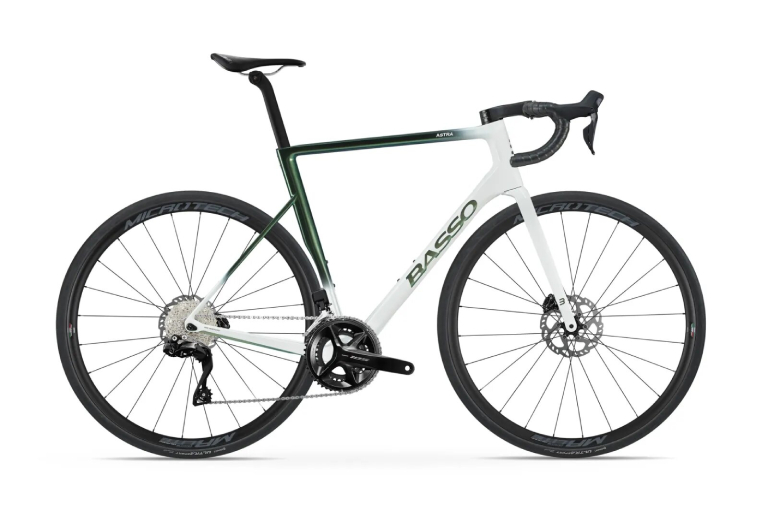
    The all new 2023 Basso Astra All-Road Bike

    Talk about moving with the times. When we first heard of the Astra becoming an all-road bike we nearly fell off our chair. It’s exactly what we need for our Girona and Málaga bike rental fleets. With clearance for a 35 mm tyre, this is enough to still enjoy the fast road sections but also dive off onto a track and explore the countryside. Tyre choice is obviously important here, we will go with the widest possible low tread tyre to ensure minimal rolling resistance on the road but maximum comfort off road.

    The second feature of the 2023 All-Road Astra we love is the integration of all the cables. It now looks like a €10k bike for half the price. It’s got smooth lines and as always sexy colours to choose from. If you want one bike for all your riding this should be a serious contender in 2023.

    Basso Astra Disc Road Bike
    Can a racing bicycle be versatile and performing at the same time?

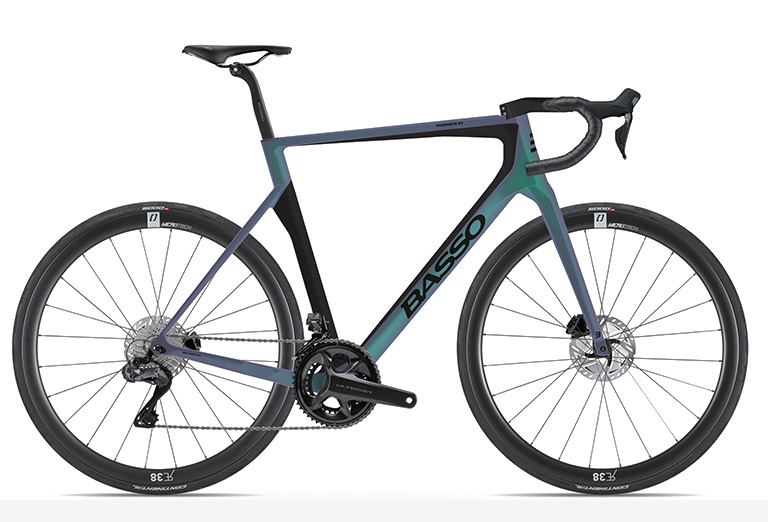
    The new 2023 Basso Diamante Climbing Bike

    The elephant in the room with the Basso Diamante always was its weight. It always had the looks and handled amazingly, but it was the slightly heavier weight with comparatively priced models which put people off the bike.

    In its eighth evolution Basso engineers have shaved off 200 grams from the frame which may not sound like a lot but we know it’s possible to build a 6.8 kg bike with the frame. That’s light!

    If you like a high performance but stable geometry the Basso Diamante is your bike. It gives so much confidence on the descents we literally select it for our high end rental fleet so less people fall off and damage the bike!

    Basso-Diamante-SV-Ultegra-Aurora
    Diamante is devoted to the slopes, to the differences in height, to the most rugged climbs.

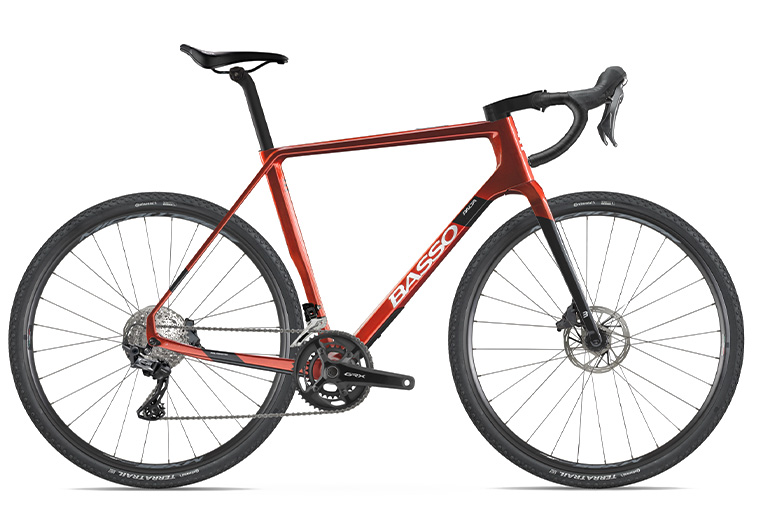
    The Basso Palta Gravel Bike

    Ok, so officially this bike came out in 2022 but we can’t help but include it. The Palta is so popular it became a brand in its own right. Now it is one of the gravel bikes of choice in and around Girona again achieving high performance and comfortable geometry.

    The Basso Palta is born from aggressive, race geometry but the latest model has evolved to a much more versatile machine – now just a ready for bikepacking adventure as it is for race-day.

    Basso-Palta-II-Shimano-GRX-2x11-Candy-Red
    The proof that exploration is better with adrenaline and speed.

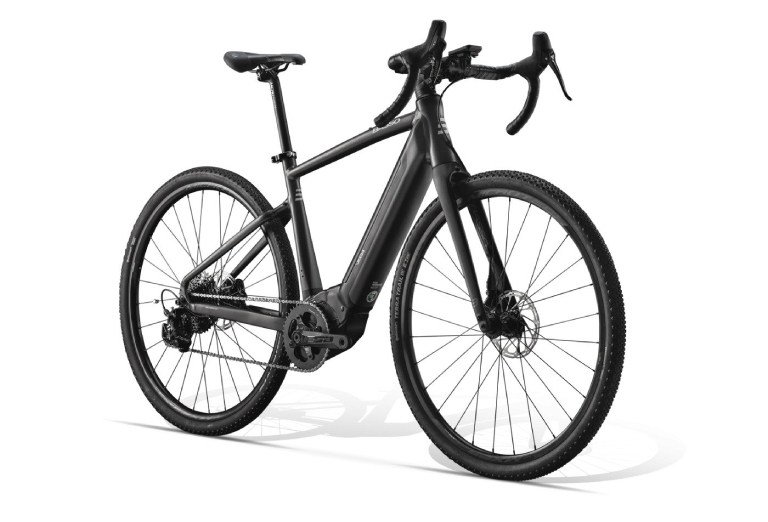
    The Vega Gravel Electric Bike

    The Volta is Basso´s high end carbon electric gravel bike but it comes at a price. So the Vega gravel is an introduction to the same technology at an affordable price point. With a massive 500 Wh battery this bike goes as far and hard as you need it to. And 17.8 kg isn´t all that bad considering it is an alloy frame and the size of the battery and motor.

    Vega Gravel e-bike
    A bicycle that makes gravel accessible to every cyclist.

    Want to find out more about Basso

    The best way to get to know the brand is to ride the bikes. You can’t test ride these stunning bikes at our cycling hubs in Girona or Málaga. Head over to our Bike Hire page to book your ride!

  • Why You Should Consider Cycling in Málaga

    The Eat Sleep Cycle Cycling Hub, Málaga

    Málaga is also the home of our Malaga Cycling Hub. This city is a gateway to popular Eat Sleep Cycle tour locations like Andalucia and Portugal. It is also our home for culture, food, good vibes and amazing riding.

    For us, Málaga is the place to be, it’s a buzzing city that’s full of life and we’re proud to be part of Málaga road cycling’s journey as an up-and-coming cycling destination.

    Come and see us, join one of our Social Rides and let’s talk cycling!

    Cycling in Málaga: Coast and Mountains

    One of our favorite rides out of Málaga is the Puerto Leon, a 16.1 Km 5.6 % AVG gradient road climb that starts right from the city. In no time you are away from the hustle and bustle and into the mountains, crossing paths only with farmers. But it is when you swing back towards the coast and you’re hit with that lovely sea breeze, that you realise just how special that mix of mountains and coast really is.

    Our Málaga Classic Climbs itinerary offers 6 unique rides that combine the highlight climbs in the area with the coast. There is no better feeling than riding back from the hills to the beach for that well deserved ice coffee, ice cream or chilled beer (or all three).

    Málaga: An Amazing City with a relaxed Spanish vibe

    Málaga is Spain’s 6th largest populated city, so there is plenty going on when you are off the bike, but it still has that relaxed feeling where people are not in a rush.

    Cycling in Málaga City: Traffic

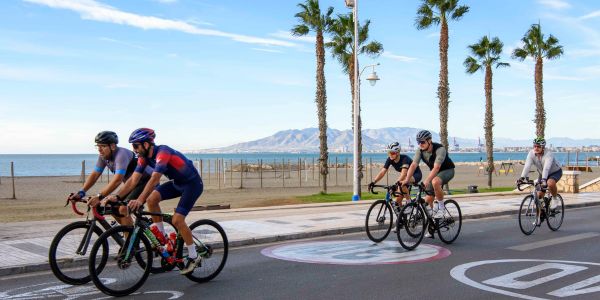
    We had a huge question mark around traffic entering & leaving the city. The relaxed atmosphere means that even the busier roads feel safe. There are dedicated lanes on the road that give priority to cyclists & local drivers are more than happy to sit back, relax & let us cyclist’s do our thing. There are also plently of bike lanes separating bikes from traffic completely. The coastal road is more transited but a joy to ride and again, drivers show cyclists plenty of respect out on the road.

    Anyone with a couple of years of experience cycling on roads should feel more than comfortable riding in & out of the city every day.

    Food, Coffee & Cyclist Hot Spots in Málaga

    The specialty coffee scene has a way to go in Málaga, but there are some great coffee places starting to pop up. We enjoyed a delicious pre-ride coffee at Santa Coffee in the soho district, the breakfast looked fantastic too – plus we saw the chef cycling home from work one day so a huge tick from us!

    Mid-ride cyclists in Andalucia enjoy a tostada con jamon. It’s served at pretty much any bar you can find, fills the hunger gap & is completely delicious.

    Post-ride it’s hard to beat stopping at a chiringuito on the beach for a cold beer or a coke before retiring for a siesta & a freshen up before heading out into town.

    The evenings in Málaga are fantastic. If you’re a cyclist who loves the buzz of a vibrant city then Màlaga should be high on your list of places to ride. Head to the port for an aperitivo & listen to the buskers. Then stroll back into the old town to sample one of Màlaga’s many restuarants. After dinner, head to a traditional bar for a vino dulce to finsih off the night. The brave (or those on a rest day) could happyily bar-hop until the early hours.

    Outstanding transport links

    Málaga Airport received around 20 million passengers in 2019. It is a modern fully equiped, busy yet relaxed airport. What we love most is eliminating a long transfer in a vehicle after your flight. You can almost land and get right out on your bike, maximising your cycling time. With the high speed train just 2 hrs and 24 minutes from Madrid, Málaga also boasts excellent rail connections to the rest of Spain and Europe.

    What a city

    Málaga city, as well as being situated right on the beach, boasts an upmarket town center, modern port and many cultural attractions . For years the mayor has been pumping money into restoring various areas of the city and does it show. Trust us, you will be impressed by just how clean and well restored Málaga is.

    Did we mention the climate

    With minimum winter night temperatures of 10 degrees and daytime temperatures in the late teens and early twenties, Málaga is one of the best winter cycling destinations in Europe.
    The combination of coast and mountains means rides can be made to make the most of the temperature conditions, which are predictable and stable. Who doesn’t want to ride with arms and legs out in January?!

    You can find out more about our Málaga Classic Climbs tour right here or contact us for a custom tour proposal in South Spain.